What Does an EIN Look Like?
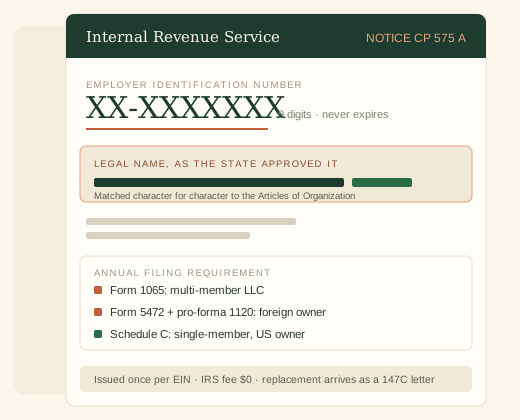
An EIN is 9 digits in the format XX-XXXXXXX, for example 12-3456789. The first 2 digits are the campus prefix. An SSN, by contrast, is 9 digits grouped XXX-XX-XXXX.
The 2-digit prefix once mapped to the IRS office that issued the number, though since 2001 online assignment has made the prefix a routing artifact rather than a location. The remaining 7 digits are sequential. All 9 digits stay fixed for the life of the entity. A number written with the SSN grouping XXX-XX-XXXX is a sign the identifier is a personal SSN or ITIN, not an EIN.
Reading the number left to right, the 2-digit prefix comes first, then a hyphen, then 7 more digits, for 9 in total. Prefixes run from 01 to 99, and about 20 of them, including 20, 26, 27, 45, 46, and 47, are reserved for EINs assigned through the online tool. The prefix once identified 1 of 10 IRS campuses in cities such as Andover, Atlanta, Austin, Cincinnati, Fresno, Kansas City, Memphis, Ogden, Philadelphia, and Brookhaven. Since 2001 it has signalled the assignment method rather than a mailing address, so a Florida business can carry a prefix that once belonged to a Utah campus. The exact prefix ranges and what each 2-digit block means are laid out on the EIN number format page.
A single choice of grouping separates an EIN from a Social Security Number even though both carry 9 digits. An EIN groups them 2 then 7 as XX-XXXXXXX, an SSN groups them 3-2-4 as XXX-XX-XXXX, and an ITIN uses that same 3-2-4 SSN grouping but always opens with a 9. Banks and payment processors read the hyphen pattern to tell a business number from a personal one, so entering an EIN in an SSN field, or the reverse, is 1 of the most frequent causes of a rejected tax interview. The side-by-side contrast is covered in full on EIN vs SSN and ITIN vs EIN.
Who Needs an EIN?
Every partnership, every corporation, every multi-member LLC, and any business with employees needs an EIN. A sole proprietor or single-member LLC with no employees can use an SSN, but needs an EIN for a bank account.
| Business type | EIN required? | Why |
|---|---|---|
| Multi-member LLC | Yes | Files a partnership return, Form 1065 |
| Single-member LLC, no employees | Optional for tax, yes for banking | Bank needs it to open the account |
| Sole proprietor, no employees | Optional | SSN is allowed on Schedule C |
| Any business with employees | Yes | Payroll tax reporting requires it |
| Partnership | Yes | Files Form 1065 under one number |
| C corporation or S corporation | Yes | Files Form 1120 or 1120-S |
| Nonprofit or 501(c)(3) | Yes | Required before applying for exemption |
| Estate or trust | Yes | Files Form 1041 under its own EIN |
Source: IRS, Do You Need an EIN, and 26 U.S.C. section 6109, verified August 2026.
The LLC cases are the ones most people ask about. A single-member LLC is a disregarded entity that can file under the owner's SSN, yet every US bank still asks for an EIN before opening a business account. A multi-member LLC needs one from day 1 because it files Form 1065. Full detail sits on does my LLC need an EIN.
Beyond LLCs, several entity types are required to hold their own EIN regardless of size. A nonprofit must obtain an EIN before it files Form 1023 for 501(c)(3) exemption, even with 0 paid staff. An estate of a deceased person needs a separate EIN to file Form 1041 once probate opens, and a trust other than a grantor trust needs its own number for the same return. A sole proprietor with even 1 employee, 1 Keogh or solo 401(k) plan, or 1 federal excise obligation crosses the threshold and must apply. Those 3 tests, employees, a retirement plan, and an excise filing, each force an EIN on their own, so meeting any 1 of the 3 makes the number mandatory rather than optional.
No SSN. No passport upload.
What Is an EIN Used For?
An EIN is used for 6 core tasks: filing business taxes, opening a bank account, running payroll, applying for licenses, issuing 1099s, and passing tax checks at payment processors.
A business uses its EIN to open an account at banks such as Mercury, Chase, or Wise, and to pass the tax interview at Stripe, PayPal, and Amazon. A failed match at a processor triggers backup withholding at 24% on payouts, which makes the exact 9-digit number a cash-flow matter, not just paperwork. The number also lets an LLC keep business and personal finances separate, one of the benefits of an EIN for an LLC. Opening an account is covered step by step on EIN for an LLC bank account.
The 6 uses fall into a clear order. First, the EIN heads every business tax return, from the Form 1065 a partnership files to the 1120 a corporation files. Second, it opens a business bank account, which every US bank requires before issuing a debit card or a line of credit. Third, it registers the business as an employer so federal and state payroll taxes can be deposited. Fourth, it appears on state and city license applications. Fifth, it goes on each 1099-NEC issued to a contractor paid 600 dollars or more in a year. Sixth, it clears the tax interview at Stripe, PayPal, and Amazon.
A single mismatched digit carries real cost. When the legal name and EIN a business submits do not match IRS records, a processor is required to apply backup withholding of 24 percent to every payout until the mismatch is corrected, and a payer that files 250 or more incorrect information returns faces penalties reaching 310 dollars per form. Keeping the exact 9 digits on file, and knowing each place the number is required, is walked through on using your EIN and IRS EIN number.
How Do You Get an EIN?
There are 4 ways: online in 15 minutes with an SSN, by fax in 4 to 7 business days, by mail in 6 to 11 weeks, or by phone for international applicants. All 4 cost $0 at the IRS.
| Method | Time to EIN | SSN needed? | IRS fee |
|---|---|---|---|
| IRS online assistant | About 15 minutes | Yes | $0 |
| Fax Form SS-4 | 4 to 7 business days | No | $0 |
| Mail Form SS-4 | 6 to 11 weeks | No | $0 |
| Phone, international only | On the call | No | $0 |
Source: IRS Form SS-4 instructions, verified August 2026.
The online route is fastest but validates the applicant against SSN and ITIN records, so it stops anyone who holds neither at the validation screen. Those applicants use the fax route, entering the word Foreign on Form SS-4 line 7b and faxing to 855-641-6935 within the US or 855-215-1627 from abroad. The IRS international line, 267-941-1099, releases the number on the call. Applicants with no SSN start at LLC EIN without SSN and EIN for a foreign-owned LLC. The online option itself is detailed on apply for an EIN online for an LLC.
Choosing among the 4 methods comes down to 1 question: does the applicant hold an SSN or ITIN? An applicant who does uses the online assistant at IRS.gov, which is open 7 a.m. to 10 p.m. Eastern, Monday through Friday, and issues the number the moment the 5-part interview is submitted. An applicant who holds neither cannot clear the online identity check and files Form SS-4 on paper instead, writing Foreign on line 7b. Fax reaches an agent in 4 to 7 business days at 855-641-6935 within the US; mail runs 6 to 11 weeks; a caller abroad reaches the international unit at 267-941-1099, and domestic questions go to 800-829-4933. The plain online walkthrough sits on apply for an EIN online, and the general path on how to get an EIN.
How Much Does an EIN Cost?
The IRS charges $0 for an EIN through every method. A paid service only makes sense for applicants with no SSN, who cannot use the free online tool. einforllc.co files for $97, or $127 within 24 hours.
| Item | Cost | Frequency |
|---|---|---|
| IRS fee for the EIN | $0 | One-time |
| einforllc.co filing — Standard | $97 | Faxed within 7 business days |
| einforllc.co filing — Fast | $127 | Filed within 24 hours |
| Year 2 and every year after | $0 | An EIN never renews |
IRS fee verified August 2026. Full breakdown on the LLC EIN cost page, and the free route on free EIN number for an LLC.
The 0 dollar fee is worth stating plainly, because a search for an EIN surfaces dozens of sites charging 75 to 300 dollars for the number itself. The IRS never charges for an EIN under any of the 4 methods, and it never has. What a legitimate service sells is the paperwork and the wait: preparing Form SS-4 correctly, signing it, faxing it to the right number, and following up if the IRS rejects it. For an applicant who holds an SSN that work takes 15 minutes and is free, so paying for it adds no value. The full price comparison, line by line, sits on the LLC EIN cost page.
The paid case is narrow: a founder with no SSN and no ITIN, often outside the US, who cannot use the online tool at all. einforllc.co prepares and faxes that person's Form SS-4 for 97 dollars on a 7 business day track, or 127 dollars on a 24 hour track that is refunded if the deadline is missed. The EIN issued is the identical number the IRS would assign for free; the fee buys correct filing and speed, not a different result. Because an EIN never renews, year 2 and every year after cost 0 dollars, so the lifetime IRS cost of the number stays at 0.
What Is the Difference Between an EIN, SSN, ITIN and TIN?
TIN is the umbrella term for 5 taxpayer IDs. The SSN and ITIN identify individuals, the EIN identifies a business, and all 3 are 9 digits. A federal tax ID for a business means its EIN.
| Identifier | Identifies | Format | Issued by |
|---|---|---|---|
| EIN | A business or entity | XX-XXXXXXX | IRS |
| SSN | A US citizen or resident | XXX-XX-XXXX | Social Security Administration |
| ITIN | A non-resident individual | 9XX-XX-XXXX | IRS |
| TIN | Umbrella for all 5 types | 9 digits | IRS or SSA |
| FEIN | Same as EIN, F for federal | XX-XXXXXXX | IRS |
The most common question is whether an EIN and a tax ID are the same, and for a business they are. The identifier pages cover each pairing in full: TIN vs EIN, EIN vs federal tax ID, is an EIN the same as a TIN, and taxpayer ID vs EIN.
In everyday use the labels blur, and the blur is harmless once the map is clear. A business owner hears federal tax ID, tax ID number, and EIN used for the same 9 digits at a bank, and all 3 point to the EIN. The distinction only bites when an individual identifier is involved: a sole proprietor without an EIN uses an SSN on Schedule C, and a non-resident with no SSN uses an ITIN in its place. Both the SSN and the ITIN are 9 digits, like the EIN, which is why the 3 are so easy to confuse. The pairwise breakdowns live on EIN vs FEIN and what a FEIN is, each answering 1 side-by-side question in detail.
How Do You Find or Verify an EIN?
Find your own EIN on the CP-575 letter, a filed tax return, or a bank record. There is no free public database of every EIN. A lost number is recovered free by calling the IRS at 800-829-4933 for a 147C letter.
Public companies list their EIN in SEC filings, and a nonprofit EIN appears in the IRS Tax Exempt Organization Search. For a private business there is no national lookup, so the number is retrieved from the company's own records. The 5 places it appears, and the full 147C process, sit on LLC EIN number lookup, find an EIN for a business, and lost LLC EIN. The confirmation and replacement letters are covered on EIN verification letter.
Finding your own EIN and verifying someone else's follow different routes. To find your own, check the CP-575 the IRS mailed when the number was assigned, any filed return, a bank welcome packet, or a prior 1099; the 5 places it hides are walked through on how to find your EIN. To confirm a number a vendor handed you, match the legal name and EIN against a W-9 or, for a nonprofit, the IRS Tax Exempt Organization Search; those steps sit on how to verify an EIN. If your own CP-575 is lost, the IRS reissues proof as a 147C letter, free, when you call 800-829-4933 and wait up to 14 days for the fax or mail, a process detailed on the 147C letter page.
Does a Business Keep the Same EIN?
Yes. An EIN stays with the business for its lifetime. A new EIN is needed only when the entity itself changes, such as a sole proprietorship incorporating or an LLC converting to a corporation.
A name change, an address change, or a new responsible party all keep the same 9-digit number and are reported to the IRS in writing, not by a new application. The exact triggers that force a fresh EIN are listed on new EIN for an LLC, and a name change is handled on LLC name change and EIN. Reclassifying how an LLC is taxed, using Form 8832, also keeps the same EIN, as explained on Form 8832 for an LLC.
The line between an amendment and a brand-new entity decides whether the EIN survives. Updating the business name, moving to a new address, or naming a new responsible party is reported to the IRS on Form 8822-B within 60 days and keeps the identical 9 digits. Electing to be taxed as an S corporation on Form 2553, or as a corporation on Form 8832, changes only the tax treatment, not the number. A fresh EIN is required in 4 situations: incorporating a sole proprietorship, adding partners to a 1-owner business, a corporation spinning off a subsidiary, and a statutory merger where a new entity survives. The address-change filing is walked through on Form 8822-B, and the S corporation election on Form 2553.
This page states federal tax rules current as of August 2026. It is not legal or tax advice. Confirm your business's position with a licensed CPA or attorney before filing.