Table of contents
- Does a PLLC need an EIN?
- Why do PLLC EIN applications get rejected?
- Which Form SS-4 lines does a PLLC complete?
- How does the IRS classify a PLLC?
- Which states require a PLLC instead of an LLC?
- Does a licensing board approve the PLLC before the EIN?
- How does a PLLC owner without an SSN get the EIN?
- What does a bank verify for a PLLC account?
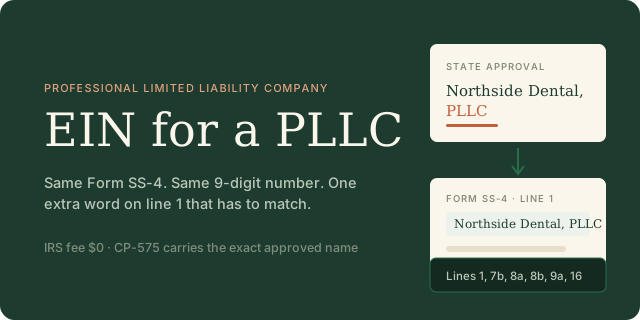
The EIN for a PLLC is the same 9-digit number, from the same Form SS-4, as any other LLC. The IRS holds no PLLC category: line 8a answers Yes to the LLC question, and the word PLLC lives only inside the legal name on line 1. That one word is what gets these applications rejected. The IRS charges $0.
A PLLC is a state creature. Dentists, architects, physicians, accountants, veterinarians, and attorneys form one because a licensing statute tells them to, and the entity arrives with a designator attached to its name. The IRS has no matching category, which is why the federal side of this is short and the failure mode is narrow. This page teaches one mechanism completely: how the approved professional name travels from the state certificate to line 1 of Form SS-4 to the CP-575, and what breaks when it does not. If your practice has 1 owner, read ein for single member llc alongside this.
A Professional LLC needs an EIN on the same terms as any other LLC, and it applies on the same form. There is no PLLC checkbox and no separate PLLC process: Form SS-4 line 9a offers Limited Liability Company, and a PLLC checks it. The 1 line that differs is line 1, which has to carry the approved professional name including the PLLC designator exactly as the licensing board and the state approved it, because the IRS prints line 1 onto the CP-575 unchanged. The IRS charges $0, the number arrives in about 15 minutes online, and a PLLC needs it to open a bank account, run payroll, and file its federal return.
Does a PLLC need an EIN?
A PLLC needs an EIN whenever it has 2 or more members, hires 1 employee, or opens a business bank account. The EIN for a PLLC comes from the same Form SS-4 every LLC files.
The IRS recognises no PLLC. Line 8a of Form SS-4 asks whether the application is for a limited liability company, and a professional limited liability company answers Yes. The IRS records the entity as an LLC. The professional designator survives in one place only: the legal name on line 1.
A single-member PLLC with 0 employees sits outside the IRS requirement. It still needs the number in practice. A bank asks for the CP-575 before it opens an account in the practice name, insurance payers ask for the EIN on enrollment forms, and a merchant processor asks for it before it settles a single patient payment.
Licensed practices reach the EIN earlier than other LLCs because third parties force the date. Payer credentialling, a malpractice policy in the entity's name, and the first associate's payroll each depend on the 9-digit number, and all three land in the weeks right after the state approves the Articles of Organization.
The number never renews. An EIN issued to a PLLC in 2026 stays valid for the life of the practice, and the year-2 cost is $0.
Whether the IRS requires the number at all, for a practice with 1 owner and 0 employees, is answered in detail on does a single member llc need an ein.
Why do PLLC EIN applications get rejected?
Name mismatch causes most PLLC rejections. Line 1 of Form SS-4 carries the professional designator the state approved: PLLC, P.L.L.C., or Professional Limited Liability Company, character for character, including the comma before it.
The state registry holds one exact string. "Northside Dental, PLLC" and "Northside Dental PLLC" are two different strings, and the comma is part of the approved name in the first. The IRS pairs the EIN with whatever line 1 says, then prints that string on the CP-575 letter for the life of the entity.
A practice that writes "Northside Dental LLC" on line 1 receives a CP-575 naming an entity the state never approved. The bank compares the CP-575 against the Articles of Organization, finds 2 different names, and declines the account. Correcting it means a signed written request to the IRS and a wait measured in weeks, not minutes.
Abbreviation drift is the second failure. Some states approve "P.L.L.C." with 4 periods and others approve "PLLC" with 0. The state's own certificate settles it. Copy the name from the stamped Articles, not from the practice website, the letterhead, or the domain name.
Line 2 exists for the name patients see. A PLLC legally named "Northside Dental, PLLC" that trades as "Northside Family Dentistry" puts the legal name on line 1 and the trade name on line 2. Line 3 stays blank, because it collects an executor or trustee and an LLC has neither.
Which Form SS-4 lines does a PLLC complete?
A PLLC completes line 1 with the approved legal name, line 4 with the mailing address, lines 7a and 7b with the responsible party, line 8a Yes, line 8b member count, line 9a classification, and line 16 activity.
Line 8b is the field that sets the next decade of filings. It records the number of LLC members, and the count decides the annual return. Enter 1 and the practice reports on Schedule C. Enter 2 and the practice owes a partnership return every year it exists.
Line 9a asks what kind of entity is applying. A multi-member PLLC checks Partnership. A single-member PLLC checks Other and writes "Disregarded entity" on the line beside it. A PLLC that already filed Form 2553 checks Corporation and enters 1120-S as the form number.
Lines 10 through 14 handle timing. Line 10 records the reason, which reads "Started new business" for a new practice. Line 11 takes the date the practice started. Line 12 takes the closing month of the accounting year, which is December for a calendar-year practice. Line 13 takes the highest number of employees expected in the next 12 months.
Line 14 is worth 4 seconds of attention for a small practice. Checking it lets the PLLC file Form 944 once a year instead of Form 941 four times a year, and the IRS opens that box to employers expecting $1,000 or less of annual employment tax. A solo practice with 1 part-time receptionist lands there.
Lines 16 and 17 describe the work. Line 16 offers checkboxes including Health care & social assistance, and line 17 takes a plain description such as "general dentistry" or "licensed architectural services". These 2 lines feed the IRS activity code and change nothing about liability or classification.
How does the IRS classify a PLLC?
The IRS classifies a PLLC by member count. 1 member produces a disregarded entity. 2 or more members produce a partnership. Form 8832 and Form 2553 change the classification, and the PLLC keeps the same EIN.
A single-member PLLC files Schedule C inside the owner's Form 1040 and pays no separate federal income tax. The classification carries the professional's practice income onto a personal return, at personal rates, with self-employment tax on the profit.
A 2-member PLLC files a partnership return by March 15 and issues 1 Schedule K-1 per member. Two dentists who split a practice 60 and 40 receive K-1s for 60 and 40 percent of the allocated income, and each reports that share on a personal Form 1040 due April 15. Each member owes tax on the allocated share whether or not the practice distributed the cash.
Form 2553 is the election professional practices reach for most. It moves the PLLC to Form 1120-S, and it is due within 2 months and 15 days of the start of the tax year the election takes effect. The EIN does not change, because the number belongs to the entity and not to the tax treatment.
Form 8832 moves the PLLC to Form 1120 as a C corporation. Personal service corporations face their own federal rules, which is why a practice runs this election past a CPA before filing rather than after. The EIN survives that election too.
The partnership return itself, its March 15 deadline, and the Schedule K-1 it produces are covered on form 1065 for llc. The 8a, 8b, and 9a interaction that decides which return applies is covered on llc tax classification.
Which states require a PLLC instead of an LLC?
States decide the entity, not the IRS. New York requires a PLLC for licensed professions. Texas, Florida, and Illinois offer one by statute. California prohibits LLCs for licensed professions under Corporations Code section 17701.04(b).
The state answer changes the EIN application in exactly 1 place: line 1. A California orthodontist forms a professional corporation, so line 1 reads "Northside Orthodontics, Inc." and line 9a checks Corporation with 1120 or 1120-S beside it. A New York orthodontist forms a PLLC, so line 1 carries PLLC and line 8a answers Yes.
Membership rules also come from the state. Most states restrict PLLC membership to individuals holding a licence in the practice's profession, which is why a PLLC does not admit an outside investor the way a standard LLC does. That restriction lives in state law and appears nowhere on Form SS-4.
The liability shield is narrower than owners expect. A PLLC shields each member from the other members' malpractice and from ordinary business debts. It does not shield a professional from a claim arising out of that professional's own work, which is why the malpractice policy stays in force alongside the entity.
The IRS treats a PLLC exactly as it treats an LLC. Form SS-4 offers no PLLC checkbox, line 8a is answered Yes for the LLC question, and the classification on line 9a follows the member count in the ordinary way. The professional designation is a state-law matter that changes nothing federally.
Does a licensing board approve the PLLC before the EIN?
Several states require licensing-board consent before the state files the Articles of Organization. New York requires Education Department consent under Limited Liability Company Law section 1203. The EIN application follows state approval and never precedes it.
The order is fixed by what each step produces. Board consent produces the right to use the professional name. The state filing produces the exact legal string. Form SS-4 line 1 copies that string. The CP-575 prints it. The bank verifies it. Skip a step and the string breaks somewhere downstream.
Applying for the EIN before the state approves the name is the most expensive shortcut in this process. The IRS issues the number against whatever name was submitted, and the practice then holds a CP-575 that contradicts its own Articles. Fixing that costs weeks that a credentialling deadline does not have.
Line 11 of Form SS-4 asks for the date the business started. A practice that entered a date before its board consent creates a record that disagrees with the state file. Use the date on the stamped Articles.
Sequencing matters more for a PLLC than for an ordinary LLC. The board consent comes first, the state files the Articles second, and the EIN application comes third. A practice that applies for the EIN before the state stamps the Articles has no confirmed legal name to put on line 1, which is the entry the IRS matches every later filing against.
How does a PLLC owner without an SSN get the EIN?
Line 7b takes the word Foreign when the responsible party holds no SSN or ITIN. The PLLC then files Form SS-4 by fax: 855-641-6935 for entities based in a US state, 855-215-1627 for international.
No passport is required for an EIN, and no upload of any identity document is part of the process. Line 7b is a text field, and "Foreign" is a valid entry in it. The IRS built the fax route for exactly this applicant.
The IRS international phone line is 267-941-1099 for applicants outside the United States. The online application at irs.gov is a different route: it requires an SSN or ITIN, it runs 15 minutes end to end, and it costs $0.
A licensed professional without an SSN meets a state question before the federal one. Most states require every PLLC member to hold a licence issued by that state, so a foreign-licensed practitioner confirms membership eligibility with the board before filing anything.
A foreign-owned single-member LLC carries an annual Form 5472 with a pro-forma Form 1120, and Internal Revenue Code section 6038A sets a $25,000 penalty for a missed filing. That obligation attaches to ownership, not to profession, and it applies to a PLLC the same way it applies to any other single-member LLC.
What does a bank verify for a PLLC account?
A bank verifies 3 documents in order: the state-stamped Articles of Organization, the IRS CP-575 letter, and the operating agreement naming the licensed members. All 3 names have to match character for character.
The CP-575 is the document banks treat as the EIN's proof of existence. The IRS issues it once, at assignment, and it prints the legal name exactly as line 1 recorded it. A practice that lost the letter requests a 147C replacement instead, which states the same EIN and the same name.
Professional practices meet a fourth document that other LLCs never see. Many banks ask for the state licence number of each member before they open an account for a PLLC, because the entity type asserts a licence and the bank confirms the assertion.
Merchant processing raises the bar again. A processor handling patient payments matches the EIN, the legal name, and the practice address across all 3 documents before it releases funds, and a mismatch on any one of the 3 holds the first settlement.
The designation itself is the detail that trips PLLC accounts. A bank matches the legal name character for character, so a practice registered as PLLC and written as LLC on Form SS-4 line 1 fails the check. Confirm which of PLLC, P.L.L.C. or Professional Limited Liability Company the state approved before the application goes out.
Which SS-4 entry does a PLLC make on each line?
Nine lines carry the whole application. Line 1 takes the approved name, line 7b takes the responsible party or the word Foreign, line 8a takes Yes, and line 8b takes the member count.
| SS-4 line | What it asks | What a PLLC enters | Why it matters |
|---|---|---|---|
| 1 | Legal name of entity | The approved name including PLLC or P.L.L.C. | Prints on the CP-575; banks match it |
| 2 | Trade name | The patient-facing name, when it differs | Leave blank when there is no DBA |
| 7b | Responsible party SSN / ITIN / EIN | The number, or the word Foreign | The no-SSN route runs through this field |
| 8a | Is this an LLC? | Yes | A PLLC is an LLC to the IRS |
| 8b | Number of LLC members | 1, 2, or more | Decides Schedule C vs Form 1065 |
| 9a | Type of entity | Partnership, or Other: Disregarded entity | Must agree with line 8b |
| 12 | Closing month of accounting year | December for calendar-year practices | Sets the annual return deadline |
| 14 | Expect $1,000 or less of employment tax | Check it for a 1-employee practice | Form 944 yearly instead of Form 941 quarterly |
| 16 | Principal activity | Health care & social assistance, or Other | Feeds the IRS activity code |
Source: IRS Form SS-4 and its instructions, verified July 2026.
How does state law change the PLLC application?
State law decides the entity name and the membership rules, and both land on line 1. California sends licensed professionals to a professional corporation, so line 8a reads No instead of Yes.
| State | Entity for licensed professionals | Authority | Effect on Form SS-4 |
|---|---|---|---|
| New York | PLLC required | LLC Law art. 12, consent under sec. 1203 | Education Dept consent before Articles |
| Texas | PLLC available | Business Organizations Code, Title 7 | Line 1 carries PLLC |
| Florida | PLLC available | Florida Statutes Chapter 621 | Line 1 carries PLLC or P.L.L.C. |
| Illinois | PLLC available | 805 ILCS 185 | Line 1 carries PLLC |
| California | LLC prohibited for licensed professions | Corporations Code sec. 17701.04(b) | Professional corporation; line 8a is No |
Source: the state statutes named in each row, verified July 2026. Confirm the current designator on the stamped Articles before copying it to line 1.
- Have an SSN? Go to irs.gov. The EIN is free, the online application takes 15 minutes, and you walk away with the number the same session. Paying anyone for that is paying for nothing.
- No SSN? The online application is closed to you. Line 7b takes the word Foreign and the application goes by fax to 855-641-6935 or 855-215-1627. Do it yourself, or we file it for $97, faxed within 7 business days, or $127 filed within 24 hours with the IRS call included.
- Practice not chartered yet? A professional entity clears its licensing board first, and that consent belongs to your board rather than to any filing service. Once the entity route is settled, formation with a first-year registered agent and an operating agreement is an optional +$197 add-on, plus the state fee at cost, with the agent renewing at $99/year. The state runs its own clock, tracked apart from the EIN.
Either way, the IRS fee is $0 and the number never renews. The EIN carries its own price, so a PLLC the state has already approved pays that one line and we tell you to leave the add-on unchecked. The full no-SSN sequence is on ein for llc without ssn.
What does an EIN for a PLLC cost?
The IRS charges $0 for the EIN itself, in year 1 and every year after. Filing services charge for the paperwork: our price is $97 one time, faxed within 7 business days, or $127 filed within 24 hours with the IRS call included. The Articles review and the classification check sit inside both prices.
| Route | Price | Requirement | Written deadline |
|---|---|---|---|
| IRS, direct at irs.gov | $0 | SSN or ITIN required | 15 minutes online |
| einforllc.co: Standard | $97 one time | No SSN required | Faxed in 7 business days, or that fee refunded |
| einforllc.co: Fast | $127 one time | No SSN required | Filed in 24 hours with the IRS call, or that fee refunded |
| Northwest | $200 | No-SSN rate | No written deadline |
| ZenBusiness | $99 | Add-on | No written deadline |
| Rocket Lawyer | $59.99 | Add-on | No written deadline |
Competitor prices verified July 2026. Standard reaches the EIN in 16–19 business days total; Fast reaches it in 6 to 8 business days total. State formation fees and licensing-board fees are paid to those bodies and appear in no row above. The EIN is priced on its own: a PLLC the state has already approved pays that single row and nothing more. Practices that have not filed yet can add formation with a first-year registered agent and an operating agreement for +$197, plus the state fee at cost, with the registered agent renewing at $99/year, stated here rather than in fine print.
What else do PLLC owners ask about the EIN?
The 10 questions below cover the 9-digit EIN for a PLLC: line 1 naming, line 9a classification, the no-SSN fax route, Form 1065, and Form 2553. Each answer names the form line or the deadline it depends on.
+Does a single-member PLLC need an EIN?
The IRS requires one once the PLLC hires 1 employee or elects corporate treatment. A solo practice with 0 employees is outside that rule, and still needs the number in practice: banks, insurance payers, and merchant processors all request the 9-digit EIN and the CP-575 before they open an account.
+Is an EIN for a PLLC different from an EIN for an LLC?
No. Both come from Form SS-4, both produce a 9-digit number, and both cost $0 at the IRS. Line 8a answers Yes for a PLLC exactly as it does for an LLC. The only difference sits on line 1, where the legal name carries the PLLC designator.
+What goes on line 1 of Form SS-4 for a PLLC?
The legal name exactly as the state approved it, including the professional designator and any comma before it. Northside Dental, PLLC and Northside Dental PLLC are 2 different strings. The IRS prints line 1 on the CP-575, and a bank compares that letter to the Articles of Organization filed with the state.
+Which box does a PLLC check on line 9a?
A PLLC with 2 or more members checks Partnership. A 1-member PLLC checks Other and writes Disregarded entity beside it. A PLLC that already filed Form 2553 checks Corporation and enters 1120-S. Line 9a agrees with the member count on line 8b in every 1 of the 4 cases.
+Can a PLLC get an EIN without an SSN?
Yes. Line 7b accepts the word Foreign when the responsible party holds no SSN or ITIN, and the PLLC files Form SS-4 by fax to 855-641-6935 from a US state or 855-215-1627 internationally. No passport and no identity upload form any part of the application.
+Does a PLLC need a new EIN when a member leaves?
The PLLC keeps its 9-digit EIN through membership changes. A 3-member practice that drops to 2 files the same partnership return under the same number. A new EIN applies when the entity itself changes, such as a PLLC that converts to a professional corporation under state law.
+Does a PLLC file Form 1065?
A PLLC with 2 or more members files Form 1065 by March 15 each year and issues 1 Schedule K-1 per member. The return reports the practice's income and pays no federal income tax itself. A 1-member PLLC files Schedule C inside Form 1040 instead.
+Does an S-corp election change a PLLC's EIN?
No. Form 2553 changes the return to Form 1120-S and leaves the 9-digit EIN untouched, because the number belongs to the entity rather than to the tax treatment. The election is due within 2 months and 15 days of the start of the tax year it takes effect.
+How long does an EIN take for a PLLC?
An applicant with an SSN or ITIN finishes at irs.gov in 15 minutes for $0. An applicant without one uses the fax route, which runs on IRS processing time. Standard is $97, filed by fax within 7 business days, or that fee is refunded, and 16–19 business days total to the EIN. Fast is $127, filed and the IRS call made within 24 hours, guaranteed, or that fee is refunded, and 6 to 8 business days total.
+Does a PLLC protect a professional from malpractice claims?
A PLLC shields each member from the other members' malpractice and from the entity's ordinary debts. It does not shield a professional from a claim arising out of that professional's own work. State statutes such as New York LLC Law section 1205 preserve that personal liability, so the malpractice policy stays in force.
Updated July 2026. This page states federal tax rules and the state statutes named above as they stand in July 2026. It is not legal or tax advice. Confirm your practice’s position with a licensed CPA or attorney, and confirm entity eligibility with your licensing board, before filing.
Who can file the EIN for a PLLC for you?
We file Form SS-4 for a PLLC for $97 one time, by fax within 7 business days, or that fee is refunded. That route reaches the 9-digit EIN and the official IRS CP-575 in 16–19 business days total. Fast is $127: filed and the IRS call made within 24 hours, guaranteed, or that fee is refunded, and 6 to 8 business days total.
We read your stamped Articles character by character, copy the approved professional name to line 1 exactly, and set lines 8a, 8b, and 9a to the structure your practice actually has. One wrong character on line 1 costs weeks. The EIN is priced on its own, so a practice the state has already approved pays that one line and we will tell you to skip the optional +$197 formation add-on rather than sell it to you.
No SSN. No passport upload. · IRS fee $0 · The EIN never renews, so year 2 is $0 · get your LLC’s EIN