Is There a Free EIN Lookup Database?
No single free database lists every EIN. Only 2 free public sources exist: SEC EDGAR for public companies, and the IRS Tax Exempt Organization Search for nonprofits. Private EINs are not published anywhere.
| Source | Covers | Cost | Where the EIN appears |
|---|---|---|---|
| SEC EDGAR | Public companies | $0 | Cover of Form 10-K and 10-Q |
| IRS Tax Exempt Org Search | 501(c)(3) nonprofits | $0 | Organization record and Form 990 |
| The business itself | Any business | $0 | On a Form W-9 you request |
| Your own records | Your business | $0 | CP-575, tax return, bank file |
| Paid data brokers | Some disclosed EINs | $10 to $100+ | Only if already public |
Source: SEC EDGAR, IRS Tax Exempt Organization Search, verified August 2026.
The confusion comes from how EINs feel like public data. An EIN prints on invoices, W-2 forms, and loan paperwork, so many searchers assume a central government lookup mirrors the way a Secretary of State lists a registered LLC name. It does not. The IRS master file that stores all EINs is closed to the public, and disclosing another taxpayer's return information carries penalties under 26 U.S.C. section 6103. That is why the 2 free sources both work by disclosure, not by registry: SEC EDGAR shows an EIN because a public company is required to file it, and the IRS nonprofit tool shows one because a 501(c)(3) trades transparency for its tax exemption. Neither reaches a private business.
Free-lookup pitches online lean on that gap. A site may promise a national EIN database, then hand back a number that came from a public filing you can read yourself at $0, or ask for payment and return nothing usable for a private LLC. The honest scope of what is genuinely free is mapped on free EIN lookup, and if the business you are checking is your own, the recovery paths on how to find your EIN cost nothing and return the exact 9-digit number the IRS holds.
How Do You Find Your Own EIN?
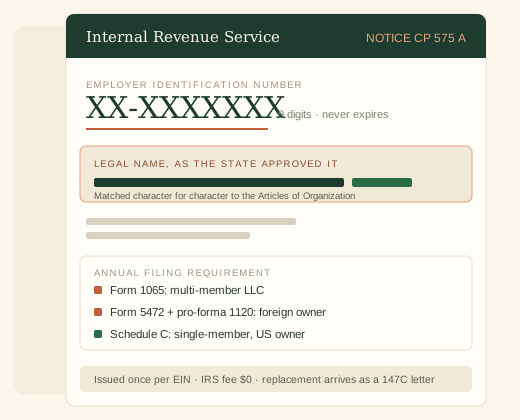
Check 5 places in order: the CP-575 letter, a filed tax return, a business bank application, a prior Form W-9, and your accountant's file. If none survive, call the IRS at 800-829-4933 for a free 147C letter.
The CP-575 is the fastest source, because the 9-digit number sits at the top of the letter the IRS mailed when the EIN was assigned. A filed Form 1065, 1120, or 1040 with Schedule C carries it in the identification block. If every copy is gone, the 147C letter is the IRS-issued replacement, released only to the responsible party on the account. The full recovery route sits on lost LLC EIN and LLC EIN number lookup.
Work the 5 sources in the order that ends fastest. The CP-575 is the single confirmation notice the IRS mailed the day the EIN was assigned, and the number sits in its top-right block; the IRS reprints no second CP-575, so a lost original is replaced by a 147C, never by a duplicate CP-575. A filed return is the next-best source, since a Form 1065 partnership return, an 1120 corporate return, or a Schedule C on a 1040 all carry the EIN in the identification block. A business bank application, a prior Form W-9, and your accountant's client file round out the 5, because each one required the number to be recorded at signup. The difference between the 2 letters is spelled out on the LLC CP-575 letter and the 147C letter.
When no document survives, one call closes the gap. The IRS Business and Specialty Tax Line at 800-829-4933 runs Monday to Friday, 7 a.m. to 7 p.m. local time, and an agent reads the EIN back to a responsible party after identity verification, then faxes or mails a 147C at no charge. Budget 30 to 60 minutes on hold in peak season. A single-member LLC owner who filed under a Social Security number and never used the EIN should still hold it, and the specific recovery steps for that case sit on the lost LLC EIN page.
No SSN. No passport upload.
How Do You Look Up Another Business's EIN?
For a public company, read the EIN off the cover of its Form 10-K in SEC EDGAR. For a nonprofit, use the IRS Tax Exempt Organization Search or its Form 990. For a private company, ask it directly.
A public company must print its EIN, labeled IRS Employer Identification No., on the first page of every 10-K and 10-Q, so EDGAR resolves it in under 2 minutes at $0. The disclosure traces to the Securities Exchange Act of 1934, and a 10-K is filed 60 to 90 days after the fiscal year ends. A 501(c)(3) discloses its EIN on the annual Form 990, mirrored free by GuideStar and ProPublica across more than 1.8 million organizations. A private company has no public EIN, so the reliable path is a Form W-9, which it must provide to a payer who sends it $600 or more in a year. More on that route sits on the LLC EIN number lookup page.
Match the source to the entity type before you start. For a public filer, EDGAR full-text search covers every submission since 2001 and the filer index reaches back to 1994, so a ticker or a company name resolves the EIN in under 2 minutes. For a nonprofit, the IRS tool confirms exempt status alongside the EIN, and the Form 990 lists it on the first page; ProPublica and GuideStar mirror more than 1.8 million of those 990 filings free. For a private LLC, no federal EIN registry exists at all, so the W-9 remains the one certain path, and a vendor that ignores a W-9 request can face 24% backup withholding on every payment. If the counterparty is an LLC and you want the distinctions between a business number and a personal one, read what is a FEIN and free EIN lookup.
How Do You Verify an EIN Is Valid?
A business verifies its own EIN with a free 147C letter from the IRS at 800-829-4933. A payer verifies a vendor's EIN through IRS TIN Matching, which returns a result in 1 business day and prevents 24% backup withholding.
The 147C confirms the exact 9-digit number and the legal name the IRS holds on file, printed on IRS letterhead. For payers issuing 1099s, the TIN Matching program checks a name and EIN pair against IRS records before filing, so a mismatch is caught before it triggers backup withholding at 24%. The confirmation and replacement letters are detailed on EIN verification letter and LLC CP-575 letter.
Verification splits by who is asking. If you own the number, the 147C is definitive: an agent at 800-829-4933 confirms the exact 9-digit EIN and the legal name on file, and the letter arrives by fax during the call or by mail in 4 to 6 weeks. If you are a payer preparing 1099s, TIN Matching is the right tool, because it checks a name-and-EIN pair against IRS records and returns 1 of 3 codes, often inside 1 business day, before you file. A clean match protects you from a CP2100 notice and from the 24% backup withholding the IRS orders when a TIN is missing or wrong. The full walkthrough of both checks sits on how to verify an EIN.
Do not confuse an EIN with the other identifiers on the same paperwork. A TIN is the umbrella term for any taxpayer number, and an EIN is 1 of several kinds, alongside the Social Security number and the ITIN, so a W-9 asks for whichever applies to the payee. A sole proprietor may verify under an SSN while an LLC verifies under an EIN, and matching the wrong number type is a common cause of a failed check. The distinction is laid out on TIN vs EIN and the confirmation notices are catalogued on the 147C letter page.
Do Paid EIN Lookup Services Actually Work?
Only for EINs a business already disclosed. No paid service can read the IRS master file, so a data broker returns an EIN only when it came from a public filing that a $0 search already covers.
Dun and Bradstreet, LexisNexis, and similar databases compile business records and sometimes surface an EIN, but the number is confidential at the IRS, so no vendor has authorized access to it. For the 2 cases where an EIN is genuinely public, the free SEC and nonprofit searches return the same result at $0. For a private company, the paid search fails for the same reason the free one does. If you still need to obtain an EIN, the routes are on how to get an EIN for an LLC.
Price out the choice and the free path wins on the 2 public cases. A data broker may charge $10 to $100 or more per record, bundle the EIN into a $500-plus annual subscription, and still deliver only what SEC EDGAR or the IRS nonprofit tool already publishes at $0. For a private company the broker returns a stale DUNS profile or a firmographic guess, not the verified EIN, because the IRS never sells or licenses the master file to any vendor. The one number a broker cannot fabricate is the one the business chooses to withhold, which loops back to the W-9 that applies once payments cross $600 in a year. The direct-filing route, and what a legitimate filing actually costs, is broken down on how to get an EIN and LLC EIN cost.
Applying for a brand-new EIN is separate from any lookup, and it is free at the source. The IRS issues an EIN at no charge through Form SS-4, online in about 15 minutes for a US-based responsible party with an SSN or ITIN. A filing service like this one exists for founders who want the SS-4 prepared and the CP-575 returned without the wait, at $97 for standard turnaround or $127 for the 24-hour tier. Once the number is in hand, the day-to-day uses are covered on using your EIN.
This page states federal rules current as of August 2026. It is not legal or tax advice. Confirm your position with a licensed CPA or attorney.