Table of contents
- Do Etsy and Shopify require an EIN?
- How does the Shopify Payments setup work?
- How does Etsy handle the tax details?
- Who collects sales tax, the platform or the seller?
- Does Stripe or PayPal need the EIN too?
- Can a non-US seller use these platforms with an LLC?
- Which tax classification does an ecommerce LLC pick?
- What goes wrong with ecommerce tax setup?
Etsy and Shopify both collect a tax identification number for seller verification. An LLC supplies its EIN on Form W-9, and the legal name has to match IRS records exactly. Shopify Payments will not release payouts until that verification clears. The key difference is sales tax: Etsy collects and remits as a marketplace facilitator, while a Shopify store owner does it themselves.
The two platforms feel similar and sit on opposite sides of one important line. Etsy is a marketplace, which makes it responsible for collecting sales tax on your behalf. Shopify is software, which leaves you as the merchant of record and every sales tax obligation with you. Both ask for the same 9-digit number first. The application is covered on llc ein application, and the bank account that receives the payouts on ein for llc bank account.
Do Etsy and Shopify require an EIN?
Both require a tax identification number. An LLC supplies its EIN. A sole proprietor may supply an SSN instead, but an LLC seller uses the entity's own number on Form W-9.
Etsy collects the number during shop setup and uses it for the Form 1099-K it issues each year. Selling without completing that step is possible for a short while, and Etsy then restricts the shop until the information is supplied, which arrives at the worst possible moment for a shop with orders in flight.
Shopify collects it when Shopify Payments is activated, because Shopify Payments is a payment processor subject to the same IRS reporting rules. A store can be built, themed and stocked without the number, and it cannot take a single payment through Shopify Payments until verification clears.
For an LLC, the number is the EIN in both cases. The W-9 asks for the legal name, the federal tax classification and the taxpayer identification number, and the platform validates the name and number as a pair against IRS records rather than checking the number in isolation.
The alternative of using a personal SSN works technically and is worth declining. The number then sits in 2 more commercial systems, appears on every 1099-K, and ties the store's tax identity to an individual rather than to a business that can be sold.
How does the Shopify Payments setup work?
Shopify asks for the business type, the legal business name, the EIN and the details of a beneficial owner. Payouts stay on hold until that information is verified against IRS and identity records.
Select the business type accurately, because it routes the rest of the form. Choosing individual or sole proprietor when the store is owned by an LLC produces a verification path that asks for personal details and creates a mismatch between the store's tax identity and its legal owner.
The legal business name field takes the name on the Articles of Organization and the CP 575, not the store name. Those are different fields and different values, and a store called Wild Hare Ceramics owned by Hare Holdings LLC needs the second string in the legal name field.
Beneficial ownership details are required by anti-money-laundering rules rather than by tax law. Shopify asks for identifying information on anyone holding 25 percent or more, which is the same threshold banks apply, and incomplete answers here stall verification as effectively as a wrong EIN.
Payouts are held rather than lost while verification is outstanding. Orders still process, the money still accrues, and it lands once the checks clear. A store that launches a campaign before verification completes is nonetheless financing its own inventory for the duration.
How does Etsy handle the tax details?
Etsy collects the taxpayer name and number at shop setup and issues Form 1099-K annually. As a marketplace facilitator it also calculates, collects and remits sales tax on orders itself.
The taxpayer name Etsy asks for is the legal name attached to the number, which for an LLC seller is the entity name rather than the seller's own. Etsy validates the pair, and a mismatch produces a notice and eventually a restriction on the shop.
Marketplace facilitator laws in every US state with a sales tax place the collection duty on Etsy rather than on the seller for orders placed through the marketplace. Etsy adds the tax at checkout, collects it, and remits it, and the seller neither receives nor remits that money.
That does not eliminate every state obligation. Some states still expect a seller with nexus to hold a registration even where the marketplace remits, and a seller with an off-Etsy sales channel collects on those sales themselves. Each registration asks for the EIN.
Etsy issues Form 1099-K reporting gross payment volume before fees, refunds and shipping. That figure is routinely far above the shop's actual profit, and reconciling it against the books is a normal part of the return rather than a sign that something is wrong.
Who collects sales tax, the platform or the seller?
Etsy collects and remits as a marketplace facilitator. Shopify does not: a Shopify store owner is the merchant of record and collects and remits in every state where the store has nexus.
This is the single largest practical difference between the 2 platforms and the one most new sellers discover late. Shopify provides tools that calculate the tax at checkout, and calculating it is not the same as remitting it. The filing obligation, the registration and the liability all remain with the store owner.
Nexus is what creates the obligation, and it arises 2 ways. Physical nexus follows inventory, employees or an office in a state. Economic nexus follows sales volume, with most states using a threshold around $100,000 in sales or 200 transactions in a year.
A seller running both channels tracks them separately. Etsy orders are marketplace sales that Etsy handles; Shopify orders are direct sales the seller handles. The same product sold through both channels produces 2 different sales tax outcomes, which is a bookkeeping requirement rather than a choice.
Registrations are keyed to the EIN, so the federal number precedes every state one. A seller crossing an economic nexus threshold registers in that state, collects at its rate, and files returns on its schedule, which is monthly, quarterly or annual depending on volume.
Does Stripe or PayPal need the EIN too?
Yes. Any US payment processor is a payment settlement entity under IRS rules and collects a taxpayer name and number before releasing funds, then reports the year's volume on Form 1099-K.
Shopify Payments runs on Stripe infrastructure, so a store using it has already completed the Stripe-style verification. A store using Stripe directly, or PayPal, or another gateway, completes an equivalent check with each one, and each validates the same name and number pairing.
Consistency across processors matters more than most sellers expect. The same legal name and the same EIN should appear at every processor, at the bank and on the return. Divergence between them produces mismatched 1099-Ks, and reconciling those at filing time is avoidable work.
The 1099-K reporting threshold has moved repeatedly in recent years, so the current year's figure is worth checking rather than assuming. The safer operating assumption is that every processor reports every dollar, and that the books have to reconcile to the total either way.
Funds are held rather than forfeited during verification, exactly as with Shopify Payments. What varies is how long, and a processor holding a launch week's revenue while a name mismatch is investigated is a cash-flow problem for a business that has already paid for inventory.
Can a non-US seller use these platforms with an LLC?
Yes. A US-formed LLC gets its EIN with line 7b of Form SS-4 completed as Foreign, by fax in 4 to 7 business days, and then completes Form W-9 as a US person.
The distinction that decides the paperwork is where the entity was formed, not where the owner lives. A Wyoming or Delaware LLC owned entirely from abroad is a US person for withholding purposes, so it completes Form W-9 with its EIN rather than Form W-8BEN-E.
Shopify Payments availability depends on the country of the business, and a US LLC with a US bank account is within scope in most cases where the owner's home country is not. That is a substantial part of why non-US sellers form US entities in the first place.
Etsy requires a bank account in a supported country matching the shop's registered location, so the US LLC needs a US business account. That account needs the EIN confirmation letter, the stamped Articles and identification for each 25 percent owner.
A foreign-owned single-member LLC files Form 5472 with a pro-forma Form 1120 every year, at a $25,000 penalty for a missed filing under 26 U.S.C. 6038A. That is an annual obligation attaching at $0 of sales, and it applies to a shop that never opened as much as to one turning over six figures.
Which tax classification does an ecommerce LLC pick?
The default follows member count: 1 member gives a disregarded entity reporting on Schedule C, and 2 or more gives a partnership filing Form 1065. Profitable stores consider an S corporation election later.
Line 8b of Form SS-4 carries the member count and produces the default, and for most new stores the default is correct. A solo seller reports the shop's profit on Schedule C and pays self-employment tax at 15.3 percent on it alongside ordinary income tax.
The S corporation election becomes worth modelling once profit is consistent. Electing on Form 2553 splits the owner's take into a reasonable salary and a distribution, and the 15.3 percent stops applying to the distribution half, at the cost of running payroll and filing Form 1120-S by March 15.
Most practitioners put the break-even above roughly $40,000 of profit over a reasonable salary. Below that, payroll administration and the extra return cost more than the tax saved, which is why the election is a year-2 or year-3 decision for most stores rather than a formation-day one.
Inventory accounting is the ecommerce-specific wrinkle underneath all of this. Stock is not deductible when purchased; it is deductible as cost of goods sold when it sells. A store that spent heavily on inventory in December and treats it as a December expense has overstated its deduction and understated its tax.
What goes wrong with ecommerce tax setup?
Entering the store name as the legal name, selecting sole proprietor when an LLC owns the store, assuming Shopify remits sales tax, and starting verification before the EIN exists.
The store-name error is the most common across every platform and the fastest to fix. The legal name field takes the string on the Articles and the CP 575; the store name is a display field elsewhere in the same form, and putting each in its right place clears most verification failures.
Selecting the wrong business type causes deeper problems than a rejected form. An LLC store verified as a sole proprietorship has a tax identity that does not match its legal owner, which surfaces at 1099-K time, at the bank, and at any future sale of the business.
The Shopify sales tax assumption is the most expensive error on this page. A seller who believed Shopify remitted on their behalf can accrue years of uncollected liability across several states, and the liability sits with the seller regardless of what they believed.
Starting verification before the EIN exists wastes a week. The number takes about 15 minutes online for an owner with an SSN and 4 to 7 business days by fax for one without, and either wait is shorter than unwinding a verification completed with the wrong details.
How do Etsy and Shopify differ for an LLC seller?
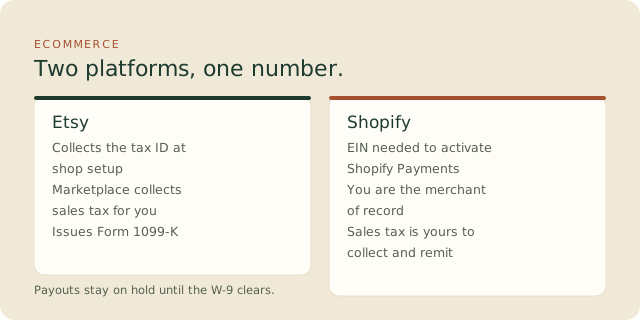
Both collect the EIN and both issue a 1099-K. They diverge on sales tax: Etsy remits as a marketplace facilitator, and a Shopify store owner remits themselves.
| Item | Etsy | Shopify |
|---|---|---|
| Platform type | Marketplace | Store software |
| Tax ID collected | At shop setup | At Shopify Payments activation |
| Form used by an LLC | Form W-9 | Form W-9 |
| Sales tax collection | Etsy collects and remits | Seller collects and remits |
| Merchant of record | Etsy | The seller |
| Annual IRS reporting | Form 1099-K | Form 1099-K |
| State registrations | Sometimes still required | Required wherever nexus exists |
| Payout hold on failure | Shop restricted | Payouts held until verified |
Source: IRS Form W-9 and 1099-K guidance plus state marketplace facilitator statutes, verified August 2026.
What else do Etsy and Shopify sellers ask?
+Do I need an EIN to sell on Etsy?
Etsy requires a taxpayer identification number, and an LLC supplies its EIN. A sole proprietor may use an SSN. Etsy validates the legal name and number as a pair against IRS records and issues Form 1099-K each year, so the 9-digit entity number is the cleaner answer.
+Does Shopify require an EIN?
Shopify Payments does, because it is a payment processor subject to IRS reporting rules. A store can be built and stocked without one, and it cannot take a payment through Shopify Payments until the EIN and the details of anyone holding 25 percent or more are verified, which holds payouts rather than cancelling them.
+Does Shopify collect sales tax for me?
No. Shopify calculates tax at checkout, and the seller remains the merchant of record responsible for registering, collecting and remitting in each of the 45 states with a sales tax where nexus exists. Etsy is different: as a marketplace facilitator it collects and remits on marketplace orders itself.
+Why did Shopify or Etsy reject my EIN?
Almost always a legal name mismatch. Both validate the name and number as a pair against IRS records, so 1 comma or a missing LLC suffix fails. The legal name field takes the string on the Articles and CP 575, not the store name, which belongs in a separate field.
+Can a non-US seller use Shopify with a US LLC?
Yes. A US-formed LLC is a US person for withholding, so it files Form W-9 with its EIN even when owned entirely from abroad. Line 7b of Form SS-4 takes the entry Foreign, and the fax route returns the number in 4 to 7 business days.
+What is economic nexus for an online store?
A sales threshold that creates a sales tax obligation without any physical presence. Most states set it around $100,000 in sales or 200 transactions in a year. Crossing it in a state requires registering there, collecting at its rate, and filing on its schedule under the EIN.
+Does Stripe or PayPal need the EIN as well?
Yes. Every US payment processor is a payment settlement entity under IRS rules and collects a taxpayer name and number before releasing funds, then reports annual volume on Form 1099-K. Using the same legal name and EIN across all of them avoids mismatched reporting at filing time.
+Should an Etsy shop elect S corporation status?
Only once profit is consistent. The election on Form 2553 removes self-employment tax of 15.3 percent from the distribution portion, at the cost of payroll and a Form 1120-S by March 15. Most practitioners put the break-even above roughly $40,000 of profit over a reasonable salary.
+Is the 1099-K figure my taxable income?
No. Form 1099-K reports gross payment volume before platform fees, refunds, shipping and cost of goods, so it is routinely far higher than actual profit. Reconciling it against the books is a normal part of the return, and the difference is explained by ordinary deductible costs.
+When can I deduct inventory I bought for my store?
When it sells, as cost of goods sold, not when it is purchased. A store that spent $20,000 on stock in December and treated it as a December expense has overstated the deduction. Unsold stock at year end is an asset carried into the next year.
This page states federal tax rules current as of August 2026. It is not legal or tax advice. Confirm your LLC’s position with a licensed CPA or attorney before filing.
Verification holding up your first payout?
Both platforms validate the legal name against the number the IRS holds, and a mismatch there is the reason most payouts sit on hold. We check your Articles against line 1 of Form SS-4 before anything is transmitted, set the classification on lines 8a, 8b and 9a, and file for $97 within 7 business days, or that fee is refunded. The $127 Fast tier files within 24 hours with the IRS call included. Start with an EIN for your LLC, filed right the first time.
No SSN required · The EIN never renews, so year 2 and beyond is $0 · get your LLC’s EIN