What Is a Disregarded Entity?
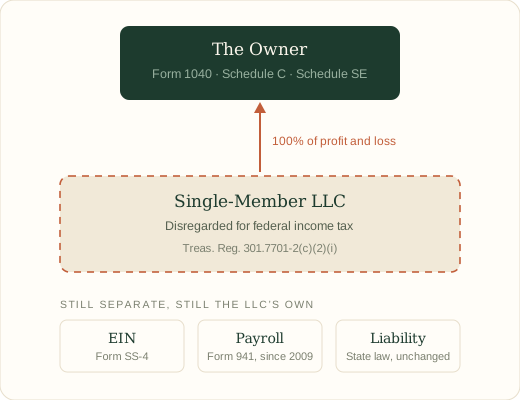
A disregarded entity is a business entity with 1 owner that the IRS ignores as separate from that owner for federal income tax. Treasury Regulation 301.7701-2(c)(2)(i) sets the rule. The income is reported on the owner’s own return.
The word disregarded describes exactly 1 thing: who reports the income. It is not a business type you register, not a status you apply for, and not something printed on a state certificate. The IRS looks at a 1-owner LLC, decides it will not tax the company separately, and taxes the owner instead. Every dollar of revenue, every deduction, and every dollar of profit passes through to 1 tax return.
The regulation that created this comes from the check-the-box rules, effective January 1, 1997. Before that date, entity classification ran on a 4-factor test that produced years of disputes. The current system replaced it with a simple default: a domestic entity with 2 or more members is a partnership, a domestic entity with 1 member is disregarded, and either one changes that by filing a form. Read the complete LLC tax classification rules, or look up the vocabulary in our llc ein terms glossary. Disregarded status is also the single most common reason an owner ends up unsure which 9-digit number a form wants, which TIN vs EIN resolves box by box.
Disregarded for what, exactly
The status is narrower than the word suggests. The IRS disregards the entity for federal income tax and regards it for 3 other things. Keeping those 4 lanes straight prevents most of the filing errors we see on incoming orders.
Disregarded: federal income tax. Profit flows to the owner’s Form 1040, Schedule C, or the corporate owner’s Form 1120.
Regarded: employment tax. Since January 1, 2009 the LLC files Form 941 and Form 940 under its own EIN.
Regarded: excise tax. Since January 1, 2008 the LLC files Form 720 in its own name under its own EIN.
Regarded: state law liability. The LLC statute in the state of formation governs, in all 50 states, unchanged by IRS labels.
Which Entities Does the IRS Disregard?
Three: a single-member LLC, a qualified subchapter S subsidiary under IRC 1361(b)(3), and a qualified REIT subsidiary under IRC 856(i). A single-member LLC is the version almost every founder meets.
| Entity | Authority | Owner must be | Election form |
|---|---|---|---|
| Single-member LLC | Reg. 301.7701-3(b)(1)(ii) | 1 person or 1 entity | None, automatic |
| Qualified subchapter S subsidiary | IRC 1361(b)(3) | An S corporation, 100% of stock | Form 8869 |
| Qualified REIT subsidiary | IRC 856(i) | A REIT, 100% of stock | None, automatic |
| Single-owner foreign entity | Reg. 301.7701-3(b)(2) | 1 owner, no limited liability | Form 8832 to change |
Source: Internal Revenue Code and Treasury Regulations, verified July 2026.
One structure never qualifies: a corporation. An entity incorporated under a state corporation statute is a per se corporation under Regulation 301.7701-2(b)(1) and stays taxed separately no matter how many shareholders it has, even at exactly 1. This is why converting an LLC into a corporation is a classification decision with permanent consequences, and why the member count on the LLC EIN application deserves 2 minutes of attention before you file.
A single-member LLC owned by another LLC is still disregarded. The IRS looks through both and taxes the ultimate owner. A single-member LLC owned by a corporation is disregarded too, and its numbers appear inside the parent’s Form 1120 rather than on a separate return. Not sure which box you are in? Run the llc tax classification quiz (tool).
Does Disregarded Status Remove Liability Protection?
No. Disregarded is a federal income tax label from Treasury Regulation 301.7701-2. Liability protection comes from the state LLC statute where you filed. The 2 systems never touch each other.
This is the single most common misreading of the term, and it costs founders real money when they dissolve a working LLC because a forum post told them the IRS does not see it. The IRS not taxing your LLC separately says nothing about whether a creditor can reach your personal bank account. All 50 states have LLC statutes granting limited liability to members, and every one of them applies to a single-member LLC that is disregarded for federal tax.
What does threaten the shield is behavior, not classification: mixing personal and business money, skipping the state annual report, or signing contracts in your own name rather than the LLC’s. A dedicated business bank account is the first defense, and every US business bank requires the EIN and the CP-575 letter to open one. That is covered on the LLC CP-575 letter page.
The 2 systems answer different questions. State law decides who can be sued and for what, and it treats a disregarded LLC as a full legal entity separate from its owner. Federal tax law decides which return the income lands on, and it looks through the LLC to the owner. Neither ruling touches the other.
The word disregarded describes 1 narrow thing: the IRS ignores the entity for income tax reporting. It does not ignore the LLC for employment tax, for excise tax, or for the Form 5472 obligation that follows a foreign owner. In each of those areas the LLC files under its own EIN as a separate entity.
How Does Form SS-4 Set Disregarded Status?
Three fields do it. Line 8a marks the applicant as an LLC, line 8b states the member count, and line 9a names the entity type. Entering 1 on line 8b produces a disregarded entity.
Nothing on Form SS-4 says the word disregarded in a checkbox. The status is produced by arithmetic. Line 8b takes a number, and the number 1 triggers the default in Regulation 301.7701-3(b)(1)(ii) as of the LLC’s formation date. This is why a mistyped member count is not a clerical issue: it sets the federal tax treatment the IRS expects returns to match for the life of the company.
| SS-4 line | What it asks | Entry for a disregarded entity |
|---|---|---|
| Line 7a | Responsible party, legal name | The 1 human being who controls the LLC |
| Line 7b | Responsible party SSN, ITIN or EIN | SSN, ITIN, or the entry Foreign |
| Line 8a | Is this application for an LLC? | Yes |
| Line 8b | Number of LLC members | 1 |
| Line 8c | Was the LLC organized in the United States? | Yes for a 50-state LLC |
| Line 9a | Type of entity | Other, then write Disregarded entity |
| Line 11 | Date business started | The state-recorded formation date |
Source: IRS Form SS-4 and its instructions, verified July 2026.
The most common reversal we correct. A founder who owns 100% of the LLC lists a business partner, a spouse, or a formation agent on line 8b out of politeness, turning a disregarded entity into a partnership on IRS records. That LLC now owes Form 1065 every year it never intended to file. Every einforllc.co order includes a classification check on lines 8a, 8b, and 9a against your Articles of Organization before the SS-4 leaves our desk.
No SSN. No passport upload.
Does a Disregarded Entity Need Its Own EIN?
Yes in practice. The IRS requires an EIN for payroll, excise tax, and Form 5472. Every US business bank account, Stripe account, and PayPal business account requires one before it opens.
The technical answer and the practical answer separate here. Technically, a disregarded entity with no employees, no excise liability, and a US owner reports under the owner’s Social Security Number. Nothing in the Code forces an EIN in that narrow case. Practically, the narrow case barely exists, because the first thing a working LLC does is open a bank account, and the second is accept a payment.
| Situation | EIN required? | Why |
|---|---|---|
| Hiring 1 or more employees | Yes | Form 941 and Form 940 file under the LLC’s EIN |
| Owing federal excise tax | Yes | Form 720 files under the LLC’s EIN |
| Foreign owner, any income level | Yes | Form 5472 and pro-forma Form 1120 need it |
| Opening a US business bank account | Yes | Every US bank verifies the EIN and CP-575 |
| Electing corporate or S corp status | Yes | Form 8832 and Form 2553 both require an EIN |
| US owner, no employees, no excise tax | No | The owner’s SSN carries the reporting |
Source: IRS Form SS-4 instructions and Publication 1635, verified July 2026. Full walkthrough on does my llc need an ein.
The honest router, before you pay anyone
Have an SSN? Go to irs.gov. The online assistant is free, runs Monday through Friday 7 a.m. to 10 p.m. Eastern, and issues the EIN in 15 minutes. Do not pay us or anyone else.
No SSN? The online tool blocks you. Take the fax route with a paper Form SS-4 to 855-641-6935 for a US-based entity or 855-215-1627 from outside the United States. The IRS Instructions for Form SS-4 give 4 business days for the faxed reply when you supply a return fax number. Or we file it for $97, faxed within 7 business days in writing, 16 to 19 business days end to end. The $127 Fast tier files within 24 hours and includes the IRS call, 6 to 8 business days end to end.
Line 7b accepts the entry Foreign. No passport upload is ever required. The IRS international line is 267-941-1099. Details on LLC EIN Without SSN.
How Does a Disregarded Entity File Its Taxes?
A disregarded entity files no income tax return of its own. The owner reports the numbers: Schedule C for a trade or business, Schedule E for rental property, Schedule F for farming, or Form 1120 for a corporate owner.
| Who owns the LLC | Where the income lands | Self-employment tax | Return due |
|---|---|---|---|
| US individual, operating business | Schedule C, Form 1040 | 15.3% on net earnings | April 15 |
| US individual, rental property | Schedule E, Form 1040 | None on rents | April 15 |
| US individual, farming | Schedule F, Form 1040 | 15.3% on net earnings | April 15 |
| A US corporation | Inside the parent’s Form 1120 | None | April 15 |
| A US partnership | Inside the parent’s Form 1065 | Per partner | March 15 |
| A non-US person | Pro-forma Form 1120 + Form 5472 | None | April 15 |
Source: IRS instructions for Form 1040, Form 1065, Form 1120 and Form 5472, verified July 2026. Calendar-year filers; a 6-month extension is requested on Form 4868 or Form 7004.
Self-employment tax is the line item that surprises new owners. A US individual running a disregarded LLC pays 15.3% on net earnings under Schedule SE: 12.4% for Social Security and 2.9% for Medicare, with an extra 0.9% Additional Medicare Tax above $200,000 of wages for a single filer and $250,000 for a joint return. There is no employer to split it with, because the IRS sees 1 person.
One document trips up almost every new disregarded LLC: Form W-9. Line 1 takes the owner’s name, line 2 takes the LLC name, and Part I takes the owner’s TIN. Filling in the LLC’s EIN where the owner’s TIN belongs produces a name-TIN mismatch at the payer, and mismatches invite 24% backup withholding on every payment until they are fixed.
Is a Disregarded Entity Disregarded for Payroll and Excise Tax?
No. Regulation 301.7701-2(c)(2)(iv) treats it as a corporation for federal employment tax from January 1, 2009, and Regulation 301.7701-2(c)(2)(v) does the same for excise tax from January 1, 2008.
These 2 carve-outs are the reason a disregarded entity has a separate EIN at all. Before 2009 an owner ran payroll under their own SSN and the IRS chased the individual for the LLC’s employment tax. The regulation moved the obligation to the entity: the LLC withholds, deposits, files Form 941 for each of the 4 quarters, files Form 940 once a year for federal unemployment tax, and issues Forms W-2 in its own name under its own 9-digit number.
Form 941, quarterly. Filed by the LLC under the LLC’s EIN, 4 times a year, due the last day of the month after each quarter.
Form 940, annually. Federal unemployment tax, filed by the LLC under the LLC’s EIN, due January 31.
Forms W-2 and W-3. Issued in the LLC’s name, due to employees and the Social Security Administration by January 31.
Form 720, quarterly. Federal excise tax, filed by the LLC in its own name since January 1, 2008.
The owner of a disregarded entity is not an employee of it. Paying yourself does not go through payroll, is not a W-2 wage, and is not a deduction. It is an owner draw, and the tax on it arrives through Schedule SE at 15.3%. Owners who want a salary elect S corporation treatment on Form 2553 instead, which changes the classification entirely.
What Does a Foreign-Owned Disregarded Entity Owe the IRS?
Form 5472 with a pro-forma Form 1120, every year, even at $0 of income. Regulation 1.6038A-1 has required it for tax years beginning on or after January 1, 2017. The penalty is $25,000.
This is the most expensive gap in the whole disregarded-entity subject, and it exists because 2 rules point in opposite directions. For income tax, a foreign-owned single-member LLC stays disregarded and pays nothing at entity level. For information reporting, the same LLC is treated as a domestic corporation and owes an annual filing that most owners never hear about until a notice arrives.
| Requirement | Detail |
|---|---|
| Forms filed | Form 5472 attached to a pro-forma Form 1120 |
| Applies from | Tax years beginning on or after January 1, 2017 |
| Income threshold | None: $0 of revenue still triggers the filing |
| Reportable transactions | Any transaction between the LLC and its 25% foreign owner |
| Due date | April 15 for a calendar-year LLC, extended to October 15 on Form 7004 |
| Penalty for failure | $25,000 under IRC 6038A(d)(1) |
| Continuing penalty | A further $25,000 for each 30-day period after 90 days of IRS notice |
| Records | Books adequate to establish the accuracy of the return, kept by the LLC |
Source: IRC 6038A, Treasury Regulation 1.6038A-1, IRS instructions for Form 5472, verified July 2026.
The EIN is what makes that filing possible. Form 5472 has no field for a foreign passport number and no field for a personal tax ID from another country. It identifies the LLC by its 9-digit EIN, which means a foreign-owned disregarded LLC with no EIN cannot comply even when the owner wants to. That is the sequence we file for every day. The complete guide sits on the Form 5472 page, and the ownership rules on EIN for a Foreign-Owned LLC.
No SSN. No passport upload.
How Do You Stop Being a Disregarded Entity?
Three ways: admit a second member and become a partnership, file Form 8832 for corporate treatment, or file Form 2553 for S corporation treatment. Each takes effect on a date you control.
| Route | New classification | Timing rule | New EIN? |
|---|---|---|---|
| Admit a 2nd member | Partnership, Form 1065 | Effective the day the member is admitted | No |
| File Form 8832 | C corporation, Form 1120 | Up to 75 days back or 12 months forward | No |
| File Form 2553 | S corporation, Form 1120-S | Within 2 months and 15 days of the tax year | No |
| Incorporate under state law | Corporation, Form 1120 | On the state’s effective date | Yes |
Source: IRS instructions for Form 8832, Form 2553 and Publication 1635, verified July 2026.
One rule catches people who change their mind. Under Regulation 301.7701-3(c)(1)(iv), an entity that makes an election is barred from electing again for 60 months from the effective date. A classification chosen in a rush in year 1 governs through year 5. That 60-month lock is the reason we read your Articles of Organization before setting line 9a rather than after.
Notice the last column. Three of the 4 routes keep the same 9-digit EIN, because the entity did not change, only its tax label did. Full detail on how to file Form 8832 and on when an LLC needs a new EIN.
Disregarded Entity vs Partnership vs Corporation: What Changes?
The return, the layers of tax, and the paperwork. A disregarded entity files 0 entity returns, a partnership files Form 1065 plus a Schedule K-1 per member, and a corporation files Form 1120 and is taxed twice.
| Feature | Disregarded entity | Partnership | C corporation | S corporation |
|---|---|---|---|---|
| Members allowed | Exactly 1 | 2 or more | Any number | 1 to 100 |
| Entity income return | None | Form 1065 | Form 1120 | Form 1120-S |
| Owner reporting | Schedule C, E or F | Schedule K-1 | Dividends on Form 1040 | Schedule K-1 |
| Layers of federal tax | 1 | 1 | 2 | 1 |
| Self-employment tax | 15.3% on net earnings | 15.3% on active shares | None on dividends | Wages only |
| Return due, calendar year | April 15 | March 15 | April 15 | March 15 |
| Foreign owners permitted | Yes | Yes | Yes | No |
| Election form | None, it is the default | None, it is the default | Form 8832 | Form 2553 |
| EIN required | For payroll, excise, 5472 | Always | Always | Always |
Source: IRC 1361, IRC 7701 and Treasury Regulation 301.7701-3, verified July 2026.
One row deserves a second look: foreign owners permitted. An S corporation cannot have a non-resident alien shareholder under IRC 1361(b)(1)(C), which removes Form 2553 from the menu for most of the founders who read this page. A disregarded entity has no such restriction, which is why the foreign-owned single-member LLC is the most common structure we file for, across 150+ countries. Ready to file? You can get started on the homepage.
The 3 classifications differ on 2 axes: which return the LLC files, and who pays the tax. A disregarded entity files no separate return and the owner pays. A partnership files Form 1065 and issues a Schedule K-1, and each member pays. A corporation files Form 1120 and the entity itself pays at 21 percent.
Only 1 of the 3 is chosen. Disregarded and partnership treatment arrive by default from the member count, and corporate treatment requires Form 8832 or Form 2553. The EIN is identical across all 3, because the IRS assigns it to the entity rather than to the classification.
What Does Filing the EIN Cost a Disregarded Entity?
$0 at the IRS on every channel. einforllc.co charges $97 on Standard or $127 on Fast, and both include the check on lines 8a, 8b and 9a that sets disregarded treatment correctly the first time.
The EIN itself is free. The IRS charges $0 online, $0 by fax, $0 by mail and $0 on the international phone line, and it never renews, so year 2 and every year after cost $0. Paid services differ on what they add around that free number.
| Route | Price | Classification check | Written filing deadline |
|---|---|---|---|
| File it yourself at irs.gov | $0 | You decide lines 8a, 8b, 9a | None |
| einforllc.co Standard | $97 | Yes, on every order | Faxed within 7 business days, or that fee is refunded |
| einforllc.co Fast | $127 | Yes, on every order | Filed within 24 hours, or that fee is refunded |
| Rocket Lawyer | $59.99 | No | None |
| ZenBusiness | $99 | No | None |
| Northwest | $200 | No | None |
Competitor prices verified July 2026. Northwest’s figure is its no-SSN rate. Full breakdown on LLC EIN Cost.
The EIN is priced on its own. $97 to fax Form SS-4 within 7 business days, or $127 to file within 24 hours with the IRS call included. If your LLC already exists, that is the whole invoice: one line, one charge, and the EIN never renews. LLC formation sits beside it as a separate optional line at +$197 for people who have not filed with a state yet, and the registered agent inside it renews at $99/year, printed here rather than buried in fine print. We will tell you to leave that box unchecked rather than sell it to you. If you hold an SSN, the free 15-minute route at irs.gov is the right answer and we will say so.
This page states federal tax rules current as of July 2026. It is not legal or tax advice. Confirm your LLC’s position with a licensed CPA or attorney before filing.