Does Form 2553 Change Your LLC's EIN?
No. An LLC keeps the same 9-digit EIN through the S corporation election. Form 2553 changes the return the LLC files, to Form 1120-S. The number on the CP-575 letter stays assigned for the life of the company.
The EIN appears in the identification block at the top of Form 2553, which is the IRS confirming it expects the same number. A new EIN becomes necessary only when the entity itself changes, not when its tax label does. The full list of triggers that force a fresh number sits on new EIN for an LLC, and the EIN side of the S election is covered on LLC S corp election and the EIN.
In practice the EIN you already hold keeps doing every job it did before. Payroll deposits, the business bank account, and vendor W-9 forms all continue under the same 9-digit number, so moving to Form 1120-S changes no account you have opened. The IRS matches the S corporation return to the EIN on file, which is exactly why the identification block of Form 2553 asks for the existing number rather than issuing a new one. If you have not pulled the EIN yet, the how to get an EIN for an LLC page lays out the SS-4 fields in order, and using your EIN covers what the number unlocks once the CP-575 arrives.
A converted entity is the 1 exception to the same-EIN rule. When an LLC re-forms as a state-law corporation, the new legal entity applies for its own EIN before it files, because the tax label did not change on its own, the entity did. That distinction is the whole reason Form 2553 keeps 1 number while a statutory conversion needs 2.
No SSN. No passport upload.
Who Is Eligible to Elect S Corporation Status?
An eligible entity must be domestic, have no more than 100 shareholders, hold only 1 class of stock, and have only allowed owners. Nonresident aliens are barred, so a foreign-owned LLC cannot elect.
| Requirement | Rule |
|---|---|
| Entity | Domestic LLC or corporation only |
| Shareholders | No more than 100 |
| Stock | 1 class only |
| Owners | US citizens or residents, certain trusts and estates |
| Barred owners | Nonresident aliens, partnerships, corporations |
| Tax year | Calendar year, or a valid business-purpose year |
Source: IRS Form 2553 instructions and Internal Revenue Code section 1361, verified August 2026.
S corporation status dates to 1958, when Congress added Subchapter S to the tax code, and the nonresident-alien bar has applied ever since. A foreign owner who wants corporate treatment takes the C corporation route on Form 8832 instead. The details of both routes for non-US owners sit on EIN for a foreign-owned LLC.
The 100-shareholder cap counts owners, not units, and it treats a family as 1 shareholder, so spouses and their descendants collapse into a single count. The 1-class-of-stock rule means every ownership interest carries identical rights to distributions and to liquidation proceeds, so an LLC operating agreement that splits members into preferred and common tiers fails the test until those tiers are flattened to 1. Trusts and estates qualify only in the narrow categories 26 U.S.C. section 1361 lists, such as grantor trusts and qualified subchapter S trusts.
A multi-member LLC that clears all 4 conditions elects the same way a single-member LLC does: 1 Form 2553, signed by every member as a consenting shareholder. The shared mechanics of running that filing across several owners, and the EIN each election depends on, sit on EIN for a multi-member LLC.
When Is Form 2553 Due for an LLC?
Form 2553 is due within 2 months and 15 days of the start of the tax year the election takes effect, which is 75 days. A calendar-year LLC electing from January 1 files by March 15.
| Scenario | Effective date | Filing deadline |
|---|---|---|
| Calendar-year LLC, current year | January 1 | March 15 |
| New LLC formed mid-year | Formation date | 75 days after formation |
| Missed the window | Requested date | Within 3 years and 75 days, late relief |
Source: IRS Form 2553 instructions, verified August 2026.
The 75-day clock runs from the first day of the tax year the election takes effect, not from the day you sign the form. For an LLC that wants S corporation treatment starting January 1, 2026, the 2-month-and-15-day window closes on March 15, 2026. A brand-new LLC uses its own first tax year instead: an entity formed on June 10 counts 75 days from June 10, so its deadline lands in late August and the election covers that short first year.
Filing early is allowed. Form 2553 can be submitted up to 12 months before the requested effective date, which lets an owner lock in next year's status the moment the LLC has its EIN. Because the form has to carry that 9-digit number, the EIN has to exist first, and the LLC EIN application page walks through the SS-4 request the deadline depends on. An LLC that files after the window turns to the late-relief route instead, traced step by step in the S corp election and the EIN guide.
Does an LLC File Form 2553 or Form 8832?
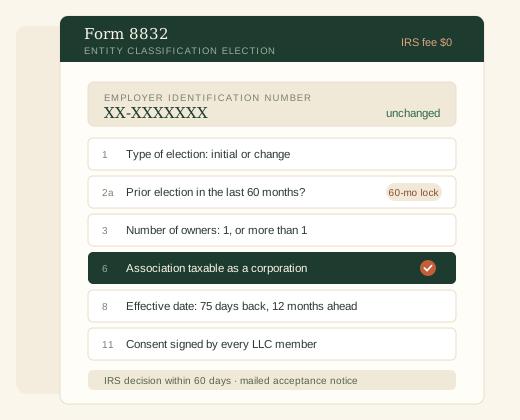
Form 2553 for S corporation status, Form 8832 for C corporation status. An LLC electing S corp files only Form 2553, and the IRS treats it as the classification election too. Both keep the same EIN.
| Question | Form 2553 | Form 8832 |
|---|---|---|
| What it elects | S corporation status | C corporation status |
| Annual return | Form 1120-S | Form 1120 |
| IRS fee | $0 | $0 |
| Deadline | 2 months and 15 days | 75 days back, 12 months forward |
| Foreign owner allowed? | No | Yes |
| Does the EIN change? | No | No |
Source: IRS Form 2553 and Form 8832 instructions, verified August 2026.
The overlap that confuses owners is the classification election. Filing Form 8832 is how any eligible entity picks corporate treatment, but the IRS lets Form 2553 stand in for it: a single Form 2553 both classifies the LLC as an association taxed as a corporation and elects S status, so a separate Form 8832 is redundant and the instructions direct owners not to file it. Form 8832 is the right form only when the goal is C corporation status, which carries its own 21% corporate rate and a Form 1120 return.
The return each path produces is the clearest divider between the 2 forms. S corporation status routes the LLC to Form 1120-S with pass-through Schedule K-1s, while the default multi-member LLC stays on Form 1065. The C corporation route on Form 8832 for an LLC produces a Form 1120 and taxes profit at the entity level before dividends reach owners. Both elections cost $0 and neither changes the 9-digit EIN, so the choice turns on tax treatment, not on any filing fee.
Why Do LLCs Elect S Corporation Status?
To reduce self-employment tax. An S corporation splits pay into a reasonable salary and a distribution, and only the salary carries the 15.3% self-employment tax. On profit above a fair salary, that saves money.
A default LLC pays 15.3% self-employment tax on all net profit, split as 12.4% Social Security and 2.9% Medicare. An S corporation pays that 15.3% only on the salary portion, so an owner taking a $60,000 salary out of $120,000 in profit shields the other $60,000 from the tax. The tradeoff is payroll: an S corporation must run real payroll, file Form 941 each quarter, and file Form 1120-S. The full comparison of all 4 classifications sits on LLC tax classification.
The savings only exist above the salary line, so the math favors LLCs with steady profit well past what a fair wage absorbs. On $120,000 of profit with a $60,000 salary, the 15.3% tax applies to $60,000 rather than the full amount, a difference of about $9,180 before the deduction for half the self-employment tax. Below roughly $40,000 of profit, the payroll cost and the extra Form 1120-S filing can erase the benefit, which is why the election rewards scale rather than every LLC.
The IRS fee to make the election is $0 either way, and the underlying EIN carries no annual charge, a point the LLC EIN cost page confirms against the $97 and $127 filing tiers. Once payroll starts, the S corporation files Form 941 four times a year and issues a W-2 to each owner-employee, and putting the 9-digit number to work across those filings is covered on using your EIN.
Can You File Form 2553 Late?
Yes. Revenue Procedure 2013-30 grants late-election relief within 3 years and 75 days of the intended effective date, if the LLC filed consistently as an S corporation. The relief statement goes on top of Form 2553.
The relief exists because many owners decide on S corporation treatment after the 75-day window closes. As long as the LLC has filed its returns as if the election were already in place, and has reasonable cause for the delay, the IRS accepts the late Form 2553 with the relief language written across the top. The EIN still does not change. You need that EIN first, which the LLC EIN application page walks through field by field.
Revenue Procedure 2013-30 sets 3 years and 75 days from the intended effective date as the outer limit, and it asks for 3 things: the LLC intended to be an S corporation as of that date, the only reason it missed the deadline was the late filing, and it has reported consistently on Form 1120-S. When all 3 hold, the IRS accepts the election with no penalty and no user fee. The 9-digit EIN still carries through unchanged, and an LLC that never obtained 1 starts with the how to get an EIN for an LLC walkthrough before it files anything.
This page states federal tax rules current as of August 2026. It is not legal or tax advice. Confirm your LLC's position with a licensed CPA or attorney before filing an election.