Table of contents
- Is there a special EIN for a Texas LLC?
- When can a Texas LLC apply for its EIN?
- Where does Texas appear on Form SS-4?
- Does an EIN cover Texas franchise tax?
- Does a Texas LLC need a sales tax permit as well as an EIN?
- Does forming in Texas change how the IRS classifies an LLC?
- How does a Texas LLC owner without an SSN get the EIN?
- What does a foreign owner forming in Texas actually face?
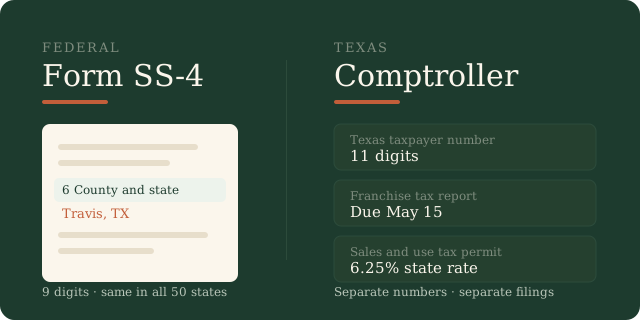
There is no Texas EIN. The EIN for a Texas LLC is the same 9-digit federal number the IRS issues in all 50 states, on the same Form SS-4. Texas appears on one line of that form. What is genuinely different in Texas is everything the EIN does not cover: the Certificate of Formation that has to be approved first, the separate Texas taxpayer number the Comptroller issues, the franchise tax report due May 15, and the sales and use tax permit.
This page separates two things that get filed under one word. The federal EIN is one number, one form and one issuer, and it behaves the same whether the LLC was formed in Houston or Honolulu. Texas is a set of obligations that sit beside it: a formation certificate that has to be approved first, a Comptroller account with its own number, and an annual report with a date that has nothing to do with any federal deadline. Owners weighing Texas against other formation states can read the same breakdown for ein for wyoming llc and ein for delaware llc, where the state layer looks different and the federal number does not.
A Texas LLC gets its EIN from the IRS on Form SS-4, the same federal application filed in all 50 states. There is no Texas EIN. The IRS charges $0 and issues the number in about 15 minutes through the online assistant, or in 4 to 7 business days by fax for an applicant with no SSN or ITIN. Texas levies no personal income tax, so the EIN is used for the federal return, the bank account, and payroll. Three Texas obligations sit beside it and none of them is the EIN: the Certificate of Formation the Secretary of State approves first, the 11-digit Texas taxpayer number the Comptroller issues, and the franchise tax report due every May 15.
Is there a special EIN for a Texas LLC?
No. The EIN for a Texas LLC is the same federal 9-digit number issued in all 50 states, on the same Form SS-4, by the same IRS. Texas appears on exactly one line of that form: line 6.
The EIN is federal property, not state property. The IRS assigns it, the IRS holds the record, and the IRS prints it on one document: the CP-575 confirmation letter. No Texas agency issues it, approves it, or has a copy of it. An LLC formed in Austin and an LLC formed in Cheyenne receive numbers from the same pool, in the same format, with the same 2-digit prefix system the IRS uses for its processing campuses.
That matters because the phrase people search is misleading. There is no Texas EIN application, no Texas EIN number, and no Texas EIN office. Searching for one leads to a state page that has nothing to do with the federal number, or to a form that is asking for a Texas taxpayer number instead. Those are two different numbers with two different issuers: the 9-digit EIN comes from the IRS on Form SS-4, and the Texas taxpayer number comes from the Texas Comptroller of Public Accounts on its own application.
The number also does not change when the LLC changes state. A Texas LLC that redomesticates, or registers in a second state, carries the same EIN with it. The EIN follows the entity for the life of the entity, and it costs $0 to obtain from the IRS in every year including the first.
When can a Texas LLC apply for its EIN?
After the Texas Secretary of State approves the Certificate of Formation, Form 205. The SS-4 carries the LLC's exact legal name, and that name does not legally exist until the state files the certificate and issues the Certificate of Filing.
Texas formation runs through the Secretary of State, not the Comptroller. An LLC files Form 205, the Certificate of Formation for a Limited Liability Company. Online submissions run through SOSDirect, which adds a credit card convenience fee, and expedited handling costs extra per document. The Secretary of State publishes the current fee schedule, and that schedule is the only place to read a Texas filing fee from. Filing Form 205 also requires a Texas registered agent who has consented, which is what Form 401 records.
The order is fixed for a reason. Line 1 of Form SS-4 asks for the legal name of the entity, and the IRS matches that string against nothing at all at the moment of filing but prints it permanently on the CP-575. A bank later compares the CP-575 name against the Certificate of Filing character by character. An SS-4 filed before the state approved the name, or with a punctuation difference such as "LLC" against "L.L.C.", produces a CP-575 that does not match and an account application that stalls.
That review is the part of our $97 service that exists because of this exact failure. We read the approved Texas Certificate of Formation and match the SS-4 name to it character by character before anything is transmitted, alongside a check of lines 8a, 8b and 9a. The same review sits inside the $127 tier, which is filed within 24 hours with the IRS call included.
An out-of-state LLC operating in Texas takes a different door. It registers as a foreign entity on Form 304, at the fee the Secretary of State publishes for that form, and it already has its EIN from the state that formed it. Registering in Texas never generates a second EIN, and applying for one produces a duplicate the IRS has to unwind.
Where does Texas appear on Form SS-4?
On line 6, which asks for the county and state where the principal business is located. Texas appears there and nowhere else. No line on Form SS-4 asks which state formed the LLC by name.
Line 6 is a routing and statistics field, not a tax field. The IRS records the county and state so the entity is attached to a geographic record. It does not set the classification, does not set the return, and does not create any Texas obligation. An LLC formed in Texas whose principal office sits in another country still completes line 6 with the location of the principal business.
Line 8c is the field people confuse with a state question. It asks whether the LLC was organized in the United States, and a Texas LLC answers yes. The answer is yes for an LLC formed in any of the 50 states regardless of where the owners live or hold citizenship. A non-resident owner answers yes here, because the question is about the entity, not the person.
Line 7a and 7b are where the owner appears, and they are the same in Texas as anywhere. Line 7a takes the responsible party's name. Line 7b takes an SSN, an ITIN, or the word "Foreign" when the responsible party holds none of those. Texas residency changes nothing about how those two lines are completed.
Line 12 has a longer tail than any other field. It sets the closing month of the accounting year, and a Texas LLC that enters December aligns its federal year with the calendar year the Texas franchise tax report is also built around. Entering a different month keeps the federal and state reporting periods out of step for the life of the company.
Does an EIN cover Texas franchise tax?
No. The Texas Comptroller administers the franchise tax under a separate Texas taxpayer number. The federal 9-digit EIN never appears in place of it, and holding an EIN registers the LLC with nothing in Texas.
Every Texas LLC is subject to the franchise tax from formation, whether or not it owes a dollar. The Comptroller assigns the Texas taxpayer number and a Webfile number, and the annual franchise tax report is due May 15. An LLC formed in one year files its first annual report on May 15 of the following year, which is the deadline first-year owners miss most.
The rate depends on what the LLC sells. The Comptroller sets one rate for retail and wholesale businesses and a higher rate for every other kind of business, both applied to taxable margin. An E-Z computation runs on apportioned total revenue instead, at a lower rate with no deductions taken, and it is open to LLCs under a revenue ceiling. The Comptroller publishes both rates and that ceiling for each report year.
Below a revenue threshold the tax is zero. The Comptroller publishes a no-tax-due threshold in annualized total revenue for each report year, and entities under that threshold no longer file a separate no-tax-due report. The threshold moves on the Comptroller's own schedule, so take the number for your report year from the Comptroller and from nowhere else.
The Public Information Report, Form 05-102, is the filing that does not go away. Texas has no separate annual report to the Secretary of State, so this report is the document that keeps the LLC's officer, manager and registered agent record current. It is due on the same May 15 date.
Missing the date costs money and then costs the entity. The Comptroller adds a flat late-filing penalty per report plus a percentage of the tax due, and that percentage rises the longer the report stays outstanding. Continued non-filing leads to forfeiture of the LLC's right to transact business in Texas, which ends the liability protection the LLC was formed for.
Does a Texas LLC need a sales tax permit as well as an EIN?
A Texas LLC selling taxable goods or services in Texas needs a sales and use tax permit from the Comptroller, applied for on Form AP-201. The permit is separate from the EIN, and the EIN does not substitute for it.
Texas charges one statewide sales tax rate, and cities, counties, transit authorities and special purpose districts add local rates on top of it, up to a combined cap fixed in statute. The Comptroller publishes the state rate, the local cap and an address-level rate lookup, which is what a seller uses rather than a rate quoted on any other site. The permit application asks for the federal EIN, which is the point in the process where an LLC without one stops.
A permit holder files sales tax returns on the frequency the Comptroller assigns, and a zero return is still a return. The permit stays open until the LLC closes it, and an LLC that stops selling without closing the permit keeps receiving filing obligations for periods with no activity.
Texas has no state personal income tax. That is the fact that draws owners to Texas and the fact that gets over-read: no state income tax does not mean no federal tax, does not remove the franchise tax, and does not remove a single federal filing attached to the EIN.
Does forming in Texas change how the IRS classifies an LLC?
No. Federal classification is set by member count on lines 8a, 8b and 9a of Form SS-4, not by the state of formation. A Texas LLC and a Delaware LLC with the same member count receive the same treatment.
One member produces a disregarded entity by default. The LLC reports on Schedule C inside the owner's Form 1040 when the owner is a US person, and the LLC files no separate federal income tax return of its own.
Two or more members produce a partnership by default. The LLC files Form 1065 every year it exists, issues a Schedule K-1 to each member, and files by March 15 for a calendar-year LLC. Form 7004 extends that return by 6 months to September 15.
An election overrides the default and still has nothing to do with Texas. Form 8832 moves the LLC to corporate treatment and Form 1120. Form 2553 makes the S-corporation election, is due within 2 months and 15 days of the start of the tax year it takes effect, and does not require a new EIN.
Line 8b is the field that decides all of it. A husband and wife who form a Texas LLC together face a wrinkle no single-owner LLC has, because Texas is a community property state and the IRS permits qualified joint venture treatment for a spousal LLC in a community property state. That is the one place where Texas law reaches into federal classification, and it turns on state property law rather than on the EIN.
How does a Texas LLC owner without an SSN get the EIN?
By filing Form SS-4 with "Foreign" written on line 7b, then faxing it to the IRS. The online application at irs.gov requires an SSN or ITIN. The fax route requires neither, and no passport is uploaded anywhere.
The honest router first. An owner with an SSN applies at irs.gov, pays $0, and receives the EIN in about 15 minutes on screen. That path is free and nobody should pay for it. An owner without an SSN cannot use it, because the online assistant validates the responsible party's SSN or ITIN before it will issue a number.
The fax route is the documented alternative and it is in the IRS instructions for Form SS-4. Line 7a takes the responsible party's full name. Line 7b takes the word "Foreign". The completed form goes to 855-641-6935 for an entity based in a US state, which includes a Texas LLC, or to 855-215-1627 for an international filer. The IRS international line for status questions is 267-941-1099.
The address fields do not require a Texas address. Lines 4a and 4b take the mailing address the CP-575 is sent to, and a non-US address is accepted. Lines 5a and 5b take the street address of the business. A Texas registered agent's address is not automatically the right entry for either field.
Nothing in this route asks for identity documents. No passport, no scan, no upload. Line 7b takes the word "Foreign" and the IRS processes the application on the form alone.
What does a foreign owner forming in Texas actually face?
A foreign-owned single-member Texas LLC files Form 5472 with a pro-forma Form 1120 every year, and a missed filing carries a $25,000 penalty under Internal Revenue Code section 6038A. Texas adds the franchise tax report and a registered agent.
Form 5472 catches owners who believed a zero-income LLC had nothing to file. The obligation attaches to the structure, not the activity: a foreign-owned single-member LLC with $0 of revenue and one reportable transaction still files. Forming the LLC and funding its bank account is itself a reportable transaction between the LLC and its foreign owner.
The return is due with the pro-forma Form 1120, on April 15 for a calendar-year filer, and Form 7004 extends it by 6 months. The LLC files under the EIN from the CP-575, which is why the number is obtained before the first deadline rather than after it.
Texas requires a registered agent with a physical Texas street address who has consented on Form 401. A post office box does not satisfy it. The agent is a state formation requirement and has no bearing on the EIN application itself. Owners who have not filed Form 205 yet can take Texas formation with a first-year registered agent and an operating agreement as an optional +$197 add-on, plus the Texas filing fee at cost, with the agent renewing at $99/year. Owners whose Certificate of Formation is already issued need the EIN and nothing else from us, and that single charge is the whole invoice.
The state-level appeal of Texas is real and narrow: no state personal income tax, and a franchise tax that reaches zero below the Comptroller's revenue threshold. Neither of those touches the federal side. The Form 5472 obligation, the $25,000 penalty and the EIN itself are identical for a foreign owner forming in Texas, Wyoming, Delaware or anywhere else.
Which lines of Form SS-4 does a Texas LLC fill in?
Ten lines carry the answer. Only line 6 mentions Texas. Lines 8a, 8b and 9a set the federal classification, and line 7b is the field that decides whether the owner applies online or by fax.
| SS-4 line | What it asks | Texas LLC entry | Why it matters later |
|---|---|---|---|
| 1 | Legal name of entity | Exact name on the filed Form 205 | Printed on the CP-575; banks match it character by character |
| 4a / 4b | Mailing address | Any address, US or non-US | The CP-575 is posted here |
| 6 | County and state of principal business | County name, TX | The only line where Texas appears |
| 7a | Responsible party name | Full legal name of the person | The IRS holds one responsible party per EIN |
| 7b | SSN, ITIN or EIN | SSN, ITIN, or the word "Foreign" | "Foreign" rules out the online application |
| 8a | Is the entity an LLC? | Yes | Sets the LLC branch of the form |
| 8b | Number of LLC members | 1, 2 or more | 1 = disregarded entity; 2+ = partnership |
| 8c | Organized in the United States? | Yes | Yes for all 50 states, whoever owns it |
| 9a | Type of entity | Matches the line 8b count | A mismatch here routes the LLC to the wrong return |
| 12 | Closing month of accounting year | December for a calendar year | Sets the federal year for the life of the LLC |
Source: IRS Instructions for Form SS-4, verified July 2026.
What does the EIN cover and what does Texas still require?
The EIN covers federal identity only. Texas formation, the franchise tax report, the Texas taxpayer number and the sales tax permit are four separate registrations with separate agencies, forms and dates.
| Registration | Agency | Form | Which number it runs on | Deadline |
|---|---|---|---|---|
| Certificate of Formation | Texas Secretary of State | Form 205 | None yet, the LLC name only | Before the SS-4 |
| Registered agent consent | Texas Secretary of State | Form 401 | None, the agent is named on Form 205 | At formation |
| Federal EIN | IRS | Form SS-4 | Issues the 9-digit EIN | After state approval |
| Franchise tax report | Texas Comptroller | Form 05-158 or 05-169 | Texas taxpayer number, not the EIN | May 15 each year |
| Public Information Report | Texas Comptroller | Form 05-102 | Texas taxpayer number, not the EIN | May 15 each year |
| Sales and use tax permit | Texas Comptroller | Form AP-201 | Asks for the EIN, issues a permit number | Before first taxable sale |
| Foreign entity registration | Texas Secretary of State | Form 304 | The existing EIN, unchanged | Before transacting in Texas |
| Assumed name (DBA) | Texas Secretary of State | Form 503 | The existing EIN, unchanged | Before using the name |
Agencies and forms verified July 2026 against the Texas Secretary of State and the Texas Comptroller of Public Accounts. Texas filing fees, franchise tax rates and the no-tax-due threshold change on those agencies’ schedules, so this page does not reproduce them. Read the current figure at the agency before you file. Every number on this page comes from the IRS or from our own published price.
Texas taxpayer number vs EIN: what is the difference?
2 different numbers from 2 different governments. The EIN is 9 digits from the IRS, issued on Form SS-4, and it identifies the LLC federally. The Texas taxpayer number is 11 digits from the Texas Comptroller, and it identifies the LLC for state franchise and sales tax. Neither substitutes for the other.
| Federal EIN | Texas taxpayer number | |
|---|---|---|
| Who issues it | Internal Revenue Service | Texas Comptroller of Public Accounts |
| Length and format | 9 digits, written XX-XXXXXXX | 11 digits |
| How you apply | Form SS-4, online, fax, mail or phone | Comptroller Webfile registration |
| Fee | $0 | $0 |
| What it identifies | The LLC to the federal government | The LLC to the State of Texas |
| Used on Form 1065 and Form 5472 | Yes | No |
| Used on the franchise tax report | No | Yes |
| Used on the sales and use tax permit | Asked for on Form AP-201 | Issued alongside the permit |
| Required to open a US bank account | Yes | No |
| Valid in the other 49 states | Yes | No |
| Expires or renews | Never | Stays with the entity while it is active in Texas |
The order matters as much as the difference. The EIN comes first, because the Comptroller's registration asks for it and because the Certificate of Formation has to be approved before Form SS-4 is filed at all. The sequence is Form 205 to the Secretary of State, then Form SS-4 to the IRS, then Webfile registration with the Comptroller. Running it out of order produces a rejected SS-4 or a Comptroller registration that cannot be completed.
Confusing the 2 costs real time in 3 specific places. A bank asking for a “tax ID” wants the 9-digit EIN, and an 11-digit Texas number fails the field validation. A franchise tax report filed against the EIN cannot be matched to the account. And a vendor Form W-9 asks for the federal number only, so a Texas taxpayer number entered there produces a mismatch and 24% backup withholding.
Neither number is a substitute for the other and neither is optional for a Texas LLC that trades. The full identifier taxonomy, including where SSN and ITIN sit against the EIN, is on TIN vs EIN.
Source: Texas Comptroller of Public Accounts and the IRS Instructions for Form SS-4, verified August 2026.
Which federal returns does a Texas LLC file under its EIN?
The return follows the classification on lines 8a, 8b and 9a, not the state. One member files Schedule C, two or more file Form 1065 by March 15, and a foreign-owned single-member LLC files Form 5472.
| Structure | Federal return | Due, calendar year | Extension | Filed under |
|---|---|---|---|---|
| Single member, US owner | Schedule C inside Form 1040 | April 15 | Form 4868, 6 months | Owner's SSN; EIN for payroll and banking |
| Single member, foreign owner | Form 5472 + pro-forma Form 1120 | April 15 | Form 7004, 6 months | The 9-digit EIN |
| Two or more members | Form 1065 + Schedule K-1 per member | March 15 | Form 7004, 6 months | The 9-digit EIN |
| C-corporation election | Form 8832, then Form 1120 | April 15 | Form 7004, 6 months | The 9-digit EIN |
| S-corporation election | Form 2553, then Form 1120-S | March 15 | Form 7004, 6 months | The same EIN, never a new one |
| Any LLC with employees | Form 941 quarterly, Form 940 annually | Form 940 by January 31 | None | The 9-digit EIN |
Source: IRS instructions for Forms 1065, 1120, 1120-S, 7004, 2553, 8832 and 5472, verified July 2026.
Not one date in that table is May 15. That is the whole point of keeping the two layers apart. May 15 is the Texas Comptroller’s franchise tax date and it belongs to the Texas taxpayer number. March 15 and April 15 are IRS dates and they belong to the EIN. An owner who files the franchise tax report on time and misses Form 1065 has satisfied Texas and defaulted to the IRS, and the reverse is just as easy to do.
The two election forms carry their own clocks. Form 2553 is due within 2 months and 15 days of the start of the tax year the S-corporation election takes effect. Form 8832 can take effect up to 75 days before the date it is filed. Neither issues a new number: the EIN on the CP-575 carries through every election the LLC ever makes.
Employees add the only federal returns that run on a quarterly clock. Form 941 reports withheld income tax and both halves of Social Security and Medicare, four times a year. Form 940 reports federal unemployment tax once a year, due January 31. Both are filed under the 9-digit EIN, and both exist the moment the LLC has one employee, whether that employee sits in Dallas or outside the United States.
What does an EIN for a Texas LLC cost?
The IRS charges $0 for an EIN, in the first year and every year after, because the number never renews. Filing services charge for doing the work. Ours is $97 one time, faxed within 7 business days, or $127 filed within 24 hours with the IRS call included.
Here is the honest router, and it is the same in Texas as everywhere. Have an SSN? Go to irs.gov, pay nothing, and have the number on screen in about 15 minutes. No SSN? The online application will not run, and the route is Form SS-4 with “Foreign” on line 7b sent to 855-641-6935 for a Texas-based entity or 855-215-1627 internationally. Do that yourself for $0, or we file it. If the Texas Secretary of State has not filed your Form 205 yet, formation with a first-year registered agent and an operating agreement is an optional +$197 add-on on top of the EIN price, with the Texas fee at cost and the agent renewing at $99/year. Texas processing runs on its own clock, tracked apart from the EIN and never folded into the EIN’s dates.
| Route | Price | Written deadline | Classification review |
|---|---|---|---|
| IRS, filed yourself | $0 | None published | None |
| einforllc.co: Standard | $97 | Faxed in 7 business days, or that fee refunded | SS-4 lines 8a, 8b, 9a + Articles review |
| einforllc.co: Fast | $127 | Filed in 24 hours with the IRS call, or that fee refunded | SS-4 lines 8a, 8b, 9a + Articles review |
| Northwest (no-SSN rate) | $200 | None published | None |
| ZenBusiness | $99 | None published | None |
| Rocket Lawyer | $59.99 | None published | None |
Competitor prices verified July 2026. Business days are Monday to Friday excluding US federal holidays. Standard reaches the EIN in 16–19 business days total; Fast reaches it in 6 to 8 business days total. Texas Secretary of State filing fees and Comptroller obligations are paid to Texas and appear in no row above. The EIN carries its own price: a Texas LLC that already holds its Certificate of Formation pays that single row and nothing more. Texas formation with a first-year registered agent is a separate optional +$197 for owners who have not filed Form 205 yet, plus the state fee at cost, with the registered agent renewing at $99/year.
What else do Texas LLC owners ask about the EIN?
The 10 questions below cover the 9-digit EIN for a Texas LLC: line 1 naming, line 6, the no-SSN fax route, the separate Texas taxpayer number, and Form 5472. Each answer names the form or line it depends on.
+Is there a separate EIN for a Texas LLC?
No. The EIN is one federal 9-digit number issued by the IRS on Form SS-4, and it is identical in all 50 states. Texas appears only on line 6 of the form, which records the county and state of the principal business. No Texas agency issues or holds the EIN.
+Do I need my Certificate of Formation before applying for the EIN?
Yes. Form SS-4 line 1 carries the LLC's exact legal name, and that name exists only once the Texas Secretary of State files Form 205 and issues the Certificate of Filing. Applying earlier risks a CP-575 whose name does not match the state record, which stalls the bank account.
+How much does a Texas LLC EIN cost?
The IRS charges $0, and the number never renews, so year 2 also costs $0. Our Standard is $97 one time, filed by fax within 7 business days, 16-19 business days total. Fast is $127 in 6 to 8 business days with the IRS call. Both include the Articles review and the SS-4 lines 8a, 8b and 9a check. Texas formation is an optional +$197 add-on.
+Is the EIN the same as my Texas taxpayer number?
No. The federal EIN has 9 digits and comes from the IRS on Form SS-4. The Texas taxpayer number is issued separately by the Texas Comptroller of Public Accounts. They serve different agencies, and the Comptroller's franchise tax filings run on the Texas number, not on the EIN.
+When is the Texas franchise tax report due?
May 15 each year, filed with the Texas Comptroller. An LLC formed in one year files its first annual report on May 15 of the following year. Late filing adds a flat penalty per report plus a percentage of the tax due, both published by the Comptroller. Form 05-102 is due on the same date.
+Can I get an EIN for my Texas LLC without an SSN?
Yes. Write the word Foreign on line 7b of Form SS-4 and fax the form to 855-641-6935 for an entity based in a US state, or 855-215-1627 internationally. The online application at irs.gov requires an SSN or ITIN. No passport or identity document is uploaded on the fax route at any of the 4 stages of the process.
+Does a Texas LLC pay state income tax?
Texas levies no state personal income tax. The franchise tax still applies to every Texas LLC from formation, at rates the Comptroller sets by business type against taxable margin, and it reaches zero below the Comptroller's published revenue threshold. Federal filings attached to the 9-digit EIN are unaffected, including Form 5472 for a foreign-owned single-member LLC.
+Does registering my out-of-state LLC in Texas create a new EIN?
No. Foreign entity registration uses Form 304 and registers an existing company to transact business in Texas. The LLC keeps the 9-digit EIN it already holds, and the CP-575 is unchanged. Applying for a second EIN produces a duplicate the IRS has to unwind, which delays every bank account opened under it.
+Does a Texas LLC need a sales tax permit?
A Texas LLC selling taxable goods or services in Texas needs a sales and use tax permit from the Comptroller, applied for on Form AP-201. The application asks for the 9-digit federal EIN, so the EIN comes first. The state rate, the local rates and the combined cap are published by the Comptroller.
+Does a foreign-owned Texas LLC file anything extra?
Yes. A foreign-owned single-member LLC files Form 5472 with a pro-forma Form 1120 annually, due April 15 for a calendar-year filer. A missed filing carries a $25,000 penalty under Internal Revenue Code section 6038A. Forming the LLC in Texas rather than another state changes none of it.
This page states federal tax rules and Texas filing requirements current as of July 2026. It is not legal or tax advice. Confirm your LLC’s position with a licensed CPA or attorney, and confirm Texas figures with the Texas Comptroller of Public Accounts and the Texas Secretary of State, before filing.
Your Texas LLC is formed. What is the next step?
Form SS-4. The EIN is the federal number a Texas LLC needs after the Certificate of Formation is approved. The IRS charges $0. We file it for $97 by fax within 7 business days, or that fee is refunded, and 16–19 business days total. Fast is $127, filed within 24 hours with the IRS call included, and 6 to 8 business days total.
We read your filed Texas Certificate of Formation, match the SS-4 name to it character by character, and set lines 8a, 8b and 9a to your real structure. Filed by fax within 7 business days, or that fee is refunded. On Fast: filed and the IRS call made within 24 hours, guaranteed, or that fee is refunded. The EIN is priced on its own, so a Texas LLC that already exists pays that one line; owners still waiting on Form 205 can add formation with a first-year registered agent for +$197 on Texas’s own timeline, with the agent renewing at $99/year. If the Texas paperwork is done and the federal number is the last thing standing, get your LLC’s EIN.
No SSN. No passport upload. · The EIN never renews, so year 2 is $0 · Have an SSN? irs.gov is free and takes 15 minutes.