Table of contents
- Does a real estate LLC need its own EIN?
- Does each property need its own LLC and EIN?
- How does a series LLC change the EIN question?
- When does the EIN matter at a closing?
- How does a real estate LLC report rental income?
- Can a foreign investor hold US property in an LLC?
- What keeps the liability separation real?
- When does a real estate LLC need a new EIN?
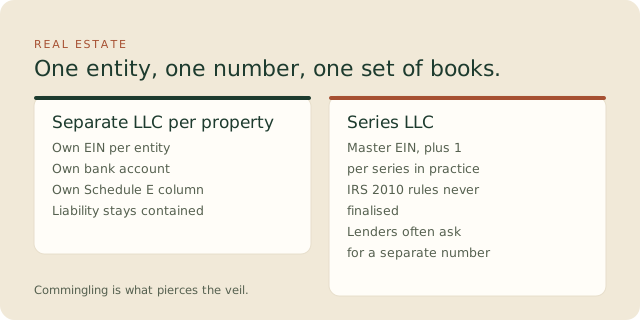
A real estate LLC needs its own EIN to open a bank account, take title at closing, and report rental income. Investors holding several properties in separate LLCs obtain a separate EIN for each, because the separation is what keeps liability contained. A series LLC holds a master EIN and, in practice, 1 per series.
Real estate is where the EIN stops being paperwork and starts being structural. An investor holding 4 properties in 4 LLCs holds 4 EINs, 4 bank accounts and 4 sets of books, and the discipline of keeping them apart is exactly what a court examines when someone tries to reach past 1 property to the others. Whether each cell of a segregated structure needs its own number is taken up on ein for series llc, and the bank documentation on ein for llc bank account.
Does a real estate LLC need its own EIN?
Yes in practice. A single-member real estate LLC may report under the owner's SSN federally, but no bank opens an account without an EIN, and closings, lenders and property managers all ask for one.
The federal rule and the commercial reality diverge here more than in most industries. The IRS treats a single-member LLC as a disregarded entity and permits reporting under the owner's SSN, so on a strict reading the number is optional for a solo investor with no employees.
Every counterparty in a real estate transaction disagrees. The title company preparing the closing statement, the lender underwriting the mortgage, the insurer writing the policy and the property manager remitting rent all ask for the entity's own tax number, and none of them accepts a personal SSN for an entity holding title.
The liability argument is stronger than the tax one. An LLC that receives rent into the owner's personal account, under the owner's personal tax number, looks in litigation exactly like the owner doing business personally. The separate EIN is the first of several facts that make the entity look like an entity.
The cost of the separation is $0 and about 15 minutes. Set against a structure whose entire purpose is containing liability across properties worth six or seven figures, declining to obtain a free federal number is a false economy that a plaintiff's attorney reads as an invitation.
Does each property need its own LLC and EIN?
Each separate LLC needs its own EIN. Whether each property needs its own LLC is a risk decision: separate entities contain a claim to 1 property, while 1 LLC holding several exposes all of them.
The structural logic is straightforward. A tenant injured at property A sues the entity that owns property A. Where that entity owns only property A, the claim reaches 1 asset. Where the same LLC owns properties A, B and C, a judgment reaches all 3, and the separation the investor believed they had does not exist.
The cost of separation scales linearly and is not trivial. Each LLC carries its own formation fee, its own registered agent, its own state annual report and its own bookkeeping, and in a state like California each also carries the $800 minimum franchise tax regardless of whether the property earned anything.
Most investors settle on a threshold rather than a rule. Properties below a certain equity value share an entity, and properties above it get their own, with the line set by how much the investor is willing to expose to a single claim. Refinancing is a second input, because some lenders price single-asset entities differently.
Whatever the structure, the EIN follows the entity rather than the property. Three LLCs holding 9 properties hold 3 EINs, not 9. One LLC holding 9 properties holds 1 EIN and 1 set of books, with the properties tracked as separate columns on Schedule E rather than as separate taxpayers.
How does a series LLC change the EIN question?
A series LLC holds a master EIN, and each series obtains its own in practice. The IRS proposed rules treating each series as a separate entity in 2010 and never finalised them, so the practice runs ahead of the guidance.
A series LLC creates internally segregated cells under 1 state filing, each holding its own assets and, under state law, its own liability shield. The appeal for a real estate investor is obvious: the separation of a multi-entity structure with 1 formation fee and 1 annual report.
The federal treatment is the unresolved part. Proposed regulations issued in 2010 would treat each series as a separate entity for federal tax purposes, and they remain proposed. Practitioners work from them because nothing better exists, and because the direction of travel has been consistent for 15 years.
The practical answer is to obtain a separate EIN per series, which is what most real estate practitioners do. A series that holds its own property, receives its own rent and maintains its own account is functioning as a separate entity, and a shared number undercuts that in exactly the way the structure exists to avoid.
Lenders and title companies frequently force the question regardless of the tax analysis. A lender advancing against 1 series routinely asks for a number specific to that series, and a title company insuring it asks the same. The EIN per series answers both without waiting for final regulations.
When does the EIN matter at a closing?
At title transfer and at funding. The title company needs the entity's tax number for the settlement statement and for any Form 1099-S reporting, and the lender needs it before it wires funds to an entity.
The EIN belongs in place before the closing date rather than during the week of it. A single-member LLC applying online receives the number in about 15 minutes, but an entity whose owner holds no SSN waits 4 to 7 business days on the fax channel, which is long enough to move a settlement date.
Title companies report certain real estate transactions to the IRS on Form 1099-S, which carries the transferor's taxpayer identification number. An entity taking or transferring title supplies its EIN for that reporting, and a missing number stalls the paperwork at the least convenient moment.
Lenders underwrite the entity as well as the borrower. Commercial and portfolio lenders lending to an LLC verify the entity's formation documents, its operating agreement and its EIN before funding, and several require the EIN confirmation letter itself rather than the number alone.
Where an investor is buying in a new state, the sequence lengthens. The LLC has to be formed and approved in that state, the EIN applied for against the approved legal name, and any foreign qualification completed, all before the entity can take title. Compressing that into a 30-day escrow is where deals slip.
How does a real estate LLC report rental income?
A single-member LLC reports rents on Schedule E inside the owner's Form 1040. A multi-member LLC files Form 1065 by March 15 under its EIN and issues a Schedule K-1 to each member.
Member count sets the return, exactly as it does for any LLC. One member gives a disregarded entity whose rental activity lands on Schedule E, with a separate column per property. Two or more members gives a partnership filing Form 1065 and allocating each member's share on a K-1.
The EIN appears on the partnership return and on every K-1 it issues. A 3-member LLC files 1 Form 1065 and issues 3 K-1s, all carrying the same entity number in Part I, with each member's own identifying number in Part II.
Property managers issue their own reporting. A manager collecting rent on behalf of an LLC reports the gross rents to the IRS on Form 1099-MISC under the LLC's EIN, which is 1 more reason the entity's number rather than the owner's personal number belongs on the management agreement.
Depreciation is where real estate returns get their character, and it follows the entity holding title. Residential rental property depreciates over 27.5 years and commercial over 39, claimed by the entity that owns it, which makes the question of which LLC holds which property a tax question as well as a liability one.
Can a foreign investor hold US property in an LLC?
Yes, and the EIN process is unchanged: line 7b of Form SS-4 takes the entry Foreign. FIRPTA withholding of 15 percent on disposals and the annual Form 5472 filing both apply.
Foreign investment in US real estate through an LLC is routine, and the federal identifier is available without an SSN or ITIN. The fax channel to 855-641-6935 returns the number in 4 to 7 business days, and the online tool is closed to these applicants.
FIRPTA is the rule that most surprises foreign investors. On the disposal of a US real property interest by a foreign person, the buyer withholds 15 percent of the gross sale price, not of the gain. That is a cash-flow event on a sale at a loss as much as on a profitable one, recovered later by filing a return.
A foreign-owned single-member LLC also files Form 5472 with a pro-forma Form 1120 every year, at a $25,000 penalty for a missed filing. A holding entity with no revenue is squarely inside that requirement, and dormancy is not a defence.
Structuring decisions here carry estate tax consequences that go well beyond the EIN. US-situs assets held directly by a non-resident face estate tax above a $60,000 exemption, which is why foreign investors frequently hold through layered structures. That analysis belongs with a cross-border tax adviser before the first purchase.
What keeps the liability separation real?
Separate EIN, separate bank account, separate books, and no personal use of entity funds. Courts disregard an entity that exists only on paper, and commingled accounts are the most common reason.
Veil piercing is a fact-driven inquiry, and the facts a court weighs are mundane. Did the entity keep its own accounts? Were its funds kept apart from the owner's? Were its formalities observed? An investor who obtained the EIN and then ran rent through a personal account has answered the second question badly.
The bank account is the practical centre of this. Each LLC needs its own account under its own EIN, rent from its properties goes into it, expenses for its properties come out of it, and transfers to the owner are recorded as distributions rather than treated as the same pocket.
Undercapitalisation is the second recurring theme. An entity holding a property with no reserve for its own insurance deductible, its own repairs and its own carrying costs looks like a shell, and the owner funding each expense personally as it arises reinforces that impression.
The paperwork side is cheap. An operating agreement that matches what actually happens, minutes for significant decisions, leases in the entity's name and insurance naming the entity as insured cost little and are exactly what an opposing attorney asks for in discovery.
When does a real estate LLC need a new EIN?
When the entity changes rather than the portfolio. Adding a second member to a single-member LLC forces a new number; buying another property, changing the name, or moving states does not.
The IRS test is whether the same entity survives for federal tax purposes. Under Revenue Ruling 99-5, a single-member LLC that admits a second member becomes a partnership and needs a new EIN. Under Revenue Ruling 99-6, a multi-member LLC dropping to 1 member also needs a new one.
Bringing in an equity partner on a deal is the event most likely to trigger this in a real estate context. An investor who has held a property alone and sells a 50 percent interest to a partner has converted a disregarded entity into a partnership, with a new number and a Form 1065 obligation from that year.
Acquiring more property changes nothing. An LLC that buys its fourth building keeps the same EIN, the same account and the same return, adding a column on Schedule E or a line on the partnership return. The number belongs to the entity, not to the assets.
Renaming and redomiciling are also neutral. IRS guidance lists a name change and a move between states among the events that keep the existing number, though both require state filings and a written notification to the IRS so the name it holds stays current.
Which real estate events require a new EIN?
Events that end 1 federal tax entity and start another require a new number. Events that change the portfolio, the name or the state do not.
| Event | New EIN? | Why |
|---|---|---|
| Buying another property | No | Same entity, more assets |
| Adding an equity partner | Yes | Rev. Rul. 99-5: becomes a partnership |
| Buying out all other members | Yes | Rev. Rul. 99-6: becomes disregarded |
| Renaming the LLC | No | Entity survives; notify the IRS |
| Moving the LLC to another state | No | Entity survives; re-register locally |
| Adding a new series to a series LLC | In practice yes | Each series operates separately |
| Electing S corporation status | No | Classification change only |
| Forming a new LLC for a new property | Yes | A new entity is a new taxpayer |
Source: IRS Do You Need a New EIN? guidance and Revenue Rulings 99-5 and 99-6, verified August 2026.
What else do property investors ask?
+Does a rental property LLC need an EIN?
In practice yes. The IRS lets a single-member LLC report rents under the owner's SSN on Schedule E, but no bank opens an entity account without the 9-digit EIN, and title companies, lenders and property managers all ask for one. The IRS charges $0 for it.
+Do I need a separate EIN for each rental property?
You need 1 EIN per LLC, not per property. Three LLCs holding 9 properties hold 3 EINs. One LLC holding 9 properties holds 1 EIN, with each property tracked as a separate column on Schedule E rather than as a separate taxpayer.
+Should each property have its own LLC?
It is a risk decision. Separate entities contain a claim to 1 property, while 1 LLC holding 3 exposes all 3 to a judgment. The cost scales: each LLC carries its own filing fee, registered agent and annual report, plus $800 a year in California regardless of income.
+Does each series in a series LLC need its own EIN?
Most real estate practitioners obtain 1 per series. The IRS proposed rules in 2010 treating each series as a separate entity and never finalised them, so the practice runs ahead of the guidance. Lenders and title companies frequently require a series-specific number regardless.
+Does adding a partner to my property LLC need a new EIN?
Yes. Under Revenue Ruling 99-5, a single-member LLC that admits a second member becomes a partnership for federal tax purposes and needs a new number, plus a Form 1065 obligation from that tax year. Selling a 50 percent interest to an investor is exactly this event.
+Do I need a new EIN if my LLC buys another building?
No. The entity survives and simply holds more assets, so the same EIN, the same bank account and the same return continue. Acquiring a 4th property adds a column on Schedule E or a line on the partnership return. The number belongs to the entity, not the assets.
+Can a foreign investor get an EIN for a US property LLC?
Yes, with no SSN or ITIN. Line 7b of Form SS-4 takes the entry Foreign, and the fax route returns the number in 4 to 7 business days. FIRPTA then withholds 15 percent of the gross sale price on disposal, and Form 5472 is filed annually at a $25,000 penalty for missing it.
+How does an LLC report rental income to the IRS?
A single-member LLC reports on Schedule E inside Form 1040, with 1 column per property. A multi-member LLC files Form 1065 by March 15 under its EIN and issues a Schedule K-1 to each member. Residential property depreciates over 27.5 years and commercial over 39.
+What stops a court from piercing my LLC's veil?
Keeping the entity genuinely separate: its own 9-digit EIN, its own bank account, its own books, leases and insurance in its name, and no personal use of entity funds. Commingling is the most common finding in veil piercing cases, followed by undercapitalisation.
+Does a property manager report rent under my EIN?
Yes. A manager collecting rent for an LLC reports the gross rents to the IRS on Form 1099-MISC under the LLC's 9-digit EIN. That is 1 more reason the entity's number rather than the owner's SSN belongs on the management agreement and the lease.
This page states federal tax rules current as of August 2026. It is not legal or tax advice. Confirm your LLC’s position with a licensed CPA or attorney before filing.
Forming a new entity for the next property?
Every new LLC in a portfolio is a new federal taxpayer needing its own number before it can take title or open an account. We review the Articles, set lines 8a, 8b and 9a so the classification matches the ownership you actually have, and file Form SS-4 for $97 within 7 business days, or that fee is refunded. The $127 Fast tier files within 24 hours when a closing date is fixed. Start with an EIN for your LLC, filed right the first time.
No SSN required · The EIN never renews, so year 2 and beyond is $0 · get your LLC’s EIN