Table of contents
- What is a disregarded entity?
- Does a disregarded entity need its own EIN?
- Should a disregarded entity use the owner's SSN?
- How does employment tax work for a disregarded entity?
- What changes for a foreign-owned disregarded entity?
- How does an LLC stop being a disregarded entity?
- Do states follow the disregarded classification?
- What do owners get wrong about disregarded entities?
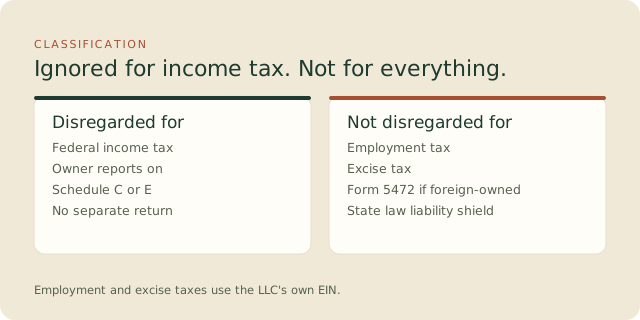
A disregarded entity is a single-member LLC the IRS ignores for federal income tax, so the owner reports its income on their own return. The LLC is not disregarded for employment tax, excise tax or Form 5472, and it needs its own EIN for any of those. Banks require one regardless of what the IRS allows.
Disregarded is a precise term doing a narrow job, and reading it broadly is how owners get into trouble. The IRS disregards a single-member LLC for income tax and for nothing else: the entity is fully visible for employment tax, for excise tax, for the foreign-ownership reporting rules, and for every purpose under state law. The classification itself is set out on what is a disregarded entity, and the election that moves away from it on form 8832 llc.
What is a disregarded entity?
A business entity with 1 owner that the IRS ignores as separate from that owner for federal income tax. The owner reports the LLC's income and deductions on their own return as though the LLC did not exist.
The default arises automatically from 26 CFR 301.7701-3 rather than from anything the owner files. A domestic LLC with a single member is disregarded unless it elects otherwise, so most single-member LLCs are disregarded entities without their owners ever using the phrase.
The practical effect is that no separate federal income tax return exists. A single-member LLC operating a business reports on Schedule C inside the owner's Form 1040. One holding rental property reports on Schedule E. The LLC files nothing of its own for income tax purposes.
Disregarded status is a federal income tax concept and does not touch state law. The LLC remains a separate legal person, its liability shield is unaffected, its contracts are its own, and its assets are not the owner's. Conflating the two is the most consequential misreading of the term.
Other entities can be disregarded too. A qualified subchapter S subsidiary and a single-owner grantor trust are both disregarded in the same sense. For LLC owners the single-member LLC is the case that matters, and it is the one every rule below addresses.
Does a disregarded entity need its own EIN?
For federal income tax, no: the owner's SSN suffices. An EIN becomes mandatory once the LLC has employees, owes excise tax, or is foreign-owned, and banks require one regardless.
The IRS position is narrow and often over-read. A disregarded entity with no employees and no excise tax liability may use the owner's SSN on income tax filings, because there is no separate return for it to appear on. That permission covers income tax and nothing beyond it.
Employment tax removes the choice immediately. A disregarded entity with employees is treated as a corporation for employment tax purposes under 26 CFR 301.7701-2(c)(2)(iv), files Form 941 and Form 940 in its own name, and needs its own EIN to do so. Hiring 1 person triggers this.
Excise tax works the same way. A disregarded entity liable for federal excise taxes is treated as separate for those purposes and files under its own number. Fuel, heavy vehicles, indoor tanning and certain manufacturing all fall inside this, and each requires the entity's own EIN.
Commercially the question rarely arises, because banks settle it. No US bank opens an LLC account against the owner's SSN, so the overwhelming majority of single-member LLCs obtain an EIN in week 1 for reasons that have nothing to do with what the IRS strictly requires.
Should a disregarded entity use the owner's SSN?
No, as a matter of practice. Both satisfy the IRS where no employees or excise tax exist, but the SSN route puts a personal identifier on vendor W-9s, platform accounts and payment processor records.
Every business relationship that asks for a taxpayer number is a place the number will be stored. Vendors requesting a W-9, marketplaces running tax interviews and payment processors verifying merchants all retain what they are given, and a personal SSN in those systems is exposure with no offsetting benefit.
Identity theft is the concrete risk rather than an abstract one. An SSN circulating through commercial systems is the single most useful piece of information for opening credit in someone's name, and a business owner has far more counterparties holding it than a private individual does.
There is a separation argument as well. Running a business under a personal tax number weakens the impression that the entity is genuinely separate, which is the impression the LLC exists to create. It is not decisive in a veil-piercing analysis, and it points the wrong way alongside commingled funds.
The cost of avoiding all of this is $0 and about 15 minutes. Given a free federal number available on demand, the case for putting a personal SSN into commercial circulation does not survive contact with the alternative.
How does employment tax work for a disregarded entity?
The LLC is treated as a corporation for employment tax and files in its own name under its own EIN. Form 941 quarterly and Form 940 annually are filed by the LLC, not by the owner.
The rule sits in 26 CFR 301.7701-2(c)(2)(iv) and reverses the default specifically for this purpose. An entity that is invisible for income tax becomes fully visible for employment tax, which is the clearest illustration that disregarded is a narrow term rather than a general one.
The practical consequence is 2 tax identities in 1 business. The LLC's profit lands on the owner's Schedule C under the owner's SSN, while its payroll runs under the LLC's EIN on Form 941 each quarter and Form 940 each year. Both are correct simultaneously.
The owner of a disregarded entity is not an employee of it. A single member does not take a W-2 salary from their own disregarded LLC; they take draws, and they pay self-employment tax at 15.3 percent on the business profit through Schedule SE. Putting the owner on payroll is a common and expensive error.
Electing S corporation treatment changes that specifically. After a Form 2553 election the owner does become an employee, takes a reasonable W-2 salary, and the entity is no longer disregarded at all. That is the mechanism behind the self-employment tax saving the election is chosen for.
What changes for a foreign-owned disregarded entity?
It must obtain an EIN and file Form 5472 with a pro-forma Form 1120 every year, even at $0 of revenue. The penalty for not filing is $25,000 per year under 26 U.S.C. 6038A.
Regulations finalised in 2017 treat a foreign-owned domestic disregarded entity as a corporation for reporting purposes under 26 CFR 301.7701-2(c)(2)(vi). The entity remains disregarded for income tax and becomes a filer for information reporting, which is why an EIN is mandatory rather than optional here.
The filing is a pro-forma Form 1120 carrying only identifying information, with Form 5472 attached reporting reportable transactions with related parties. Those transactions are defined broadly and include capital contributions and distributions, so an LLC that merely received its own funding has something to report.
The $25,000 penalty applies per form per year and is not proportionate to activity. A dormant foreign-owned single-member LLC with no bank account, no revenue and no customers is inside the requirement, and dormancy is the most common reason owners believe wrongly that they are outside it.
The obligation attaches from the first year the entity exists. Forming a US LLC and leaving it idle while plans develop creates an annual filing duty immediately, which is why the reporting position belongs in the decision to form rather than in a later review.
How does an LLC stop being a disregarded entity?
Three ways: admit a second member, which makes it a partnership; file Form 8832 to elect corporate treatment; or file Form 2553 to elect S corporation treatment.
Admitting a second member is the only route that requires a new EIN. Under Revenue Ruling 99-5 the LLC becomes a partnership from that tax year, applies for a new number, and files Form 1065 by March 15 with a Schedule K-1 to each member. The other 2 routes keep the existing EIN.
Form 8832 elects treatment as an association taxable as a corporation, moving the LLC to Form 1120 and a 21 percent entity-level rate. It carries a 60-month lock, so an LLC that elects and regrets it waits 5 years to change again absent a substantial ownership change.
Form 2553 elects S corporation treatment and is the route most profitable single-member LLCs take. The owner becomes an employee on a reasonable salary, and self-employment tax at 15.3 percent stops applying to the distribution portion of the profit. Payroll and a Form 1120-S by March 15 are the cost.
Reverting is possible and slow. An LLC returning to disregarded status revokes the S election by written statement, or files Form 8832 after the 60-month period, and in both cases waits 5 years before electing again without IRS consent. Modelling against 5 years rather than 1 is the sensible frame.
Do states follow the disregarded classification?
Most do for income tax, and many charge entity-level taxes regardless. California levies its $800 minimum franchise tax on a disregarded LLC, and New York charges an annual filing fee.
Federal disregarded status does not exempt an LLC from state entity-level charges, because those are levied on the entity's existence rather than on its federal classification. California's $800 minimum applies to a disregarded single-member LLC at $0 of revenue, in its first year and every year after.
New York charges an annual filing fee on Form IT-204-LL running from $25 to $4,500 based on New York-source gross income, and it reaches disregarded entities. Texas applies its franchise tax to LLCs above a revenue threshold irrespective of federal treatment.
Sales tax is entirely separate from any of this. A disregarded LLC selling taxable goods registers, collects and remits under its own EIN in every state where it has nexus, and its federal invisibility for income tax has no bearing on that obligation.
The pattern across all of these is consistent: federal income tax is the 1 place the entity disappears, and every other tax regime sees it. Assuming a state follows the federal treatment without checking is a reliable way to accrue a liability the owner did not know existed.
What do owners get wrong about disregarded entities?
Reading disregarded as meaning no liability protection, putting the owner on payroll, missing Form 5472 as a foreign owner, and assuming state taxes follow the federal treatment.
The liability misreading is the most serious. Disregarded is an income tax term and says nothing about state law, where the LLC remains a separate legal person with its own liability shield. Owners who conclude that the IRS sees no separation and therefore no separation exists have the analysis backwards.
Putting the owner on payroll is the most common operational error. A single member of a disregarded LLC is not an employee and takes draws rather than a W-2 salary, paying self-employment tax through Schedule SE. Payroll for the owner creates filings that have to be unwound.
Missing Form 5472 is the most expensive. A $25,000 annual penalty on a dormant company with no revenue is a punishing outcome, and it arises from exactly the reasoning that feels most sensible: nothing happened, so nothing needs filing.
The state assumption compounds quietly. An owner who forms in California expecting federal invisibility to carry across finds an $800 bill in year 1 and every year after, and by the time the position is reviewed there is more than 1 year outstanding plus penalties.
What is a disregarded entity disregarded for?
Federal income tax only. Employment tax, excise tax, foreign-ownership reporting and state law all treat the LLC as a separate entity with its own EIN.
| Purpose | Treated as separate? | Number used |
|---|---|---|
| Federal income tax | No | Owner's SSN or the LLC's EIN |
| Employment tax, Forms 941 and 940 | Yes | The LLC's own EIN |
| Federal excise tax | Yes | The LLC's own EIN |
| Form 5472, if foreign-owned | Yes | The LLC's own EIN |
| State liability shield | Yes | Not applicable |
| State franchise tax | Yes | The LLC's own EIN |
| Sales tax registration | Yes | The LLC's own EIN |
| Business bank account | Yes | The LLC's own EIN |
Source: 26 CFR 301.7701-2 and 301.7701-3 and IRS single-member LLC guidance, verified August 2026.
What else do owners ask about disregarded entities?
+Does a disregarded entity need an EIN?
Not for federal income tax, where the owner's SSN suffices. It becomes mandatory once the LLC has employees, owes excise tax, or is foreign-owned. Every US bank requires the 9-digit number to open an entity account, so nearly all single-member LLCs obtain one anyway.
+Does disregarded mean my LLC has no liability protection?
No. Disregarded is a federal income tax term and has no effect on state law, where the LLC remains a separate legal person with its own liability shield, its own contracts and its own assets. Conflating the 2 is the most consequential misreading of the word.
+Can I pay myself a salary from a disregarded entity?
No. A single member is not an employee of their own disregarded LLC and takes draws rather than a W-2 salary, paying self-employment tax at 15.3 percent through Schedule SE. Electing S corporation status on Form 2553 is what makes the owner an employee.
+Which return does a disregarded entity file?
None of its own for income tax. The owner reports business activity on Schedule C or rental activity on Schedule E inside Form 1040. The LLC does file Form 941 quarterly and Form 940 annually under its own EIN if it has employees.
+Does a foreign-owned disregarded entity file a US return?
Yes. It files Form 5472 attached to a pro-forma Form 1120 every year under regulations finalised in 2017, even at $0 of revenue. The penalty for not filing is $25,000 per year under 26 U.S.C. 6038A, and dormancy is not a defence.
+How does an LLC stop being a disregarded entity?
Three ways: admit a second member and become a partnership, file Form 8832 for corporate treatment, or file Form 2553 for S corporation treatment. Only the first requires a new EIN, under Revenue Ruling 99-5. The 2 elections keep the existing number.
+Does California tax a disregarded LLC?
Yes. The $800 minimum franchise tax applies to a single-member LLC at $0 of revenue, in its first year and every year after, because it is levied on the entity's existence rather than its federal classification. A gross receipts fee applies above $250,000 of California income.
+Is a single-member LLC always a disregarded entity?
By default, yes, under 26 CFR 301.7701-3, and no filing is needed to obtain that treatment. It stops being disregarded if it elects corporate treatment on Form 8832, elects S corporation status on Form 2553, or admits a second member and becomes a partnership.
+Can a disregarded entity have employees?
Yes, and it then files employment tax returns in its own name under its own EIN. Under 26 CFR 301.7701-2(c)(2)(iv) the LLC is treated as a corporation for employment tax, which is why hiring 1 person makes the EIN mandatory rather than optional.
+Is a husband and wife LLC a disregarded entity?
Only in the 9 community property states, where the couple may elect treatment as 1 disregarded entity or as 2 sole proprietorships under Revenue Procedure 2002-69. Elsewhere a 2-member LLC is a partnership filing Form 1065 by March 15, whatever the members' relationship.
This page states federal tax rules current as of August 2026. It is not legal or tax advice. Confirm your LLC’s position with a licensed CPA or attorney before filing.
Does your disregarded LLC hold its own number yet?
The IRS lets a disregarded entity report under the owner’s SSN, and every bank, payroll provider and marketplace asks for the LLC’s own EIN instead. We review your Articles, set lines 8a, 8b and 9a so the classification matches your actual structure, and file Form SS-4 for $97 within 7 business days, or that fee is refunded. The $127 Fast tier files within 24 hours with the IRS call included. Start with an EIN for your LLC, filed right the first time.
No SSN required · The EIN never renews, so year 2 and beyond is $0 · get your LLC’s EIN