Why Does the EIN Come Before 501(c)(3) Status?
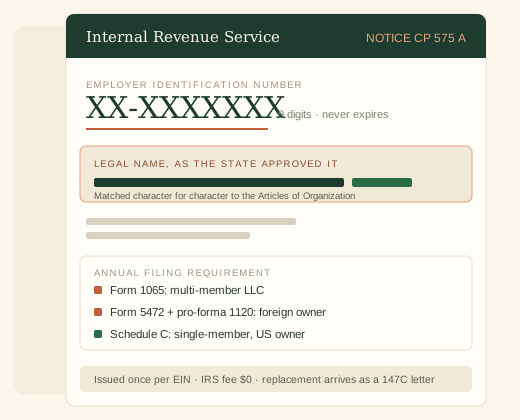
Form 1023 and Form 1023-EZ both open with a line for the EIN. An application without a 9-digit EIN is rejected on intake, so the nonprofit secures the number first, for $0.
| Order | Action | Federal cost | Output |
|---|---|---|---|
| Step 1 | Incorporate at the state | State fee | Articles of incorporation |
| Step 2 | Get the EIN on Form SS-4 | $0 | 9-digit EIN plus CP-575 |
| Step 3 | File Form 1023-EZ or Form 1023 | $275 or $600 | Application filed on Pay.gov |
| Step 4 | IRS reviews the application | $0 | Determination letter in 2 to 6 months |
Source: IRS Form 1023 and Form 1023-EZ instructions, verified August 2026.
The order is fixed: incorporate at the state, obtain the EIN for $0, then apply for 501(c)(3) recognition. The EIN issues in 15 minutes online, while the exemption review runs 2 to 6 months. The how-to for the number itself sits on EIN for a nonprofit and how to get an EIN.
The EIN sits on line 1a of Form 1023 and in the header of Form 1023-EZ, above the organization name and address. An examiner keys that 9-digit number to open the case, match prior filings, and issue the determination letter under the same identifier. The number never changes across the nonprofit's life, even after 501(c)(3) approval. After the letter arrives, the charity keeps the EIN on Form 990, on bank records, and on every donation receipt. See using your EIN and the IRS EIN number reference for where the number appears after formation.
No SSN. No passport upload.
What Is the Difference Between an EIN and 501(c)(3) Status?
An EIN identifies the organization; 501(c)(3) status exempts it from federal income tax. The 2 are separate documents from the IRS, confirmed by 2 different letters.
| Attribute | EIN | 501(c)(3) status |
|---|---|---|
| What it is | Federal tax ID number | Federal tax exemption |
| Form filed | SS-4 | 1023 or 1023-EZ |
| IRS fee | $0 | $275 or $600 |
| Confirmed by | CP-575 letter | Determination letter |
| Time to issue | 15 minutes online | 2 to 6 months |
| Statute | 26 U.S.C. section 6109 | 26 U.S.C. section 501(c)(3) |
| Effect | 9 digits, XX-XXXXXXX | Deduction under section 170 |
A nonprofit holds an EIN the moment the IRS assigns it, yet pays tax until the determination letter grants exemption under section 501(c)(3). Section 170 then makes donations tax-deductible. There are 29 subsections under section 501(c); 501(c)(3) covers charitable, religious, and educational organizations, while 501(c)(4), 501(c)(6), and 501(c)(7) cover other groups. The 9-digit EIN stays the same across all of them, as explained on what is an EIN.
The 2 documents arrive at different times. The IRS assigns the EIN in 15 minutes online and mails the CP-575 confirmation within 4 to 6 weeks. The 501(c)(3) determination letter follows 2 to 6 months after the exemption filing. A nonprofit with an EIN but no determination letter still owes federal income tax on net earnings, and its donors cannot deduct gifts yet. Only the determination letter unlocks the section 170 deduction and the public-charity status grant-makers require. Confirm the EIN on the CP-575 before filing, and read EIN for a nonprofit for the number's setup details.
Which 501(c)(3) Form Do You File, 1023 or 1023-EZ?
Form 1023-EZ costs $275 and is limited to organizations projecting $50,000 or less in annual gross receipts. Larger nonprofits file the full Form 1023 for a $600 fee.
| Feature | Form 1023-EZ | Form 1023 |
|---|---|---|
| IRS user fee | $275 | $600 |
| Gross receipts limit | $50,000 or less | No limit |
| Total assets limit | $250,000 or less | No limit |
| Length | 3 pages | Longer, plus schedules |
| Eligibility check | 30-question worksheet | Not required |
| Filing platform | Pay.gov | Pay.gov |
| Processing time | 2 to 4 weeks | 3 to 6 months |
| Introduced | 2014 | Long-standing |
Source: IRS user-fee schedule and Form 1023-EZ instructions, verified August 2026.
Form 1023-EZ runs 3 pages; Form 1023 adds narrative schedules. The $325 gap between the $275 and $600 fees reflects the depth of review. Form 1023-EZ also caps total assets at $250,000, and a 30-question eligibility worksheet confirms the fit. The IRS reduced the 1023-EZ fee from $400 to $275 in 2016 and launched the streamlined form in 2014. The EIN behind either form stays $0, covered on LLC EIN cost.
Choosing the wrong form wastes money and time. A charity that files Form 1023-EZ but exceeds the $50,000 gross-receipts ceiling or the $250,000 asset cap faces a later IRS challenge to its status. The 30-question eligibility worksheet screens for 26 disqualifying conditions before filing. Both forms demand the EIN, the state incorporation date, and the National Taxonomy of Exempt Entities code. The $275 and $600 fees are non-refundable once Pay.gov accepts payment, so the EIN and the eligibility check both come first. The 9-digit number itself stays $0, as shown on how to get an EIN.
How Long Does 501(c)(3) Approval Take?
Recognition runs 2 to 6 months. Form 1023-EZ clears in 2 to 4 weeks; the full Form 1023 takes 3 to 6 months. The EIN that precedes both issues in 15 minutes online.
| Stage | Time |
|---|---|
| Get the EIN online | 15 minutes |
| Fax Form SS-4 for the EIN | 4 to 7 business days |
| Form 1023-EZ review | 2 to 4 weeks |
| Form 1023 review | 3 to 6 months |
| Retroactive filing window | 27 months from formation |
| Auto-revocation trigger | 3 missed Form 990 filings |
Filing within 27 months of the end of the formation month makes exemption retroactive to the formation date. A nonprofit that later misses 3 consecutive Form 990 filings loses status automatically under section 6033. Confirm the EIN on the CP-575 before the 1023 goes out, using how to verify an EIN or EIN lookup.
Speed depends on the form and the EIN status, not on paying extra. The online EIN assistant returns the 9-digit number in 15 minutes, Monday through Friday, 7 a.m. to 10 p.m. Eastern. An applicant without an SSN faxes Form SS-4 and waits 4 to 7 business days. Form 1023-EZ then clears in 2 to 4 weeks, while the full Form 1023 runs 3 to 6 months. Missing the 27-month retroactive window pushes the exemption start date to the postmark, costing the charity months of deductible-donation coverage. After approval, put the EIN to work through using your EIN.
What Is a Determination Letter?
The determination letter is the IRS document that grants 501(c)(3) status. It states the organization is exempt under section 501(c)(3), and donations become tax-deductible once it issues.
| Annual return | When it is required |
|---|---|
| Form 990-N | Gross receipts $50,000 or less |
| Form 990-EZ | Receipts under $200,000 and assets under $500,000 |
| Form 990 | Receipts $200,000 or more, or assets $500,000 or more |
| Failure to file | 3 consecutive years revokes the status |
The determination letter lists the public charity classification under section 509(a), and grant-makers request it before releasing funds. Churches are treated as 501(c)(3) without filing Form 1023 under section 508(c)(1)(A), and organizations with gross receipts of $5,000 or less carry a similar exception. The letter is separate from the CP-575 that confirmed the EIN, and from the 147C letter used to re-verify a lost EIN.
The determination letter carries an effective date, the public-charity subsection under section 509(a), and the annual-return requirement. A charity keeps the letter permanently, since banks, grant portals, and state charity registrars all request a copy. Losing the EIN confirmation is recoverable: the IRS reissues it by phone on Form 147C, while the determination letter needs a written affirmation-letter request. Other entities file for their own EIN the same way a nonprofit does, including an EIN for a trust and an EIN for an estate, each on Form SS-4 for $0.
This page states federal tax rules current as of August 2026. It is not legal or tax advice. Confirm your organization's position with a licensed CPA or attorney before filing.