Table of contents
- Which form does an LLC file, 8832 or 2553?
- What does Form 8832 actually elect?
- What does Form 2553 actually elect?
- How does the tax outcome differ between the two?
- What are the filing deadlines for each form?
- Does an LLC ever file both forms?
- Does either election change the LLC's EIN?
- Can an LLC reverse either election later?
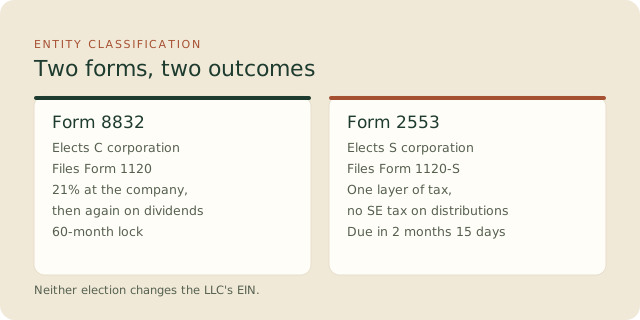
Form 8832 elects C corporation taxation. Form 2553 elects S corporation taxation. Most small LLCs changing tax status file Form 2553, because it keeps pass-through treatment and cuts self-employment tax on distributions. File Form 8832 only to be taxed as a C corporation. Neither election changes the LLC's EIN.
The two forms are confused more than any other pair in LLC taxation, and the confusion is expensive: filing 8832 when you meant 2553 hands your LLC double taxation and a 60-month lock. The distinction is simple once stated. Form 8832 is the Entity Classification Election, and it moves an LLC to corporate treatment. Form 2553 is the S Corporation Election, and it moves an LLC to S corporation treatment. Which default you are leaving is settled on llc tax classification, and the 11 lines of the first form are walked through on form 8832 llc.
Which form does an LLC file, 8832 or 2553?
An LLC files Form 2553 to be taxed as an S corporation and Form 8832 to be taxed as a C corporation. Form 2553 is the one most small LLCs want, because it keeps income passing through to the owners.
Start from what the LLC is leaving rather than what it is joining. A single-member LLC is a disregarded entity by default and a multi-member LLC is a partnership by default, and both of those defaults already pass income through to the owners without a second layer of tax. An election is worth filing only when it improves on that.
Form 2553 improves on it in exactly 1 way: it splits the owner's take into a reasonable salary and a distribution, and self-employment tax at 15.3 percent stops applying to the distribution half. That is the entire economic case, and it is why the overwhelming majority of LLC elections are 2553 elections rather than 8832 elections.
Form 8832 moves the LLC to C corporation treatment, where the company itself pays tax at 21 percent and the owner pays again on dividends. That double layer is a cost, not a benefit, for a company that distributes its profit. It earns its keep only where profit stays inside the business, or where an investor demands the structure.
One practical rule settles most cases. If the owners take the money out each year, Form 2553 is the election worth considering and Form 8832 is not. If the money stays in the company to fund growth, or a venture investor requires C corporation stock, Form 8832 becomes the live option. Everything below is detail on those 2 paths.
What does Form 8832 actually elect?
Form 8832 elects to have the LLC treated as an association taxable as a corporation. The LLC then files Form 1120 and pays corporate tax at 21 percent on its own profit before any money reaches the owners.
The form runs to 11 lines and the decision sits on line 6, which carries 6 boxes. A domestic LLC electing corporate treatment checks box 6a. Line 8 carries the effective date, and line 11 carries the signature that most rejected filings are missing.
After the election the LLC is a separate taxpayer. It files Form 1120 by April 15 for a calendar year, pays 21 percent on taxable income, and deducts owner salaries as a business expense. Money moved out beyond salary is a dividend, taxed again on the owner's personal return at 0, 15 or 20 percent depending on income.
That second layer is what the phrase double taxation describes, and it is not always a loss. A company retaining $200,000 to fund inventory or equipment pays 21 percent once and nothing further until it distributes. The same company as a partnership allocates the full $200,000 to its members, who owe personal tax on money they never received.
Form 8832 also carries a 60-month lock under 26 CFR 301.7701-3. An LLC that changes classification by election waits 5 years before changing again, with a narrow exception where more than 50 percent of ownership has changed. A formation-day election by a brand-new LLC does not start that clock.
What does Form 2553 actually elect?
Form 2553 elects S corporation treatment. The LLC files Form 1120-S, pays no entity-level tax, and passes income through to the owners, who take part of it as salary and part as a distribution.
An LLC filing Form 2553 does not become a corporation in state law. It stays an LLC with the same operating agreement, the same members and the same registered agent. Only its federal tax treatment moves, which is why the election is invisible on every state document the company holds.
The election has eligibility limits that Form 8832 does not. An S corporation carries no more than 100 shareholders, only 1 class of ownership interest, and no shareholder who is a non-resident alien. That last limit removes the option entirely for a foreign-owned LLC, which is the single most common reason a 2553 election is rejected.
The mechanics after election are where the saving appears. The owner becomes an employee, takes a reasonable salary through payroll with employment tax withheld, and takes the remaining profit as a distribution free of self-employment tax. On $120,000 of profit split as $70,000 salary and $50,000 distribution, the 15.3 percent that would have applied to that $50,000 does not.
The cost side is real and is what makes the election wrong below a certain profit. Payroll has to run, a Form 1120-S has to be filed by March 15, and the reasonable salary figure has to survive scrutiny. Most practitioners put the break-even somewhere above $40,000 of profit over a reasonable salary, below which the compliance cost exceeds the tax saved.
How does the tax outcome differ between the two?
Form 8832 produces 2 layers of tax: 21 percent at the company and again on dividends. Form 2553 produces 1 layer, at the owner's personal rate, with self-employment tax removed from the distribution portion.
Work an example at $150,000 of profit. Under the LLC default, the whole $150,000 passes to the owner and self-employment tax at 15.3 percent applies to the bulk of it, on top of ordinary income tax. Nothing is withheld at the entity, and the owner pays quarterly estimates.
Under a Form 2553 election, the owner sets a reasonable salary of, say, $80,000. Employment tax applies to that $80,000. The remaining $70,000 is a distribution, and the 15.3 percent does not touch it. Income tax still applies to the full $150,000, so the saving is the employment tax on the distribution, not on everything.
Under a Form 8832 election, the company pays 21 percent on what is left after the owner's salary, then the owner pays again on anything distributed as a dividend. Where all the profit comes out each year, the combined rate lands above the S corporation result for most owners, which is the arithmetic behind the general preference for 2553.
The comparison flips where profit is retained. A C corporation that keeps its earnings pays 21 percent and stops. A pass-through entity taxes its owners on allocated income whether or not a single dollar was distributed, which is the trap that catches partnerships reinvesting heavily. Retention, not size, is the variable that decides which form wins.
What are the filing deadlines for each form?
Form 8832 accepts an effective date up to 75 days before filing and up to 12 months after. Form 2553 is due within 2 months and 15 days of the start of the tax year the election takes effect.
The Form 8832 window is the more forgiving of the two. Line 8 accepts a retroactive date up to 75 days back, so an LLC that decides in March can make the election effective from January 1. It also accepts a date up to 12 months forward, which lets an LLC schedule a change at a clean year boundary.
The Form 2553 window is tighter and is counted from the start of the tax year, not from the date of the decision. For a calendar-year LLC electing from January 1, the form is due by March 15. Miss it and the election takes effect the following tax year instead.
Both forms have late-election relief, and both reliefs are used constantly. Revenue Procedure 2009-41 covers Form 8832 within 3 years and 75 days of the requested date. Revenue Procedure 2013-30 covers Form 2553 within 3 years and 75 days, provided the LLC has filed consistently with the intended treatment and has reasonable cause.
Relief is claimed on the form itself rather than by separate letter. For Form 2553 the reasonable cause statement goes in the space provided on the form; for Form 8832 the words FILED PURSUANT TO REV. PROC. 2009-41 are written across the top. Neither relief is automatic, and neither survives an LLC that filed returns inconsistent with the election it now claims.
Does an LLC ever file both forms?
An LLC electing S corporation status files only Form 2553. The IRS treats a valid 2553 as making the underlying corporate classification election, so a separate Form 8832 is unnecessary and creates a conflicting record.
This surprises people who reason that S corporation status requires first becoming a corporation and then electing S treatment. The logic is sound and the paperwork does not follow it. Under 26 CFR 301.7701-3(c)(1)(v)(C), an eligible entity that files a timely Form 2553 is deemed to have elected corporate classification, so the second form is folded into the first.
Filing both produces a mess worth avoiding. The 8832 lands as a C corporation election and the 2553 lands as an S election, and if the effective dates differ by even a day the IRS may process a short C corporation year followed by an S year, generating a Form 1120 obligation nobody expected.
There is 1 narrow case for filing both. An LLC that wants corporate classification effective on 1 date and S treatment from a later date files Form 8832 for the first change and Form 2553 for the second. That sequence is deliberate, rare, and worth confirming with a CPA before either form is signed.
The reverse direction also needs only 1 form. An S corporation LLC returning to its default classification revokes the S election by written statement to the IRS, and files Form 8832 only if it wants a classification other than the default that would otherwise apply. Most LLCs in that position simply revoke and land back where they started.
Does either election change the LLC's EIN?
Neither election changes the EIN. The LLC keeps the same 9-digit number it received on Form SS-4, because the entity continues to exist and only its federal tax treatment moves.
Both forms ask for the EIN in their identification block, which is itself the answer: the IRS is matching the election to a number the LLC already holds. An election filed against a blank EIN field is rejected, so the number has to exist before either form is signed.
The IRS publishes the point directly. Its Do You Need a New EIN? guidance lists a change in tax classification among the events that do not require a new number, alongside a name change and a move to another state. The events that do require one all end the entity: a single member becoming 2, 2 members becoming 1, or a conversion from a sole proprietorship.
The practical consequence is that nothing downstream needs updating. The LLC's bank account, its payroll registration, its state tax accounts and its vendor W-9s all continue against the same number. What changes is which annual return that number appears on: Form 1120 after an 8832 election, Form 1120-S after a 2553 election.
An LLC that does not yet hold an EIN completes Form SS-4 first. The IRS charges $0 on every channel, and the number arrives in about 15 minutes online for an owner with an SSN, or in 4 to 7 business days by fax for an owner without one. The election follows once the number exists.
Can an LLC reverse either election later?
Both are reversible, on different terms. A Form 8832 election locks the LLC out of another classification change for 60 months. An S election is revoked by written statement, with the same 60-month bar on re-electing.
The 60-month rule in 26 CFR 301.7701-3(c)(1)(iv) is the constraint that makes an 8832 election worth thinking about twice. An LLC that elects corporate treatment in 2026 and regrets it in 2027 waits until 2031 to change again unless it qualifies for the ownership-change exception, which requires more than 50 percent of interests to have moved to owners who held none on the election date.
Revoking an S election works differently and needs no form at all. The LLC files a written revocation statement with the service center where it files its returns, signed by shareholders holding more than 50 percent of the ownership interests. Filed by the 15th day of the third month, the revocation takes effect from the start of that tax year.
A revoked S election carries its own 5-year wait. Under IRC section 1362(g), a corporation that revokes S status waits 5 tax years to elect again without IRS consent. The consent route exists and is granted, but it is a request rather than a right, so the practical planning horizon for either election is 5 years.
The lesson both rules teach is the same. These elections are cheap to file, at $0 in IRS fees, and expensive to unwind. Model the arithmetic against 5 years of expected profit rather than 1, and confirm the reasonable salary figure with a CPA before the first payroll runs, because that number is what an examiner tests first.
How do Form 8832 and Form 2553 compare side by side?
Form 8832 elects C corporation treatment and 2 layers of tax. Form 2553 elects S corporation treatment, keeps 1 layer, and cuts self-employment tax on distributions.
| Feature | Form 8832 | Form 2553 |
|---|---|---|
| Elects | C corporation | S corporation |
| Annual return | Form 1120 | Form 1120-S |
| Tax layers | 2: 21% at company, then dividends | 1: at the owner's personal rate |
| Self-employment tax | Salary only; dividends exempt | Salary only; distributions exempt |
| Deadline | 75 days back, 12 months forward | 2 months 15 days from tax year start |
| Late relief | Rev. Proc. 2009-41 | Rev. Proc. 2013-30 |
| Foreign owners allowed | Yes | No: bars non-resident aliens |
| New EIN needed | No | No |
| Lock-in | 60 months | 5 years after revoking |
| Best for | Profit retained in the business | Profit distributed to owners |
Source: IRS instructions for Forms 8832 and 2553 and 26 CFR 301.7701-3, verified August 2026. Rates shown are 2026 federal figures.
What else do LLC owners ask about Form 8832 and Form 2553?
+Is Form 8832 or Form 2553 better for a small LLC?
Form 2553 suits most small LLCs, because it keeps 1 layer of tax and removes self-employment tax of 15.3 percent from the distribution portion of profit. Form 8832 adds a second layer at 21 percent and earns its keep only where profit stays in the business rather than being distributed each year.
+Do I file both Form 8832 and Form 2553?
No. A timely Form 2553 is deemed to make the corporate classification election under 26 CFR 301.7701-3, so 1 form does both jobs. Filing both risks the IRS processing a short C corporation year before the S year begins, which creates an unexpected Form 1120 obligation for that period.
+Can a foreign-owned LLC file Form 2553?
No. An S corporation cannot have a non-resident alien as a shareholder, so a foreign-owned LLC is ineligible. That LLC files Form 8832 if it wants corporate treatment. A foreign-owned single-member LLC also files Form 5472 each year, carrying a $25,000 penalty for a missed filing.
+What is the deadline for Form 2553?
2 months and 15 days from the start of the tax year the election takes effect, so March 15 for a calendar-year LLC electing from January 1. Revenue Procedure 2013-30 grants relief within 3 years and 75 days where the LLC has reasonable cause and filed consistently with the intended treatment.
+Does Form 8832 or Form 2553 require a new EIN?
Neither. The LLC keeps the 9-digit EIN issued on Form SS-4, because the entity survives and only its tax treatment changes. IRS guidance lists a classification change among the events that do not require a new number, alongside a name change and a move between states.
+How much does it cost to file Form 8832 or Form 2553?
The IRS charges $0 for both forms. Neither can be e-filed as a standalone election, so both go by mail to the service center for the LLC's state. The real cost of a 2553 election is ongoing payroll, which is why the election rarely pays below roughly $40,000 of profit above a reasonable salary.
+What is the 60-month rule on Form 8832?
An LLC that changes classification by election waits 60 months before changing again under 26 CFR 301.7701-3(c)(1)(iv). An exception applies where more than 50 percent of ownership has moved to people who held no interest on the election date. A formation-day election by a new LLC does not start the clock.
+Can an LLC revoke an S corporation election?
Yes, by written statement to the service center, signed by owners holding more than 50 percent of interests. Filed by the 15th day of the third month, it takes effect from the start of that tax year. Under IRC section 1362(g) the LLC then waits 5 years to re-elect without IRS consent.
+Does an S corporation election change how the LLC operates?
No. The LLC keeps its operating agreement, its members and its registered agent, and remains an LLC under state law. Only the federal tax treatment moves. What changes in practice is that the owner runs payroll, takes a reasonable salary, and the LLC files Form 1120-S by March 15.
+Which form does a multi-member LLC file to become an S corporation?
Form 2553, signed by every member. A multi-member LLC is a partnership by default filing Form 1065, and the election moves it to Form 1120-S. All owners must consent, and the LLC must satisfy the S corporation limits: no more than 100 owners and only 1 class of ownership interest.
This page states federal tax rules current as of August 2026. It is not legal or tax advice. Confirm your LLC’s position with a licensed CPA or attorney before filing.
Does your LLC hold an EIN before it elects?
Both forms ask for the EIN in their identification block, and an election filed against a blank field is rejected. We review your Articles, set lines 8a, 8b and 9a on Form SS-4 to your actual structure, and file for $97, faxed within 7 business days, or that fee is refunded. The $127 Fast tier files within 24 hours with the IRS call included. Start with an EIN for your LLC, filed right before the election deadline runs.
No SSN required · The EIN never renews, so year 2 and beyond is $0 · get your LLC’s EIN