Table of contents
- What test does the IRS apply?
- What happens when a single-member LLC adds a member?
- What happens when a multi-member LLC drops to one?
- Do members joining or leaving always change the EIN?
- What about a member's death or divorce?
- Which changes never require a new EIN?
- How do you get the new EIN and close the old one?
- What has to be updated after the EIN changes?
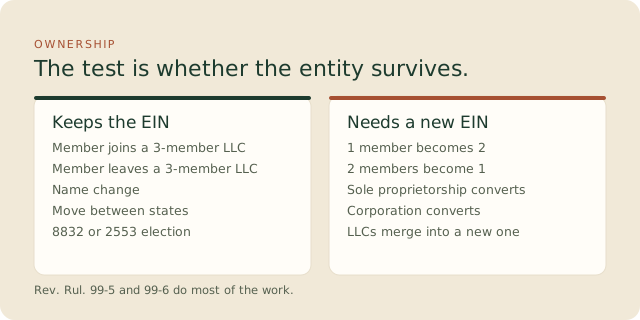
A single-member LLC that admits a second member needs a new EIN, and a multi-member LLC that drops to 1 member needs a new EIN. Adding or removing members while the LLC stays multi-member keeps the existing number. The test is whether the same entity survives for federal tax purposes, set by Revenue Rulings 99-5 and 99-6.
Ownership changes are where the EIN rules stop being intuitive. Selling an entire single-member LLC to a new owner keeps the number, while selling half of it forces a new one, and most owners guess those the wrong way round. The reason is that the IRS is asking about tax classification rather than about who holds the equity. The 5 triggers are listed on new ein for llc, and the classification each one produces on llc tax classification.
What test does the IRS apply?
Whether the same entity continues to exist for federal tax purposes. If the change ends 1 classification and starts another, a new EIN is required. If the entity survives, the number survives with it.
The test has nothing to do with how much of the company changed hands. Selling 100 percent of a multi-member LLC to entirely new owners keeps the EIN, because the entity remains a partnership throughout. Selling 1 percent of a single-member LLC forces a new number, because a disregarded entity has become a partnership.
That is why member count rather than ownership percentage is the variable to watch. The federal classification of an LLC is set by how many members it has, so the events that change the count across the boundary between 1 and 2 are the events that change the classification.
Two revenue rulings do most of the work for LLCs. Revenue Ruling 99-5 covers a single-member LLC taking on a second member, and Revenue Ruling 99-6 covers a multi-member LLC dropping to 1. Between them they settle the majority of real ownership changes.
Everything else about an ownership change is state and contract work rather than federal tax identity. Amending the operating agreement, updating the state register where required, and re-papering bank signatories all follow the transaction, and none of them turns on whether the EIN changed.
What happens when a single-member LLC adds a member?
The LLC becomes a partnership for federal tax purposes and needs a new EIN. It also starts filing Form 1065 by March 15 and issuing a Schedule K-1 to each member from that tax year.
Revenue Ruling 99-5 sets out 2 routes to the same destination. In the first, the new member buys part of the existing member's interest, treated as a purchase of an undivided interest in the assets followed by a contribution of those assets to a new partnership. In the second, the new member contributes cash to the LLC itself.
The tax consequences of the 2 routes differ even though the EIN outcome is the same. A purchase from the existing member is a taxable sale to that member, with gain measured against basis in the assets sold. A contribution to the LLC is not a taxable event for either party in the ordinary case.
The filing change is immediate and often missed. From the tax year the second member joins, the LLC files Form 1065 rather than reporting on the owner's Schedule C, and the return is due March 15 rather than April 15. A partnership that files late accrues a penalty per partner per month.
The old EIN does not disappear on its own. The single-member LLC's number remains associated with the prior classification, and the IRS expects the position to be closed out properly rather than left open. Notifying the service center in writing when the new number is obtained avoids notices against the old one.
What happens when a multi-member LLC drops to one?
The partnership terminates and the LLC becomes a disregarded entity, which requires a new EIN. Revenue Ruling 99-6 treats the departing members as selling their interests and the buyer as acquiring assets.
This is the buyout case, and it catches owners who reason that buying out a partner leaves the company unchanged. For federal tax purposes it does not: a partnership existed before the transaction and does not exist after it, and a partnership that terminates is treated as ending.
Revenue Ruling 99-6 sets asymmetric treatment for the 2 sides. The departing members are treated as selling partnership interests, with capital gain or loss measured against their outside basis. The remaining member is treated as buying the underlying assets directly, which resets basis in those assets.
That asset treatment is valuable and routinely overlooked. The continuing member takes a cost basis in the assets acquired, which restarts depreciation on equipment or property at the purchase price rather than continuing the partnership's schedule. On an asset-heavy business the difference is substantial.
The partnership files a final Form 1065 for the short year ending on the date of the buyout, marked as a final return, with final K-1s to every member including the one who stayed. The continuing single-member LLC then reports on Schedule C under its new EIN from that date forward.
Do members joining or leaving always change the EIN?
No. A multi-member LLC that adds or removes members while remaining multi-member keeps its EIN, because it is a partnership before and after. Only crossing the boundary between 1 member and 2 matters.
A 4-member LLC that admits a fifth stays a partnership and keeps its number. The same LLC losing a member and continuing with 3 also stays a partnership and keeps its number. Nothing about the count matters except whether it crosses between 1 and 2.
Even a complete change of ownership is neutral where the count holds. Three members selling their entire interests to 3 new buyers leaves a 3-member LLC that is still a partnership, with the same EIN and an uninterrupted filing history, though the transaction itself is fully taxable to the sellers.
The technical termination rule that once complicated this was repealed. Before 2018, a partnership terminated if 50 percent or more of capital and profits interests changed hands within 12 months, forcing a short-year return. The Tax Cuts and Jobs Act removed it, so a change in ownership no longer terminates a continuing partnership.
What does change is the internal accounting. New members receive capital accounts, allocations shift, and the operating agreement needs amending to reflect the new percentages. The K-1s for the year of the change allocate income between the pre-change and post-change periods.
What about a member's death or divorce?
The same count test applies. A 3-member LLC losing a member to death stays a partnership and keeps its EIN. A 2-member LLC becoming single-member through death or divorce needs a new one.
Death transfers the membership interest under the operating agreement and state law, frequently to an estate or a trust rather than to the surviving members. Where the estate becomes the member, the count is unchanged and so is the EIN, even though the identity of the holder has changed entirely.
Where the operating agreement requires the LLC or the surviving members to buy out the deceased member's interest, the count can fall. A 2-member LLC that buys out a deceased member becomes single-member, which is a Revenue Ruling 99-6 termination requiring a new EIN.
Divorce raises the same question and adds a valuation problem. A decree transferring a spouse's interest to the other spouse in a 2-member LLC leaves 1 member and requires a new number. A decree transferring the interest to a third party leaves the count at 2 and does not.
Both events are worth planning for before they happen. An operating agreement that specifies what occurs on death or divorce, how the interest is valued and who may acquire it, converts a contested and expensive process into a mechanical one, and it decides the EIN outcome in advance.
Which changes never require a new EIN?
A name change, a move to another state, a change of registered agent, a new business address, and a Form 8832 or Form 2553 election. All keep the entity intact.
Renaming an LLC changes the string the IRS matches returns against and not the entity behind it. The company notifies the IRS in writing or on its next return, and the number stays. Failing to notify leaves the old name in IRS records, which surfaces later as a rejected return or a bank verification failure.
Moving to another state is neutral federally, whatever the state paperwork involves. Domesticating an LLC from Delaware to Texas, or dissolving in 1 state and registering in another with continuity, keeps the entity and its number. The state filings are substantial and the federal identity does not move.
Tax classification elections keep the number by design. Both forms ask for the existing EIN in their identification block, which is the clearest possible signal that the IRS is attaching the election to a number the LLC already holds rather than issuing a new one.
Adding a DBA or trade name is also neutral. A DBA is a name the LLC operates under, registered with a state or county, and it belongs to the same entity with the same EIN. Banks frequently ask for the DBA registration alongside the EIN letter when opening an account under the trade name.
How do you get the new EIN and close the old one?
Apply on Form SS-4 as a new entity, then notify the service center in writing that the prior classification has ended so the old number is not left expecting returns.
The application is an ordinary Form SS-4 with the new member count on line 8b and the resulting classification on line 9a. Line 10 carries a checkbox for a change in type of organization, which is the box that describes this situation accurately.
Closing the old position matters because an EIN with an open filing requirement generates notices. The IRS does not cancel EINs, and a number once issued is never reassigned, but the account associated with it is closed to future filings on written request to the service center.
That letter states the legal name, the old EIN, the business address and the reason the account should be closed, and it accompanies rather than replaces any final return. A partnership that terminated files a final Form 1065 marked final; a disregarded entity that became a partnership stops reporting on Schedule C.
The practical sequence is short: complete the transaction, obtain the new EIN, file the final return for the old classification, notify the service center, then update the bank, payroll and state registrations to the new number. Doing the bank step first is what leaves accounts frozen mid-transition.
What has to be updated after the EIN changes?
The bank account, payroll registrations, state tax accounts, vendor W-9s and any licences keyed to the number. A new EIN is a new tax identity everywhere the old one appeared.
Banks treat a new EIN as a new entity relationship rather than an update to an existing one, so the account is reopened rather than amended. That requires the new EIN confirmation letter, the amended operating agreement and identification for the current owners, and it takes long enough to be worth starting early.
Payroll is the most time-sensitive item where the LLC has employees. Federal deposits and quarterly Form 941 filings key to the EIN, and a mid-quarter change means filings under both numbers for the year. Payroll providers handle this routinely and need notice before the next run rather than after it.
State registrations follow their own rules. Sales tax permits, employer accounts and professional licences are frequently tied to the federal number, and each agency has its own process for updating it. None of them learn about the change from the IRS.
Vendors and customers holding a W-9 need a fresh one. A payer issuing a Form 1099 against a superseded EIN creates a mismatch the recipient has to reconcile, and sending updated W-9s at the point of change is far cheaper than explaining the discrepancy the following February.
Which ownership changes need a new EIN?
Crossing between 1 member and 2 changes the federal classification and requires a new number. Everything that leaves the classification intact keeps the existing one.
| Scenario | New EIN? | Authority |
|---|---|---|
| Single-member sells the whole LLC to 1 buyer | No | Still a disregarded entity |
| Single-member sells part to a new member | Yes | Rev. Rul. 99-5 |
| Single-member converts to multi-member | Yes | Rev. Rul. 99-5 |
| Multi-member adds a member | No | Still a partnership |
| Multi-member removes a member, 2+ remain | No | Still a partnership |
| Multi-member converts to single-member | Yes | Rev. Rul. 99-6 |
| All members sell to new owners, count held | No | Still a partnership |
| LLC name change | No | Entity survives |
| LLC moves to another state | No | Entity survives |
| Form 8832 or 2553 election | No | Classification change only |
Source: IRS Do You Need a New EIN? guidance and Revenue Rulings 99-5 and 99-6, verified August 2026.
What else do owners ask about changing LLC ownership?
+Do I need a new EIN if I sell my LLC?
It depends on the member count afterwards. Selling a single-member LLC entirely to 1 buyer keeps the EIN, because it stays a disregarded entity. Selling part of it creates a 2-member partnership and requires a new number under Revenue Ruling 99-5.
+Does adding a member to my LLC require a new EIN?
Only if the LLC had 1 member before. Going from 1 to 2 converts a disregarded entity into a partnership and requires a new number. A 4-member LLC admitting a fifth stays a partnership and keeps the EIN it already holds.
+Does removing a member require a new EIN?
Only if it leaves exactly 1 member. A 3-member LLC dropping to 2 stays a partnership and keeps its number. A 2-member LLC dropping to 1 terminates the partnership under Revenue Ruling 99-6 and requires a new EIN plus a final Form 1065.
+What is Revenue Ruling 99-5?
The IRS ruling covering a single-member LLC that takes on a second member. It treats the change as creating a partnership, whether the new member buys part of the existing interest or contributes cash to the LLC. A new EIN and a Form 1065 obligation follow from that tax year.
+What is Revenue Ruling 99-6?
The ruling covering a multi-member LLC that drops to 1 member. The departing members are treated as selling partnership interests for capital gain, and the continuing member is treated as buying the assets directly, which resets basis and restarts depreciation at the purchase price.
+Does a change in ownership percentages need a new EIN?
No, as long as the member count stays above 1. Members shifting from a 50-50 split to 70-30 keeps the partnership and the EIN. The technical termination rule that once forced a short year on a 50 percent change was repealed by the Tax Cuts and Jobs Act for years after 2017.
+What happens to the EIN when a member dies?
If the estate or a trust becomes the member, the count is unchanged and so is the EIN. If the operating agreement requires a buyout that leaves 1 member, the partnership terminates under Revenue Ruling 99-6 and a new number is required along with a final Form 1065.
+Can I cancel my old EIN?
The IRS never cancels an EIN or reassigns it to another entity, but it will close the account so the number stops expecting returns. Send a written request to the service center stating the legal name, the 9-digit EIN, the address and the reason, alongside any final return.
+Does my LLC need a new EIN after a divorce?
Only if the count falls to 1. A decree transferring a spouse's interest to the other spouse in a 2-member LLC leaves a single member and requires a new number. A transfer to a third party leaves 2 members and keeps the existing EIN.
+What has to be updated when the EIN changes?
The bank account, which banks reopen rather than amend, payroll registrations and Form 941 filings, state sales tax and employer accounts, professional licences, and every vendor W-9. No agency learns about the change from the IRS, so each update is made separately.
This page states federal tax rules current as of August 2026. It is not legal or tax advice. Confirm your LLC’s position with a licensed CPA or attorney before filing.
Does the change leave your LLC needing a new number?
Crossing between 1 member and 2 in either direction ends 1 federal tax entity and starts another, and the new one applies on its own Form SS-4. We read the transaction, set line 8b and line 9a to the structure on the far side of it, and file for $97 within 7 business days, or that fee is refunded. The $127 Fast tier files within 24 hours when a closing is already booked. Start with an EIN for your LLC, filed right the first time.
No SSN required · The EIN never renews, so year 2 and beyond is $0 · get your LLC’s EIN