What Is an SSN?
An SSN is the 9-digit Social Security Number the Social Security Administration issues to a person, grouped 3-2-4 as XXX-XX-XXXX, for example 123-45-6789. A person keeps 1 SSN for life.
The SSA has issued the SSN since 1936, the year after the Social Security Act of 1935. Since 2011 the SSA assigns the 9 digits at random, so the first 3 no longer map to a state. An SSN appears on Form 1040, on a W-2, and on a W-9 when an individual has no separate business number. Because it unlocks credit and benefits, the SSN is the 1 identifier a person guards most, which is the whole case for putting an EIN in its place on business paperwork.
An SSN follows a person across every job and every state, so 1 individual holds exactly 1 SSN across a lifetime. It is the number the SSA uses to track the 40 work credits a worker earns toward retirement, and the number an employer reports on each W-2. When a sole proprietor has no separate business ID, that same SSN doubles as the business tax number on a W-9 and on a Schedule C attached to Form 1040. That overlap is the exact problem an EIN solves: it gives the business its own 9-digit ID so the personal number never travels to clients or vendors. The way the business number takes over day-to-day filing is covered on using your EIN, and the umbrella that holds both IDs is explained on TIN vs EIN.
What Is an EIN?
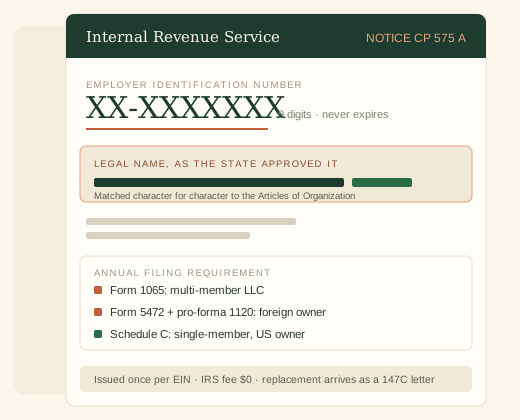
An EIN is the 9-digit Employer Identification Number the IRS issues to a business, grouped 2-7 as XX-XXXXXXX, for example 12-3456789. The IRS charges $0 and issues it under 26 U.S.C. section 6109.
An EIN does for a business what an SSN does for a person: it is the single number the IRS, banks, and payroll systems use to track the entity. The IRS assigns it on Form SS-4 and confirms it on the CP-575 letter. An applicant with an SSN gets one free online in about 15 minutes; the fax route takes 4 to 7 business days and the mail route takes 6 to 11 weeks. The EIN never expires and is never reissued to another company. Its label as a FEIN means the same 9-digit number.
An EIN carries the business through 4 core jobs an SSN cannot cover on its own. It opens a business bank account, because every US bank asks for the EIN before it will hold funds under the company name. It runs payroll, since the IRS ties every federal tax deposit for even 1 employee to the EIN. It files the entity return, whether that is Form 1065 for a partnership or Form 1120 for a corporation. And it goes on each 1099 the business issues to a contractor paid $600 or more in a year. An LLC in particular relies on the EIN from day 1, and the full filing path for that structure sits on how to get an EIN for an LLC. The distinction between the EIN and the state-level label is set out on EIN vs FEIN.
Can You Use an SSN Instead of an EIN?
Yes, in 1 case. A sole proprietor with no employees files business income on Schedule C of Form 1040 under an SSN, so no EIN is required for taxes. Every other structure needs an EIN.
| Situation | SSN alone? | Why |
|---|---|---|
| Sole proprietor, no employees | Allowed | Reports on Schedule C of Form 1040 |
| Sole proprietor opening a bank account | No | Banks ask for an EIN first |
| Any business with 1 or more employees | No | Payroll tax filing needs an EIN |
| Single-member LLC | Allowed for tax, no for banking | Bank requires the EIN |
| Partnership or multi-member LLC | No | Files Form 1065 under an EIN |
| C corporation or S corporation | No | Files Form 1120 or 1120-S |
Source: IRS, Do You Need an EIN, and Schedule C instructions, verified August 2026.
The sole proprietor case is the 1 place an SSN is enough for federal tax, and the full walk-through sits on EIN for a sole proprietor. Even there, an EIN costs $0 and removes the 9-digit SSN from client-facing forms. The way an EIN sits inside the broader tax-ID family is covered on taxpayer ID vs EIN.
The SSN-only allowance ends the moment 1 of 3 things happens: the owner hires an employee, forms a partnership or corporation, or opens a business bank account. Each of those steps forces an EIN, and the IRS still charges $0 to issue it. A single-member LLC sits in a middle spot, since it reports on Schedule C like a sole proprietor yet needs the EIN for banking and for any 1099-NEC it files. An owner who cannot get an SSN uses an ITIN for the personal side while the business runs on its EIN, and that pairing is laid out on ITIN vs EIN.
No SSN. No passport upload.
Why Get an EIN If You Have an SSN?
An EIN protects privacy, unlocks business banking, and is required to hire. It keeps the 9-digit SSN off every W-9 and invoice, and the IRS charges $0 for it.
There are 3 reasons that carry the decision. Privacy: a business that pays a contractor $600 or more in 1 year collects a W-9, and an EIN on that form keeps the owner's SSN out of a stranger's files. Banking: every US bank asks for an EIN before opening 1 business account. Hiring: running payroll for even 1 employee requires an EIN for tax deposits. The 3 benefits cost nothing, since an EIN is $0 for an applicant who holds an SSN. How an EIN differs from the umbrella tax-ID term is on TIN vs EIN and is an EIN the same as a TIN.
Identity protection is the reason that lands hardest for a 1-person business. A contractor who files a W-9 with an SSN hands that 9-digit number to every client, and each client stores it in a payables system the contractor never sees. Swapping in an EIN removes the SSN from that chain entirely, so a data breach at a client exposes only the business number. The EIN also builds a separate credit file for the company, keeps personal and business tax records apart, and lets the owner delegate bookkeeping without sharing an SSN. Once the number is in hand, the everyday tasks it unlocks are collected on using your EIN, and the fastest path to obtaining 1 is on how to get an EIN.
EIN vs SSN: Which Number Goes Where?
An SSN and an EIN differ on 6 points: who they identify, who issues them, their format, their cost, where they appear, and how many a holder gets. Both hold the same 9 digits.
| Point | SSN | EIN |
|---|---|---|
| Identifies | A person | A business or entity |
| Issued by | Social Security Administration | IRS |
| Format | XXX-XX-XXXX (3-2-4) | XX-XXXXXXX (2-7) |
| Digits | 9 | 9 |
| Cost | $0 at birth or naturalization | $0 from the IRS |
| Appears on | Form 1040, W-2 | Form 1065, 1120, 1099, W-9 |
| How many you get | 1 for life | 1 per entity |
| Is it a TIN? | Yes | Yes |
Source: IRS and SSA, and 26 U.S.C. section 6109, verified August 2026.
The 1 number that trips people up is the ITIN, a third 9-digit ID for individuals who cannot get an SSN. Its side-by-side with the business number is on ITIN vs EIN, and the federal-vs-state label question is on EIN vs FEIN. To register the business number itself, start at einforllc.co.
Reading the 8 rows in order gives a fast rule of thumb: if a form asks who a person is, it wants the SSN in the 3-2-4 shape XXX-XX-XXXX; if it asks which company is filing, it wants the EIN in the 2-7 shape XX-XXXXXXX. The IRS confirms the EIN once on the CP-575 notice, and that 1 letter is the document a bank accepts as proof. Both numbers hold exactly 9 digits, so the hyphen positions are the only visual tell. The base definition of the business number sits on what is an EIN, and the LLC-specific filing steps are on how to get an EIN for an LLC.
This page states federal tax rules current as of August 2026. It is not legal or tax advice. Confirm your business's position with a licensed CPA or attorney before filing.