Table of contents
- Does a husband and wife LLC need its own EIN?
- How does the IRS classify a husband and wife LLC?
- Can a husband and wife LLC elect a qualified joint venture?
- Which states let a husband and wife LLC be a disregarded entity?
- What does a husband and wife LLC put on Form SS-4?
- What does a husband and wife LLC file each year?
- Does the classification change a spouse's Social Security credits?
- What happens to the EIN when one spouse leaves the LLC?
- How does this work for a married couple living outside the US?
- Partnership vs disregarded entity
- The 9 community property states
- What an LLC's EIN costs
- Who should pay anyone for an EIN?
- Frequently asked questions
A husband and wife LLC needs one EIN, and the 9-digit number covers the whole entity no matter which spouse applies. Two members means the IRS treats the LLC as a partnership by default, so it files Form 1065 by March 15 and issues 2 Schedule K-1s. In the 9 community property states, Rev. Proc. 2002-69 lets the same LLC be treated as a disregarded entity instead. The choice changes the annual return, the Social Security credits each spouse earns, and nothing at all about the EIN.
Married couples arrive at the EIN application expecting the easiest version of the form and meet the hardest question on it: how many members does the LLC have. Two people who share a bank account, a tax return, and a surname are still 2 members, and that one number on line 8b decides which return the LLC files for the rest of its life. This page teaches that mechanism end to end, including the community property exception almost nobody applies correctly and the qualified joint venture election an LLC cannot use. If your LLC has 1 member rather than 2, start with ein for single member llc instead.
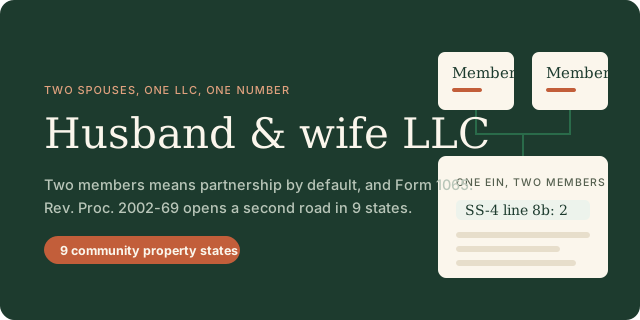
A husband and wife LLC takes 1 EIN, not 2. Form SS-4 line 8b carries the member count, and 2 spouses are 2 members. In the 9 community property states — Arizona, California, Idaho, Louisiana, Nevada, New Mexico, Texas, Washington and Wisconsin — Rev. Proc. 2002-69 lets a couple who own the LLC entirely between them treat it as a disregarded entity and skip Form 1065. In the other 41 states the LLC is a partnership: it files Form 1065 by March 15 and issues a Schedule K-1 to each spouse. The 9-digit EIN is the same number on both roads, and the qualified joint venture election under section 761(f) is closed to a state-law LLC.
Does a husband and wife LLC need its own EIN?
Yes. A husband and wife LLC EIN is one 9-digit number issued to the LLC itself, not to either spouse. The IRS assigns it through Form SS-4, and the LLC uses that single number permanently.
The number attaches to the entity. An LLC is a legal person separate from the 2 people who own it, so the EIN identifies the company on every bank form, every return, and every information filing, regardless of whose name sits first on the Articles of Organization.
Two members produce a partnership by default, and a partnership return requires an EIN. That alone settles the question for the majority of married-couple LLCs: the annual Form 1065 carries an EIN field in box D of the header block, and there is no version of the return that works without it.
The requirement survives a change of classification. An LLC that starts as a partnership and later reports as a disregarded entity keeps the same EIN. An LLC that later elects corporate treatment on Form 8832 keeps it too. One entity, one number, for the life of the company.
Banks add their own layer on top of the tax rule. A business account in the LLC's name is opened against the LLC's EIN and the IRS CP-575 letter, not against either spouse's personal identification number, which is why couples who assumed a joint SSN would do the job restart the process at the counter.
How does the IRS classify a husband and wife LLC?
As a partnership by default, because the LLC has 2 members. The married couple counts as 2 owners for federal tax purposes, so the LLC files Form 1065 and issues a Schedule K-1 to each spouse every year.
Marriage does not merge 2 members into 1 under the default rules. Treasury Regulation 301.7701-3 sets classification by member count: 1 member produces a disregarded entity, and 2 or more members produce a partnership. A married couple who each hold a membership interest are 2 members under that test.
The default is automatic. Nobody files anything to become a partnership, and no operating agreement is required to trigger it. The LLC is a partnership for federal tax purposes from the moment the second member exists, and the first Form 1065 is due for that tax year.
The single exception runs through community property law, and it is the whole reason this page exists. Rev. Proc. 2002-69 lets a qualifying married couple in a community property jurisdiction report their wholly owned LLC as a disregarded entity, which is a different road from the qualified joint venture election most articles point at.
Corporate treatment is a third road, open to any husband and wife LLC in any state. Form 8832 moves the LLC to Form 1120, and Form 2553 moves it to Form 1120-S with a filing window of 2 months and 15 days after the tax year opens. Neither election changes the EIN.
Can a husband and wife LLC elect a qualified joint venture?
No. The section 761(f) qualified joint venture election is limited to unincorporated businesses that are not held in the name of a state law entity. An LLC is a state law entity, so an LLC cannot make the election.
This is the single most misread rule in the married-couple business world. Internal Revenue Code section 761(f), added by the Small Business and Work Opportunity Tax Act of 2007 and effective for tax years beginning after December 31, 2006, lets spouses who jointly run an unincorporated business skip the partnership return. Each spouse files a Schedule C and a Schedule SE, splitting income and deductions by their interests.
The statute's own words close the door on LLCs. Section 761(f) applies to a joint venture that is not held in the name of a state law entity, and an LLC exists only because a state filed its Articles of Organization. A general partnership of 2 spouses with no state filing qualifies. The same couple's LLC does not.
The 4 qualified joint venture conditions are worth knowing anyway, because a couple who has not yet formed an LLC still has the choice: the only members are the 2 spouses, both materially participate in the business, both elect the treatment, and they file a joint Form 1040 for the year.
Where the confusion becomes expensive: a couple reads about the qualified joint venture, forms an LLC, files 2 Schedule Cs, and never files Form 1065. The partnership return was due March 15, and the late-filing penalty under Internal Revenue Code section 6698 accrues per partner, per month, for up to 12 months. Two members double the monthly figure.
Which states let a husband and wife LLC be a disregarded entity?
The 9 community property states: Arizona, California, Idaho, Louisiana, Nevada, New Mexico, Texas, Washington, and Wisconsin. Rev. Proc. 2002-69 lets a married couple's wholly owned LLC in those states report as a disregarded entity instead of a partnership.
Rev. Proc. 2002-69 is narrow and precise. It covers a business entity that is wholly owned by a husband and wife as community property under the laws of a state, a foreign country, or a US possession, where no person other than the spouses is an owner, and the entity is not treated as a corporation. Meet all 3 conditions and the IRS accepts either reporting position.
It has applied since tax years beginning after December 31, 2001, so this is settled ground rather than a new option. Puerto Rico, a US possession with a community property regime, falls inside the same language, which matters for couples running a mainland LLC from the island.
Consistency is the price of the choice. The revenue procedure requires the entity and both owners to report the same way, and a later change between disregarded entity and partnership is treated as a conversion of the entity. A couple who files Form 1065 one year and 1 Schedule C the next has changed the entity's federal character, not just a checkbox.
The 41 remaining states and the District of Columbia offer no equivalent. A married couple owning an LLC in Florida, New York, Colorado, or Ohio has 2 members and a partnership, and the only escape from Form 1065 is a corporate election on Form 8832 or Form 2553.
What does a husband and wife LLC put on Form SS-4?
Line 8a is Yes, line 8b holds the number of members, and line 9a records the tax classification. A couple filing as a partnership enters 2 on line 8b and checks Partnership on line 9a.
Line 8b is the field that sets the LLC's tax life. The IRS reads the member count entered there and routes the entity to the matching annual return, so a 2 that should have been a 1 produces a Form 1065 expectation that never goes away on its own. Community property couples taking the Rev. Proc. 2002-69 disregarded position enter 1 to match the position they will report.
Line 1 must reproduce the LLC's legal name exactly as the state approved it on the Articles of Organization, character for character, including the ending, whether that is LLC, L.L.C., or Limited Liability Company. The IRS pairs the name from line 1 with the EIN forever, and the CP-575 letter prints it back. A mismatch is the leading cause of a rejected application.
Only 1 responsible party goes on line 7a, and that is true even when 2 spouses own the LLC equally. The IRS asks for the individual who controls the entity and its funds, not a list of owners. Line 7b carries that person's SSN, ITIN, or the entry Foreign.
Line 12 sets the closing month of the accounting year, and it is the field couples ignore and regret. A December closing month puts Form 1065 on the standard March 15 deadline. Any other month moves the deadline to the 15th day of the third month after the year ends, permanently.
What does a husband and wife LLC file each year?
A partnership files Form 1065 by March 15 with 2 Schedule K-1s. A community property couple reporting as a disregarded entity files Schedule C with the joint Form 1040 by April 15 instead.
Form 1065 pays no tax itself. It reports the LLC's income, deductions, and credits, then allocates each spouse's distributive share on a Schedule K-1 that flows onto the couple's joint Form 1040. Form 7004 extends the return by 6 months, to September 15, and extends nothing on the personal side.
The disregarded road collapses the paperwork. The LLC's activity lands on a Schedule C inside the joint Form 1040, due April 15, extendable to October 15 on Form 4868. There is no partnership return, no Schedule K-1, and no exposure to the section 6698 per-partner penalty.
Employment and excise taxes ignore the classification entirely. Treasury Regulation 301.7701-2(c)(2)(iv) makes a disregarded LLC the taxpayer for federal employment taxes, so a husband and wife LLC with 1 employee files Form 941 each quarter under the LLC's own EIN even while its income sits on Schedule C.
A dormant year does not end the obligation. A 2-member LLC that earned $0 and distributed $0 still files Form 1065, because the requirement attaches to partnership classification rather than to activity. That rule collects penalties from couples who formed an LLC, never traded, and assumed silence was compliance.
What happens to the EIN when one spouse leaves the LLC?
The LLC keeps the same 9-digit EIN. Dropping from 2 members to 1 converts the LLC to a disregarded entity for federal tax purposes, and the annual return changes from Form 1065 to Schedule C.
Divorce, a buyout, and the death of a spouse all produce the same tax mechanics: 1 remaining member, a terminated partnership year, and a final Form 1065 marked as such for the year the second member left. The EIN survives all 3 events because the legal entity survives them.
The final Form 1065 is due on the 15th day of the third month after the month the partnership ended, not on the following March 15. A partnership that ends in June files its final return by September 15, and couples who wait for the usual spring deadline file 6 months late.
The reverse move works the same way. A single-member LLC that admits a spouse becomes a partnership from that tax year, keeps its EIN, and files Form 1065 in place of Schedule C. Read does a single member llc need an ein for the 1-member side of that switch.
A name change follows the entity too. An LLC that amends its Articles keeps the EIN and notifies the IRS in writing so that the name held against the number matches the name on the next return and on the bank's file.
How does this work for a married couple living outside the US?
The same member-count rule applies. Two non-resident spouses owning a US LLC hold a partnership that files Form 1065. Neither spouse needs an SSN to obtain the LLC's EIN, and Form SS-4 line 7b accepts the entry Foreign.
A non-resident couple gets no automatic community property relief. Rev. Proc. 2002-69 reaches community property under the laws of a foreign country, so the analysis runs on the marital property law where the couple lives, and the default outside that narrow path is a partnership with a Form 1065 obligation from year one.
The disregarded position carries a heavy attachment for foreign owners. A US LLC treated as a disregarded entity with a foreign owner files Form 5472 with a pro-forma Form 1120 every year, and Internal Revenue Code section 6038A sets a $25,000 penalty for a missed or incomplete filing. A married couple who elect simplicity on the income side can buy that obligation on the information side.
Partnerships with foreign partners carry withholding duties on effectively connected income on top of Form 1065. Those obligations sit alongside the return rather than replacing it, and they are the reason foreign-owned couple LLCs engage a US CPA in year one rather than year three.
The application route differs, not the outcome. An applicant without an SSN or ITIN writes Foreign on line 7b and faxes Form SS-4 to 855-641-6935 for a US-based entity or 855-215-1627 from abroad. The IRS international line is 267-941-1099. The EIN issued is identical to one issued online.
Partnership or disregarded entity: what changes?
The return, the deadline, the number of earnings records, and the penalty exposure all change. The 9-digit EIN, the LLC’s legal name, and the state filing stay exactly the same on both roads.
| Item | Partnership (default, all 50 states) | Disregarded (Rev. Proc. 2002-69, 9 states) |
|---|---|---|
| Members on SS-4 line 8b | 2 | 1 |
| Annual federal return | Form 1065 | Schedule C with Form 1040 |
| Deadline, calendar year | March 15 | April 15 |
| Extension form and date | Form 7004, to September 15 | Form 4868, to October 15 |
| Schedule K-1s issued | 2, one per spouse | 0 |
| Self-employment records built | 2 | 1 |
| Late-filing penalty regime | IRC 6698, per partner per month, 12-month cap | No partnership penalty |
| Files with $0 of income | Yes | Yes, if the couple traded |
| Employment tax filer | The LLC, under its EIN | The LLC, under its EIN |
| EIN required | Yes | Yes |
| New EIN on switching | No | No |
| Foreign-owner add-on | Withholding on ECI | Form 5472 + pro-forma 1120, $25,000 penalty |
Source: Internal Revenue Code, Treasury Regulation 301.7701-3, Rev. Proc. 2002-69, and IRS form instructions, verified July 2026. Deadlines shown for calendar-year filers.
The practical gap is 1 return against 3 documents. Disregarded treatment puts the result on a single Schedule C inside the couple’s joint Form 1040. Partnership treatment adds a Form 1065 due March 15 and a Schedule K-1 for each spouse, a month before the personal deadline.
The late-filing exposure differs by the same multiple. The Form 1065 penalty runs per partner, per month, so a 2-spouse LLC accrues it twice over for up to 12 months, and it applies to a return showing $0 of income. A disregarded couple filing only Schedule C has no separate return to be late with.
Which state laws make the community property road available?
Nine state statutes create community property, and each one opens the Rev. Proc. 2002-69 position for a married couple’s wholly owned LLC. Every other state leaves the LLC on the partnership default.
| Jurisdiction | Community property statute | Rev. Proc. 2002-69 road |
|---|---|---|
| Arizona | A.R.S. section 25-211 | Available |
| California | Family Code section 760 | Available |
| Idaho | Idaho Code section 32-906 | Available |
| Louisiana | Civil Code article 2338 | Available |
| Nevada | NRS 123.220 | Available |
| New Mexico | NMSA section 40-3-8 | Available |
| Texas | Family Code section 3.002 | Available |
| Washington | RCW 26.16.030 | Available |
| Wisconsin | Wis. Stat. chapter 766 | Available |
| Puerto Rico | US possession, community property regime | Available |
| The other 41 states and DC | No community property regime | Not available |
Source: state community property statutes and Rev. Proc. 2002-69, verified July 2026. The revenue procedure applies to tax years beginning after December 31, 2001, and requires the entity and both spouses to report consistently.
The 9 community property states are Arizona, California, Idaho, Louisiana, Nevada, New Mexico, Texas, Washington and Wisconsin. A couple whose LLC is formed in any of the other 41 owns a 2-member LLC, which is a partnership by default, and Rev. Proc. 2002-69 is unavailable to them.
The revenue procedure sets 3 conditions. The LLC is owned solely by the 2 spouses as community property, no other person holds an interest, and the entity is not treated as a corporation. Admitting a 3rd member, including an adult child, fails the test and moves the LLC to Form 1065 from that year.
What does a husband and wife LLC pay for its EIN?
The IRS charges $0 for an EIN through every channel. einforllc.co charges $97 once, or $127 filed within 24 hours with the IRS call included. Rocket Lawyer charges $59.99, ZenBusiness $99, and Northwest $200 at its no-SSN rate, verified July 2026.
| Option | Price | Written deadline | 8a / 8b / 9a check | Year 2 cost |
|---|---|---|---|---|
| DIY at irs.gov | $0 | None | You decide 8a, 8b, 9a | $0 |
| einforllc.co: Standard | $97 | Faxed in 7 business days, or that fee refunded | Yes, every order | $0 |
| einforllc.co: Fast | $127 | Filed in 24 hours with the IRS call, or that fee refunded | Yes, every order | $0 |
| Rocket Lawyer | $59.99 | None published | No | $0 |
| ZenBusiness | $99 | None published | No | $0 |
| Northwest, no-SSN rate | $200 | None published | No | $0 |
Competitor prices verified July 2026. The EIN itself is free from the IRS, an EIN never renews, and year 2 and beyond costs $0 on every row. Standard reaches the EIN in 16–19 business days total; Fast reaches it in 6 to 8 business days total. The EIN is priced on its own here: a couple whose LLC is already formed pays that single row and nothing more. Couples who have not filed with a state yet can add formation with a first-year registered agent and an operating agreement for +$197, plus the state fee at cost, with the registered agent renewing at $99/year, stated up front rather than in fine print.
Who should pay anyone for a husband and wife LLC’s EIN?
A couple with an SSN pays nobody. The IRS issues the EIN at irs.gov in 15 minutes for $0. A couple without an SSN uses the fax route, also $0, or pays someone to run it.
Apply at irs.gov. The IRS online assistant charges $0 and issues the 9-digit EIN in 15 minutes. One spouse is the responsible party on line 7a. Pay nobody, including us.
Take the fax route. Form SS-4 line 7b accepts the entry Foreign. Fax to 855-641-6935 for a US-based entity or 855-215-1627 from abroad, at $0. Or einforllc.co files it for $97, faxed within 7 business days, or $127 filed within 24 hours with the IRS call included. If the LLC itself is not formed yet, formation with a first-year registered agent is an optional +$197, and the agent renews at $99/year.
The routing question for a married couple is the same as for anyone else: whether the IRS online assistant is open to them. A spouse holding an SSN completes the application at irs.gov in about 15 minutes for $0, and there is no reason to pay anyone for that.
What is worth a second reader is the classification, not the filing. Lines 8b and 9a decide whether the couple lands on 1 Schedule C or a Form 1065 with 2 Schedule K-1s every year, and in a community property state that choice is available rather than automatic. Getting it wrong sets the wrong annual return for the life of the LLC.
What else do married LLC owners ask about the EIN?
Whether 1 EIN covers both spouses, what line 8b should say, which of the 9 community property states allow the disregarded position, what Form 1065 costs when it is late, and what changes when a spouse leaves.
+Does a husband and wife LLC need 1 EIN or 2?
One. The 9-digit EIN belongs to the LLC, not to either spouse, so 2 members share a single number. A second EIN for the same entity creates 2 open IRS records for 1 company, and returns filed under either number stop matching correctly.
+Is a husband and wife LLC a partnership or a disregarded entity?
A partnership by default, because 2 members produce partnership classification under Treasury Regulation 301.7701-3. In the 9 community property states, Rev. Proc. 2002-69 lets the couple report the LLC as a disregarded entity instead. Outside those 9 states, the partnership default stands.
+Can a married couple's LLC file as a qualified joint venture?
No. Internal Revenue Code section 761(f) applies only to a joint venture not held in the name of a state law entity, and an LLC is a state law entity. The election has been available since tax years beginning after December 31, 2006, for unincorporated husband and wife businesses only.
+Which states allow the Rev. Proc. 2002-69 treatment?
The 9 community property states: Arizona, California, Idaho, Louisiana, Nevada, New Mexico, Texas, Washington, and Wisconsin. The revenue procedure also reaches community property under the laws of a US possession or a foreign country, and it has applied since tax years beginning after December 31, 2001.
+What number goes on SS-4 line 8b for a husband and wife LLC?
Enter 2 when the couple will report the LLC as a partnership, which is the default everywhere. Enter 1 when the couple qualifies under Rev. Proc. 2002-69 in a community property state and will report the LLC as a disregarded entity. Line 8b must match the reporting position.
+When is Form 1065 due for a husband and wife LLC?
March 15 for a calendar-year LLC, with each spouse receiving a Schedule K-1. Form 7004 extends the return 6 months, to September 15. A fiscal-year LLC files on the 15th day of the third month after the closing month entered on SS-4 line 12.
+Does a husband and wife LLC with no income still file?
Yes, when it is classified as a partnership. A 2-member LLC with $0 of revenue files Form 1065, because the obligation attaches to classification rather than activity. The section 6698 late-filing penalty accrues per partner per month for up to 12 months, and 2 members double it.
+Does the LLC need a new EIN after a divorce?
No. The LLC keeps its 9-digit EIN when it drops from 2 members to 1. The classification converts to a disregarded entity, the final Form 1065 is due on the 15th day of the third month after the partnership ends, and Schedule C takes over from the next year.
+Can a married couple outside the US get an EIN for their LLC?
Yes. No SSN is required. Form SS-4 line 7b accepts the entry Foreign, and the completed form goes by fax to 855-641-6935 for a US-based entity or 855-215-1627 from abroad. The IRS charges $0, and the international phone line is 267-941-1099.
+Does electing S corporation status change the EIN?
No. Form 2553 changes the classification held against the existing EIN and the IRS assigns no new number. The election window is 2 months and 15 days after the tax year opens, and the LLC files Form 1120-S from the effective year, still under its original 9-digit EIN.
This page states federal tax rules current as of July 2026. It is not legal or tax advice. Confirm your LLC’s position with a licensed CPA or attorney before filing.
Who sets lines 8a, 8b, and 9a for a husband and wife LLC?
The applicant does, once, and the IRS keeps that entry. A couple with an SSN sets it free at irs.gov in 15 minutes. einforllc.co sets it for $97, filed by fax within 7 business days, or that fee is refunded, and 16–19 business days total to the EIN. Fast is $127, filed within 24 hours with the IRS call included, and 6 to 8 business days total.
Line 8b decides whether your LLC owes Form 1065 or a Schedule C for the rest of its life, and the IRS does not correct a wrong entry for you. We read your Articles character by character and set lines 8a, 8b, and 9a to the classification you actually want. Filed by fax within 7 business days, or that fee is refunded. On Fast: filed and the IRS call made within 24 hours, guaranteed, or that fee is refunded. The EIN is priced on its own, so a couple whose LLC already exists pays that one line and we will tell you to leave the optional +$197 formation add-on unchecked rather than sell it to you.
No SSN. No passport upload. · The EIN never renews, so year 2 is $0 · get your LLC’s EIN
Does the classification change a spouse's Social Security credits?
Yes. Schedule SE credits self-employment earnings to the spouse who reports them. Under 42 U.S.C. sections 413 and 414(a), a worker earns 4 credits per year at most and needs 40 credits for retirement benefits.
This is the quiet cost buried in the classification choice. A partnership allocates income to both spouses on 2 Schedule K-1s, and each spouse carries self-employment earnings on a separate Schedule SE. Both records grow, in the same year, from the same business.
A disregarded entity reported on a single Schedule C in 1 spouse's name credits 1 record. The other spouse shows no self-employment earnings for that year, and the 4 credits the Social Security Act makes available that year land on one side of the marriage. Across 10 years of trading, that is the difference between 2 fully insured records and 1.
The 40-credit threshold in 42 U.S.C. section 414(a) is the number to hold on to. It represents 10 years of covered work, and a spouse who never carried reported earnings reaches retirement dependent on spousal benefits drawn from the other record instead of an independent one.
The IRS side of the same mechanism runs through Schedule SE, and its numbers are fixed. Net earnings from self-employment equal 92.35% of net profit, the self-employment tax rate is 15.3% split as 12.4% for Social Security and 2.9% for Medicare, and a spouse with $400 or more of net earnings files Schedule SE. Below $400, that spouse reports no covered earnings at all.
Half of the self-employment tax comes back as a deduction. Internal Revenue Code section 164(f) lets each spouse deduct 50% of the self-employment tax on Form 1040, so a partnership that puts both spouses on Schedule SE produces 2 such deductions rather than 1, and the second earnings record is not bought at full price.
The partnership road costs a return and buys a second earnings record. The disregarded road costs a record and buys a simpler April. Couples decide this once, at the SS-4 stage.
Sources: 42 U.S.C. sections 413 and 414(a) for the 4-credit annual maximum and the 40-credit insured-status threshold; IRS Schedule SE and its instructions for the $400 filing threshold, the 92.35% net earnings factor, and the 15.3% rate; Internal Revenue Code section 164(f) for the 50% deduction. Verified July 2026.