Table of contents
- How does a California LLC get an EIN?
- What is the $800 California franchise tax?
- What is the California LLC gross receipts fee?
- Does California follow the federal classification?
- Which California registrations need the EIN?
- Can a non-resident own a California LLC?
- What does a California LLC cost in year one?
- What goes wrong with California LLC EIN filings?
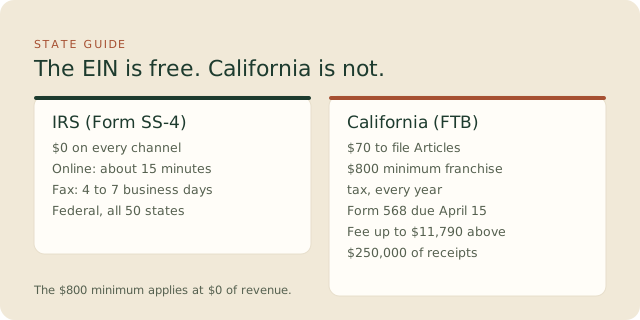
A California LLC applies for its EIN with the IRS on Form SS-4 at $0, the same federal process used in every state. California then charges an $800 minimum annual franchise tax regardless of income or activity, plus a gross receipts fee above $250,000. The EIN is used for both federal and California state filings.
California is the state where the EIN is the cheap part. The federal number costs nothing and arrives in minutes; the state attaches an $800 annual minimum that applies whether the LLC earns $2 million or nothing at all. Owners who form in California without knowing that figure are the ones who dissolve in year 2. The federal sequence is on how to get an ein for an llc, and the classification that Form 568 follows from is on llc tax classification.
How does a California LLC get an EIN?
From the IRS on Form SS-4, at $0. Apply online in about 15 minutes with an SSN or ITIN, or by fax to 855-641-6935 in 4 to 7 business days without one. California issues no EIN of its own.
The Secretary of State approves the Articles of Organization first, at $70, and issues a 12-digit entity number. That number identifies the company in California's register and is not a tax identifier. The EIN is separate, federal, and 9 digits written XX-XXXXXXX.
California processes online formations in about 8 business days and offers expedited handling for an added fee. The stamped Articles carry the exact legal name, and line 1 of Form SS-4 has to reproduce that string character for character, because every federal return is matched against it.
The online IRS application is the fastest channel and requires the responsible party named on line 7a to hold an SSN or ITIN. The session runs Monday to Friday, times out after 15 minutes of inactivity, and cannot be saved partway, so the Articles belong on screen before it starts.
An owner without an SSN or ITIN writes Foreign on line 7b and faxes the form instead, receiving the number in 4 to 7 business days. Mail is available at 6 to 11 weeks. The IRS charges $0 on all 4 channels, which the IRS Employer ID Numbers page states directly.
What is the $800 California franchise tax?
An annual minimum tax every California LLC owes to the Franchise Tax Board regardless of income, activity or profit. It is due by the 15th day of the fourth month of the tax year, April 15 for calendar-year filers.
The $800 is a minimum rather than a calculation. An LLC with $0 of revenue owes it, an LLC that lost money owes it, and an LLC that never opened a bank account owes it. The obligation attaches to being registered in California, not to doing anything there.
It applies to any LLC organised in California and to any out-of-state LLC doing business in California, which is broader than owners expect. Holding property in the state, employing someone there, or exceeding the sales thresholds all create the obligation for an LLC formed elsewhere.
First-year relief has come and gone. LLCs formed between January 1, 2021 and December 31, 2023 were exempt from the $800 in their first taxable year under Assembly Bill 85. That exemption expired, so LLCs formed from 2024 onward owe the minimum in year 1, with payment due by the 15th day of the fourth month after formation.
The tax is paid on Form 3522, separately from the annual return. Missing it accrues penalties and interest, and a suspended LLC loses the right to enforce its contracts in California courts, which is a heavier consequence than the amount suggests.
What is the California LLC gross receipts fee?
An additional fee on top of the $800, charged on total California-source income above $250,000. It runs from $900 at $250,000 to $11,790 above $5 million, and is estimated on Form 3536.
The fee is tiered rather than proportional, and each tier is a flat amount rather than a rate. Total income from $250,000 to $499,999 pays $900. From $500,000 to $999,999 it is $2,500. From $1,000,000 to $4,999,999 it is $6,000, and $5,000,000 or more pays $11,790.
The base is total income rather than profit, which is the part that surprises. A California LLC with $1.2 million of receipts and a $40,000 loss still pays $6,000 on top of the $800, because deductions do not enter the calculation. Low-margin businesses feel this far more than the headline rate suggests.
The fee is estimated and paid during the year on Form 3536, due by the 15th day of the sixth month. Underestimating triggers a penalty of 10 percent of the underpayment, so an LLC approaching a tier boundary is better served overestimating and reconciling on the annual return.
Both the $800 and the fee are reported on Form 568, the Limited Liability Company Return of Income, due April 15 for calendar-year filers. That return carries the EIN, which is why the federal number is needed for a California state filing even though California issued none of it.
Does California follow the federal classification?
Yes. California accepts the federal classification set on Form SS-4 and any later election. A disregarded entity federally is disregarded for California, and the $800 minimum applies to all of them.
California does not run a separate classification election. An LLC that is a partnership federally files Form 568 and issues California Schedule K-1s; one that elected S corporation status federally files Form 100S and pays the greater of $800 or 1.5 percent of net income.
The classification does change which state form is filed and how the minimum interacts with it. A default LLC pays $800 plus any gross receipts fee on Form 568. An LLC that elected S corporation treatment pays the 1.5 percent franchise tax with the same $800 floor, on a different return.
That difference reverses the usual federal advice for some California owners. An S corporation election saves federal self-employment tax at 15.3 percent but adds a 1.5 percent California tax on net income that a default LLC does not pay. The election still wins for most profitable California LLCs, and the margin is narrower than in a no-tax state.
The classification itself is recorded on line 9a of Form SS-4 and follows member count by default. Changing it later means Form 8832 for corporate treatment or Form 2553 for S corporation treatment, and neither changes the EIN.
Which California registrations need the EIN?
Three: the Franchise Tax Board return, a seller's permit from the Department of Tax and Fee Administration if the LLC sells taxable goods, and an Employment Development Department account if it hires.
The Franchise Tax Board is the main one and needs no separate registration step. The LLC files Form 568 under its EIN, and the FTB matches the return to the entity number issued by the Secretary of State. Both numbers appear on the return.
A seller's permit comes from the California Department of Tax and Fee Administration and is required before the first taxable sale. Registration is free, is completed online, and asks for the EIN. California's base sales tax rate is 7.25 percent, and district taxes push the combined rate above 10 percent in parts of the state.
An LLC with employees registers with the Employment Development Department within 15 days of paying more than $100 in wages in a quarter. That account covers unemployment insurance, employment training tax, state disability insurance and personal income tax withholding, and it is keyed to the EIN.
The Statement of Information is the one California filing that does not need the EIN. It is due within 90 days of formation and then every 2 years at $20, and it reports the managers, the agent for service of process and the addresses rather than anything financial.
Can a non-resident own a California LLC?
Yes, and the EIN process is identical: line 7b of Form SS-4 takes the entry Foreign and the form goes by fax. The $800 minimum and the Form 5472 obligation both still apply.
Nothing in California law restricts LLC ownership by nationality or residence, and the IRS issues EINs to foreign-owned California LLCs on the same terms as any other. The online tool is closed to applicants without an SSN or ITIN, so the fax route to 855-641-6935 is the working channel at 4 to 7 business days.
A foreign-owned single-member California LLC carries 2 annual obligations rather than 1. Federally it files Form 5472 with a pro-forma Form 1120, at a $25,000 penalty for a missed filing under 26 U.S.C. 6038A. In California it owes the $800 minimum on Form 3522 and files Form 568.
That combination makes California an expensive choice for a small non-resident venture, and it is the reason many foreign owners form in Wyoming or Delaware instead. An LLC formed elsewhere still owes the $800 if it does business in California, so the saving is real only where the business genuinely operates outside the state.
Where California is the right state, the sequence is unchanged: Secretary of State approval, then the EIN by fax, then the FTB and any CDTFA or EDD registrations. The mechanics of filing without an SSN are covered on the EIN without SSN page.
What does a California LLC cost in year one?
$870 at minimum: $70 to file the Articles of Organization, $20 for the first Statement of Information, and the $800 franchise tax. The EIN itself adds $0.
The $70 formation fee is among the lowest in the country, which is what makes the $800 minimum so easy to miss. Owners compare formation fees across states, see California at $70 against Texas at $300, and form before meeting the annual figure that dwarfs both.
The Statement of Information is due within 90 days of formation at $20, then every 2 years. Missing it triggers a $250 penalty and eventually suspension, and it is the filing most often forgotten because its 2-year cycle falls out of step with everything else on the calendar.
The $800 is due by the 15th day of the fourth month after formation, which for an LLC formed in September means a payment before the year is out and another the following April. That first-year double payment catches owners who assumed the tax was annual from the formation anniversary.
Beyond the minimums, a California LLC with more than $250,000 of total income adds the gross receipts fee, starting at $900 and reaching $11,790. Modelling that fee against expected receipts before forming is the step that decides whether California is the right state at all.
What goes wrong with California LLC EIN filings?
Applying before the Secretary of State approves, mistyping the legal name on line 1, assuming the $800 is waived in year 1, and missing the Form 3522 due date.
Early application is the same trap as in every state, made worse in California by an 8-business-day approval window that tempts owners to work ahead. The IRS issues the EIN against whatever name is typed, and if California rejects that name the number points at a company that does not exist.
The first-year exemption is the most common factual error in this topic, because it was real between 2021 and 2023 and a great deal of outdated advice still describes it as current. It expired. An LLC formed in 2026 owes the $800 in its first taxable year.
Form 3522 is a separate filing from Form 568, and paying the annual return without filing the voucher is a routine mistake. The $800 has its own form and its own deadline, and penalties accrue from the missed date rather than from the return.
The heaviest consequence is suspension. An LLC that falls behind on the franchise tax loses the capacity to enforce its own contracts in California courts, which turns a bookkeeping lapse into a commercial exposure. Reinstatement requires paying everything owed plus penalties.
What does a California LLC owe, and when?
The EIN is free. California adds an $800 annual minimum from year 1, a tiered gross receipts fee above $250,000, and a biennial Statement of Information.
| Obligation | Agency | Cost | Timing |
|---|---|---|---|
| Articles of Organization | Secretary of State | $70 | About 8 business days |
| EIN, Form SS-4 | IRS | $0 | 15 minutes online, 4 to 7 days by fax |
| Statement of Information | Secretary of State | $20 | 90 days, then every 2 years |
| Minimum franchise tax, Form 3522 | Franchise Tax Board | $800 | 15th day of the 4th month |
| Gross receipts fee, Form 3536 | Franchise Tax Board | $900 to $11,790 | 15th day of the 6th month |
| Form 568 return | Franchise Tax Board | $0 | April 15 |
| Seller's permit | CDTFA | $0 | Before the first taxable sale |
Source: California Franchise Tax Board and Secretary of State fee schedules, verified August 2026. The 2021-2023 first-year exemption has expired.
What else do California LLC owners ask?
+Does California issue its own EIN?
No. The EIN is federal and comes from the IRS at $0. California's Secretary of State issues a 12-digit entity number that identifies the company in the state register, and that number is not a tax ID. The EIN appears on Form 568 and every California employment filing.
+Do I owe the $800 franchise tax in my first year?
Yes. The first-year exemption applied only to LLCs formed between January 1, 2021 and December 31, 2023 under Assembly Bill 85, and it has expired. An LLC formed in 2026 owes the $800 by the 15th day of the fourth month after formation, regardless of income or activity.
+Does a California LLC with no income still pay $800?
Yes. The $800 is a minimum attached to being registered in California, not a tax on profit. An LLC with $0 of revenue, an LLC operating at a loss, and an LLC that never opened a bank account all owe it. Only formal dissolution or cancellation ends the obligation.
+What is the California LLC gross receipts fee?
A tiered fee on California-source total income above $250,000, paid on top of the $800. It is $900 from $250,000, $2,500 from $500,000, $6,000 from $1 million, and $11,790 above $5 million. It is calculated on total income rather than profit, so deductions do not reduce it.
+How much does an EIN cost for a California LLC?
$0. The IRS charges nothing on any of its 4 channels. California charges $70 to file the Articles of Organization and $20 for the Statement of Information, but neither of those is an EIN fee. The $800 franchise tax is separate again and is owed annually.
+Can a non-resident get an EIN for a California LLC?
Yes, with no SSN or ITIN. Line 7b of Form SS-4 takes the entry Foreign and the form goes by fax to 855-641-6935, returning the number in 4 to 7 business days. A foreign-owned single-member California LLC then files Form 5472 annually, at a $25,000 penalty for missing it.
+Does an out-of-state LLC owe California's $800?
Yes, if it is doing business in California. Holding property in the state, employing someone there, or exceeding California's sales thresholds all create the obligation for an LLC formed elsewhere. Forming in Wyoming saves the $800 only where the business genuinely operates outside California.
+Which California return does an LLC file?
Form 568, the Limited Liability Company Return of Income, due April 15 for calendar-year filers. It reports the $800 minimum and any gross receipts fee. An LLC that elected S corporation treatment federally files Form 100S instead, paying the greater of $800 or 1.5 percent of net income.
+Does an S corp election still make sense in California?
For most profitable California LLCs, yes, but the margin is narrower than elsewhere. The election saves federal self-employment tax at 15.3 percent on distributions, then adds a California franchise tax of 1.5 percent on net income that a default LLC does not pay, with the same $800 floor.
+When is the California Statement of Information due?
Within 90 days of formation, then every 2 years, at $20. Missing it triggers a $250 penalty and eventually suspension. It reports managers, the agent for service of process and addresses rather than financial figures, and it is the filing most often forgotten because of its 2-year cycle.
This page states federal tax rules current as of August 2026. It is not legal or tax advice. Confirm your LLC’s position with a licensed CPA or attorney before filing.
Getting the California classification right first time
California follows the federal classification set on Form SS-4, so line 9a decides which state return the LLC files for the rest of its life. We review your Articles, set lines 8a, 8b and 9a to your actual structure, and file for $97, faxed within 7 business days, or that fee is refunded. The $127 Fast tier files within 24 hours with the IRS call included. Start with an EIN for your LLC, filed right the first time.
No SSN required · The EIN never renews, so year 2 and beyond is $0 · get your LLC’s EIN