Table of contents
- Does an LLC need a new EIN for an S corp election?
- What does Form 2553 ask an LLC for?
- When is Form 2553 due for an LLC?
- What happens when an LLC files Form 2553 late?
- Which LLCs qualify to elect S corp status?
- Does an LLC file Form 8832 before Form 2553?
- What changes for an LLC after the S corp election?
- Which LLC changes do require a new EIN?
- What happens to the EIN when an LLC revokes the S election?
- Does a state S corp election need a separate form?
- Which events keep the EIN?
- Who should pay for an EIN?
- Frequently asked questions
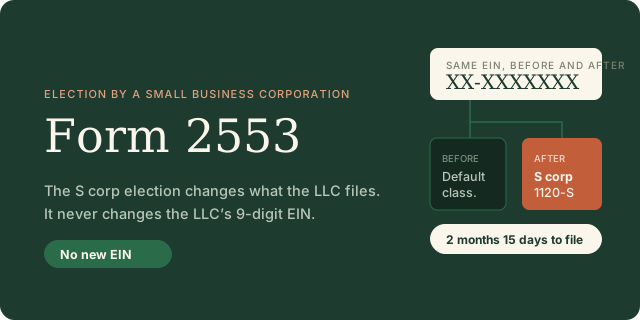
No. An LLC that already has an EIN keeps the same 9-digit number when it elects S corporation status. Form 2553 changes the classification the IRS holds against the EIN, and the IRS issues no replacement number. The LLC files Form 1120-S from the effective year, and the deadline to elect is 2 months and 15 days after the tax year starts.
The S corporation election is the point where LLC owners assume something structural happened. Nothing structural happened. The LLC is the same entity, under the same Articles of Organization, holding the same 9-digit number the IRS issued on Form SS-4. This page maps what Form 2553 moves, what it leaves alone, and the 3 events that genuinely force a new EIN. The full list of structural changes that do require a replacement number is on new ein for llc, and the parallel question for a segregated structure, where each cell may or may not need its own number, is worked through on ein for series llc. One practical note before you elect: the bank will still ask for the original number, and what it expects at account opening is covered on ein for llc bank account.
An LLC does not need a new EIN to elect S corporation treatment. The LLC keeps the same 9-digit number, because the election changes how the entity is taxed rather than what entity it is. The form is Form 2553, Election by a Small Business Corporation, not Form 8832, which elects C corporation treatment instead. Form 2553 is due within 2 months and 15 days of the start of the tax year the election covers, and Rev. Proc. 2013-30 grants relief up to 3 years and 75 days late for a filer with reasonable cause. The IRS charges $0 and answers in 60 days. The 4 default classifications an LLC elects away from are set out on LLC tax classification.
Does an LLC need a new EIN for an S corp election?
No. An LLC that already holds an EIN keeps the same 9-digit number when it elects S corporation status. Form 2553 changes the tax classification attached to the EIN, and the IRS assigns no new number.
The IRS states this directly. Its Do You Need a New EIN? guidance lists, under limited liability companies, that an LLC which already has an EIN and chooses to be taxed as a corporation or as an S corporation does not obtain a new one. The election moves the classification. The number stays.
The reason sits in how the IRS stores the record. An EIN identifies a legal entity, and the LLC remains the same legal entity after the election. The state charter number, the formation date, and the legal name on the Articles of Organization all stay unchanged. Only the federal tax treatment moves, from disregarded entity or partnership to S corporation.
Every downstream number follows the same EIN. Form 1120-S carries it, each Schedule K-1 carries it, Form 941 carries it every quarter, and each W-2 carries it every January. An LLC that applied for a second EIN after electing ends with 2 open records for 1 entity, and the IRS matches returns against the wrong one.
The CP-575 letter issued when the EIN was first assigned stays valid after the election. Banks verify the LLC's legal name and 9-digit EIN against that letter, and Form 2553 changes neither field.
What does Form 2553 ask an LLC for?
Form 2553 asks for the LLC's legal name, its 9-digit EIN on line A, the date it formed, the effective date of the election, the tax year selected, and a signed consent from every owner.
Part I of the form holds the identity block. Line A takes the EIN, line B takes the date the entity formed, and line C takes the state. The name entered has to read exactly as the state approved it on the Articles of Organization, because the IRS matches the form against the name it stores with the EIN.
Line E sets the effective date of the election, and that single date decides which tax year the LLC files as an S corporation. Line F selects the tax year, with the calendar year as the standard choice. Line H names the officer the IRS contacts, and line I holds the explanation when the form arrives late.
Part I splits the owner block across 5 lettered columns. Column J takes each owner's name and address, column K takes that owner's signed consent statement, column L takes the stock or percentage owned and the dates acquired, column M takes the social security number or EIN, and column N takes the owner's tax year end. Every owner signs column K. One missing consent invalidates the election for all of them, which is the single most common reason a 2553 comes back rejected.
The IRS confirms acceptance with a CP261 notice, issued within 60 days of receiving a complete Form 2553. An LLC that hears nothing after 60 days calls the IRS and asks the status against its EIN rather than filing a second form.
When is Form 2553 due for an LLC?
Form 2553 is due no later than 2 months and 15 days after the start of the tax year the election takes effect. A calendar-year LLC files by March 15 for that same year.
The rule sits in Internal Revenue Code section 1362(b). An LLC files either during the tax year preceding the effective year, or within the first 2 months and 15 days of the effective year itself. Both windows produce the same result, and the earlier one removes all timing risk.
Count the window from the start of the tax year, not from formation. An LLC on the calendar year that wants S corporation treatment for 2027 files any time in 2026, or between January 1 and March 15 of 2027.
A newly formed LLC counts from the earliest of 3 dates: when it first had shareholders, when it first had assets, or when it began doing business. A form filed 2 months and 16 days after that date takes effect the following tax year instead.
Form 2553 goes to the IRS by mail or fax, and the service center depends on the state on line C. The EIN application uses different numbers entirely: 855-641-6935 for entities based in a US state and 855-215-1627 for international applicants.
What happens when an LLC files Form 2553 late?
The IRS grants late-election relief under Revenue Procedure 2013-30 for up to 3 years and 75 days after the intended effective date. The LLC writes FILED PURSUANT TO REV. PROC. 2013-30 across the top.
Relief has 4 conditions. The LLC intended to be an S corporation from the requested date, it failed to qualify only because the form arrived late, it has reasonable cause for the delay, and every owner reported income consistently with S corporation treatment for all affected years.
Line I is where the reasonable-cause statement goes. A statement that names the date, the reason, and the corrective action carries the request. A blank line I sends the form back and the LLC loses the entire year it asked for.
The 3-year-and-75-day limit runs from the requested effective date, under section 4.02 of Revenue Procedure 2013-30. Count it out: an LLC asking for January 1, 2024 reaches 3 years on January 1, 2027, then adds 75 days, which lands on March 17, 2027. Past that window, the LLC requests a private letter ruling instead.
The EIN is unaffected in every one of these paths. Late, on time, or under a ruling request, the LLC files under the same 9-digit number the IRS assigned on Form SS-4.
Which LLCs qualify to elect S corp status?
An LLC qualifies when every owner is a US citizen, a US resident individual, an estate, or a qualifying trust. Internal Revenue Code section 1361 bars nonresident alien owners, and 100 owners is the ceiling.
Section 1361(b) sets 5 tests. The entity is domestic, it has no more than 100 shareholders, every shareholder is an eligible person, it has 1 class of stock, and it is not an ineligible corporation such as an insurance company or a domestic international sales corporation.
The nonresident-owner bar is the one that matters most to foreign founders. An LLC with a single nonresident owner cannot elect S corporation status, and a form filed anyway is rejected or later invalidated. That LLC stays a disregarded entity and files Form 5472 with a pro-forma Form 1120 each year, with a $25,000 penalty under Internal Revenue Code section 6038A for a missed filing.
A married couple counts as 1 shareholder for the 100-owner test, and so does a family group descended from a common ancestor within 6 generations. The 100 limit is the easy test to pass; the eligible-shareholder test is the one that removes LLCs.
The 1-class-of-stock test reaches LLC operating agreements. An agreement that gives 1 member a preferred distribution ahead of another creates a second class of economic rights and breaks the election. Read how the classification fields interact before electing anything.
Does an LLC file Form 8832 before Form 2553?
No. An LLC files Form 2553 alone. Treasury Regulation 301.7701-3(c)(1)(v)(C) treats a timely Form 2553 as an automatic election of corporate classification, so the LLC skips Form 8832 entirely.
The regulation exists to remove a double filing. Without it, an LLC would file Form 8832 to become a corporation and then Form 2553 to become an S corporation. The deemed election collapses those 2 steps into 1 form.
Form 8832 still has its own use. An LLC that wants C corporation treatment, and no S election, files Form 8832 and files Form 1120 afterward. That path keeps the same EIN as well.
Both forms sit downstream of Form SS-4. Line 8a records whether the entity is an LLC, line 8b records the number of members, and line 9a records the classification the LLC starts in. A wrong entry on 8b routes the LLC into the wrong default and the wrong annual return.
An election is a change of treatment, never a change of entity. That is the whole reason the EIN survives all of it.
Most LLCs skip Form 8832 entirely. A valid Form 2553 elects corporate status and S status in a single filing, so the 2-step route through Form 8832 is needed only when the destination is a C corporation on Form 1120. Filing both when only Form 2553 was required creates a second election the LLC then has to unwind.
What changes for an LLC after the S corp election?
The LLC files Form 1120-S instead of Schedule C or Form 1065, issues a Schedule K-1 to each owner, runs payroll for every owner-employee, and files Form 941 each quarter. The EIN stays the same.
The annual return changes first. A single-member LLC leaves Schedule C, a multi-member LLC leaves Form 1065, and both file Form 1120-S. The return is due March 15 for a calendar-year filer, and Form 7004 extends it by 6 months to September 15.
Payroll starts at the same moment. An owner who works in the business becomes an employee and takes reasonable compensation on a W-2. The LLC files Form 941 for each of the 4 quarters, Form 940 once a year, and delivers W-2 forms by January 31.
Every one of those filings carries the EIN the LLC already had. Payroll registration, the state withholding account, and the federal deposit schedule all key off that same 9-digit number.
The state charter does not move. The LLC remains an LLC under state law, keeps its Articles of Organization, keeps its registered agent, and keeps its name. S corporation is a federal tax status, not a state entity type.
Which LLC changes do require a new EIN?
A new EIN is required when the LLC incorporates under state law, when a new multi-member LLC forms, or when a new single-member LLC elects corporate taxation at formation. A classification change alone requires none.
Statutory conversion is the dividing line. An LLC that files a conversion with the state and becomes a corporation under state law creates a different legal entity, and a different legal entity needs its own EIN. An LLC that stays an LLC and only changes federal treatment does not.
A new LLC formed with 2 or more owners obtains its first EIN, because a partnership return requires one. A new single-member LLC that elects corporate or S corporation treatment at formation obtains one as well, since it will file a corporate return under its own number.
These 4 changes look large and still keep the number. A name change keeps the EIN, an address change keeps it, adding a member keeps it, and revoking an S election keeps it. The table below maps which events break the number and which do not, and the related-reading list carries the full event map.
One number per entity is the rule to hold. An LLC that files a second SS-4 to be safe creates a duplicate record, and untangling 2 EINs against 1 entity takes correspondence with the IRS that a single correct filing avoids.
What happens to the EIN when an LLC revokes the S election?
The LLC keeps its EIN and files a revocation statement signed by owners holding more than 50% of ownership. Internal Revenue Code section 1362(g) then bars a new S election for 5 tax years without IRS consent.
Revocation is a statement, not a form. The LLC writes to the service center where it files, names the EIN, states that it revokes the election under section 1362(a), and attaches consents from owners holding more than 50% of the outstanding ownership.
Timing works like the election in reverse. A revocation filed by the 15th day of the third month takes effect on the first day of that tax year. A revocation filed after that date takes effect the first day of the following tax year, or on any later date the statement names.
The 5-year bar is the expensive part. An LLC that revokes for 2027 waits until the 2032 tax year to elect again without asking the IRS for consent, which makes the election a decision worth modelling before filing rather than after.
Through revocation, re-election, and every return in between, the 9-digit EIN never changes.
Revocation has its own timing and its own waiting period. A revocation filed by the 15th day of the 3rd month takes effect for the current tax year, and one filed later takes effect the following year. After revoking, the LLC waits 5 tax years before electing S status again without IRS consent.
Does a state S corp election need a separate form?
New York requires a separate election on Form CT-6. New Jersey accepts the federal election automatically for tax years beginning on or after December 22, 2022. The LLC uses the same federal EIN on every state form.
New York is the state that catches LLC owners. Form CT-6 is filed with the New York State Department of Taxation and Finance on its own schedule, and the CT-6 instructions set the same 2-month-15-day window the federal election uses. An LLC that files only Form 2553 is an S corporation federally and a C corporation in New York.
New Jersey moved the other way. P.L. 2022, chapter 133, signed December 22, 2022, eliminated the separate New Jersey S corporation election for tax years beginning on or after that date. New Jersey now follows the federal election with no state form, which reverses guidance published before 2023.
A state election and a state tax are 2 different things. California recognises the federal election and still charges S corporations a franchise tax of 1.5% of net income under Revenue and Taxation Code section 23802(b), with the $800 minimum franchise tax of section 23153 applying regardless. Electing federally does not zero out a state bill.
The EIN carries across all of it. Federal Form 1120-S, the state return, the payroll accounts, and the bank record all reference the same 9-digit number. Check the state rule before the federal deadline, because a state form such as CT-6 carries its own deadline tied to the same March 15 date.
Which LLC events keep the EIN and which do not?
Classification changes keep the EIN. Entity changes break it. An S election, a name change, and an added member all keep the number; a statutory conversion to a corporation requires a new one.
| Event at the LLC | Form filed | New EIN? | Return after the change |
|---|---|---|---|
| S corporation election | Form 2553 | No | Form 1120-S, due March 15 |
| C corporation election | Form 8832 | No | Form 1120, due April 15 |
| Revoking the S election | Revocation statement | No | Back to Schedule C or Form 1065 |
| LLC name change | Letter to the IRS | No | Unchanged |
| Adding a second member | None at the IRS | No | Form 1065 from that year |
| Dropping to 1 member | None at the IRS | No | Schedule C from that year |
| Statutory conversion to a corporation | State conversion filing | Yes | Form 1120 under the new EIN |
| New multi-member LLC formed | Form SS-4 | Yes, its first | Form 1065, due March 15 |
| New 1-member LLC electing corporate tax | Form SS-4 + Form 2553 | Yes, its first | Form 1120-S, due March 15 |
Source: IRS Do You Need a New EIN? guidance and IRS form instructions, verified July 2026. Deadlines shown for calendar-year filers.
The Form 2553 timeline, date by date
| Step | Deadline or window | Authority |
|---|---|---|
| EIN assigned on Form SS-4 | Before any election is filed | IRS Form SS-4 instructions |
| File Form 2553, early window | Any time in the preceding tax year | IRC section 1362(b) |
| File Form 2553, standard window | 2 months and 15 days into the year, March 15 | IRC section 1362(b) |
| Late-election relief | Up to 3 years and 75 days after the effective date | Rev. Proc. 2013-30 |
| IRS acceptance notice CP261 | Within 60 days of a complete Form 2553 | IRS Form 2553 instructions |
| First Form 1120-S | March 15 of the following year | IRS Form 1120-S instructions |
| Extension of Form 1120-S | 6 months, to September 15 | IRS Form 7004 instructions |
| W-2 forms to owner-employees | January 31 | IRS Form W-2 instructions |
| Revocation for the current year | By the 15th day of the third month | IRC section 1362(d) |
| Re-election after revoking | 5 tax years later without IRS consent | IRC section 1362(g) |
Source: Internal Revenue Code and IRS form instructions, verified July 2026.
Who should pay anyone for an LLC’s EIN?
An applicant with an SSN pays nobody. The IRS issues the EIN at irs.gov in 15 minutes for $0. An applicant without an SSN uses the fax route, also $0, or pays someone to run it.
Apply at irs.gov. The IRS online assistant charges $0 and issues the 9-digit EIN in 15 minutes. Pay nobody, including us.
Take the fax route. Form SS-4 line 7b accepts the entry Foreign. Fax to 855-641-6935 for a US-based entity or 855-215-1627 from abroad, at $0. Or einforllc.co files it for $97, faxed within 7 business days, or $127 filed within 24 hours with the IRS call included.
Price context, so the $97 is legible. The IRS charges $0 for the EIN itself, and the EIN never renews, so year 2 and every year after costs $0. Formation companies price the EIN as an add-on: Northwest at $200 without an SSN, ZenBusiness at $99, and Rocket Lawyer at $59.99, all verified July 2026. None of those three publishes a written filing deadline, and none reviews the SS-4 classification lines before filing.
einforllc.co prices the EIN on its own: $97 one time, or $127 filed within 24 hours with the IRS call included. If your LLC already exists, that is the whole invoice, and we will tell you to skip the optional $197 formation add-on rather than sell it to you. We do not file Form 2553. Support runs on live chat 24/7, a dedicated post-purchase chat, and email.
What else do LLC owners ask about the S corp election and the EIN?
These 10 questions cover the 2-month-15-day deadline, the 3-year-75-day relief window, the 100-owner limit, and the 3 events that force a new EIN. Every answer applies to any LLC filing Form 2553.
+Does an LLC need a new EIN for an S corp election?
No. An LLC that already has an EIN keeps the same 9-digit number after filing Form 2553. IRS guidance states that an LLC choosing to be taxed as a corporation or S corporation does not obtain a new EIN. Only the classification attached to the number changes.
+When is Form 2553 due for an LLC?
Form 2553 is due within 2 months and 15 days after the start of the tax year the election takes effect, which is March 15 for a calendar-year LLC. The LLC also files at any time during the preceding tax year, which removes the timing risk entirely.
+Can an LLC file Form 2553 late?
Yes. Revenue Procedure 2013-30 grants relief for up to 3 years and 75 days after the requested effective date. The LLC writes FILED PURSUANT TO REV. PROC. 2013-30 at the top and gives a reasonable-cause statement on line I. All 4 relief conditions apply.
+Does an LLC file Form 8832 before Form 2553?
No. Treasury Regulation 301.7701-3(c)(1)(v)(C) treats a timely Form 2553 as an automatic corporate classification election, so 1 form does the work of 2. An LLC that wants C corporation treatment instead files Form 8832 alone and files Form 1120 afterward.
+Can an LLC with a nonresident owner elect S corp status?
No. Internal Revenue Code section 1361 bars nonresident alien shareholders, so an LLC with 1 nonresident owner cannot be an S corporation. That LLC stays a disregarded entity and files Form 5472 with a pro-forma Form 1120, which carries a $25,000 penalty if missed.
+Can an LLC get an EIN without an SSN?
Yes. Form SS-4 line 7b accepts the entry Foreign in place of an SSN or ITIN. The applicant faxes the form to 855-641-6935 for a US-based entity or 855-215-1627 from outside the US, and the IRS returns the 9-digit EIN. The IRS fee is $0.
+What does an LLC file after the S corp election?
The LLC files Form 1120-S by March 15 and issues a Schedule K-1 to each owner. Payroll starts for every owner-employee, with Form 941 filed for each of the 4 quarters, Form 940 once a year, and W-2 forms delivered by January 31.
+How long does the IRS take to accept Form 2553?
The IRS issues a CP261 acceptance notice within 60 days of receiving a complete Form 2553. An LLC that hears nothing after 60 days contacts the IRS and asks for the status against its EIN. Filing a second Form 2553 creates a duplicate record.
+Which LLC changes require a brand-new EIN?
A new EIN is required in 3 situations: the LLC incorporates under state law, a new multi-member LLC forms, or a new single-member LLC elects corporate taxation at formation. A name change, an address change, adding a member, and an S election all keep the same 9-digit number.
+What happens if an LLC revokes its S corp election?
The LLC keeps its EIN and files a revocation statement signed by owners holding more than 50% of ownership. Internal Revenue Code section 1362(g) then bars a new S election for 5 tax years without IRS consent, so the decision deserves modelling before filing.
Updated July 2026. This page states federal tax rules current as of July 2026. It is not legal or tax advice. Confirm your LLC’s position with a licensed CPA or attorney before filing Form 2553.
Does your LLC already have the EIN every one of these filings runs on?
Every election, return, and payroll filing runs on the 9-digit number assigned on Form SS-4, and lines 8a, 8b, and 9a of that form set the classification the LLC starts in. We review your Articles character by character, set those 3 lines to your actual structure, and file Form SS-4 by fax within 7 business days for $97, or that fee is refunded, with the EIN and the IRS CP-575 letter in 16–19 business days. The $127 Fast tier files and makes the IRS call within 24 hours, guaranteed, for 6 to 8 business days in total.
The IRS charges $0 for an EIN. An applicant with an SSN gets it free at irs.gov in 15 minutes and should pay nobody, including us. We file for applicants without an SSN, and we do not file Form 2553. The EIN is priced on its own, so if your LLC already exists that is the whole invoice, and we will tell you to skip the optional $197 formation add-on rather than sell it to you.
No SSN. No passport upload. · IRS fee $0 · Year 2 and beyond: $0 · the $97 LLC EIN specialist service