What Is LLC Tax Classification?
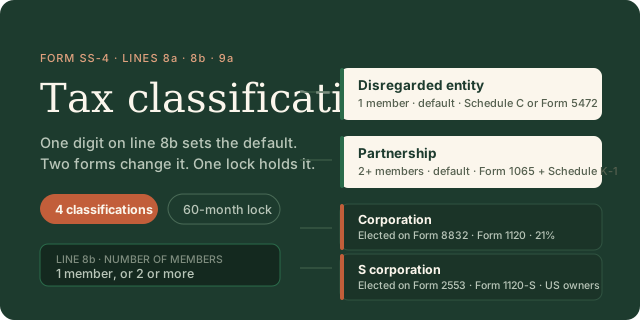
LLC tax classification is the federal tax treatment the IRS applies to an LLC: disregarded entity, partnership, corporation, or S corporation. Treasury Regulation 301.7701-3 sets it, and Form SS-4 lines 8a, 8b, and 9a record it.
The Internal Revenue Code contains no chapter for LLCs. State law creates the company, and federal tax law then borrows a classification from somewhere else. Treasury Regulation 301.7701-3, the check-the-box rule effective for tax years beginning on or after January 1, 1997, calls an LLC an eligible entity and gives it 4 possible destinations. Exactly 1 of those 4 attaches to your company from its first day of existence.
Classification is not cosmetic. It decides which annual return the LLC files, which month that return is due, whether the company pays tax itself or pushes income to its owners, and whether the owners owe self-employment tax on that income. It also decides whether a foreign-owned LLC lands inside the form 5472 regime and its $25,000 penalty.
The classification travels with the EIN. The IRS opens a tax account against the 9-digit number the day it issues, and that account expects a specific return. Start with the full how to get an EIN for an LLC walkthrough, or read the LLC EIN application field by field.
What Is the Default Tax Classification of an LLC?
A single-member LLC defaults to a disregarded entity. A multi-member LLC defaults to a partnership. Treasury Regulation 301.7701-3(b)(1) applies both defaults automatically, with 0 forms filed and $0 paid.
| LLC structure | Line 8b entry | Default classification | Annual federal return | Calendar-year due date |
|---|---|---|---|---|
| Single-member, US owner | 1 | Disregarded entity | Schedule C with Form 1040 | April 15 |
| Single-member, foreign owner | 1 | Disregarded entity | Form 5472 + pro-forma Form 1120 | April 15 |
| Multi-member, any owners | 2 or more | Partnership | Form 1065 + 1 Schedule K-1 per member | March 15 |
| Any LLC electing on Form 8832 | 1 or more | Corporation | Form 1120 | April 15 |
| Eligible LLC electing on Form 2553 | 1 to 100 US owners | S corporation | Form 1120-S + Schedule K-1 | March 15 |
Source: Treasury Regulation 301.7701-3 and the IRS instructions for Forms 1065, 1120, and 1120-S, verified July 2026.
Nothing on this table requires an application. A default is what the IRS assumes in the absence of an election, so an LLC that files no Form 8832 and no Form 2553 still has a classification from day one. The 2 defaults cover the large majority of LLCs, and both are free.
The default follows member count and nothing else. Revenue, industry, state of formation and the wording of the operating agreement all leave it untouched. Two LLCs with the same member count receive identical federal treatment whether 1 earns $0 and the other earns $5 million.
Classification is federal and separate from state law. An LLC stays an LLC in the eyes of its state regardless of what it elects with the IRS, and electing corporate treatment does not convert it into a corporation. The 2 systems run in parallel and answer different questions.
How Do Form SS-4 Lines 8a, 8b, and 9a Set the Classification?
Line 8a states that the applicant is an LLC. Line 8b carries the member count. Line 9a records the entity type the IRS files the LLC under. Those 3 entries open the LLC’s tax account.
| Form SS-4 line | What it asks | Correct entry | What it controls |
|---|---|---|---|
| 8a | Is this application for an LLC? | Yes | Flags the entity as an eligible entity under Reg. 301.7701-3 |
| 8b | Number of LLC members | 1, or the exact count of 2 or more | Disregarded entity versus partnership |
| 8c | Was the LLC organized in the United States? | Yes for all 50 states | Domestic versus foreign eligible entity |
| 9a | Type of entity | The box matching the classification, plus the form number | Which return the IRS expects each year |
| 7a and 7b | Responsible party name and tax ID | A human being, plus an SSN, an ITIN, or the entry Foreign | Whether the online route is available |
| 11 | Date the business started | The formation date the state recorded | The first tax year the classification applies to |
Source: IRS Instructions for Form SS-4, verified July 2026.
Why line 8b outranks every other entry
Line 8b is a single digit that reroutes the LLC’s entire compliance calendar. Enter 1 and the IRS expects no separate entity return from a US-owned LLC. Enter 2 and the IRS expects Form 1065 by March 15 with 1 Schedule K-1 for each member, every year, whether or not the company earned a dollar. Internal Revenue Code section 6698 then charges a penalty for each partner for each month the partnership return runs late, up to 12 months.
Members are counted by ownership, not by activity. A spouse who holds a membership interest counts. A silent partner who contributed capital and never works in the business counts. A manager who owns nothing does not. Read the mechanics for a single-member LLC and a multi-member LLC.
No SSN. No passport upload.
What Is a Disregarded Entity LLC?
A disregarded entity is an LLC with 1 owner that the IRS ignores for income tax. Its income lands on the owner’s return, and the LLC keeps its own EIN for employment tax and excise tax.
Disregarded is a tax word, not a legal one. The LLC still exists under state law, still holds its own bank account, still signs its own contracts, and still shields the owner under that state’s liability rules. Treasury Regulation 301.7701-3(b)(1)(ii) simply says the IRS treats the company as separate from its owner for 0 income tax purposes.
A US owner reports the LLC’s profit on Schedule C of Form 1040, due April 15 for a calendar year, and pays self-employment tax at 15.3% on the net earnings: 12.4% Social Security plus 2.9% Medicare under Internal Revenue Code section 1401. There is no second layer of tax, because the LLC itself pays $0 of federal income tax.
Two exceptions keep the EIN necessary. Since January 1, 2009, Treasury Regulation 301.7701-2(c)(2)(iv)(B) treats a disregarded entity as a corporation for employment tax, so payroll runs under the LLC’s own EIN rather than the owner’s SSN. The same regulation applies to certain excise taxes. See what a disregarded entity is in full.
How Is a Multi-Member LLC Taxed?
A multi-member LLC is taxed as a partnership. It files Form 1065 and issues 1 Schedule K-1 to each member by March 15 for a calendar year. The LLC itself pays $0 of federal income tax.
Form 1065 is an information return. It reports the LLC’s income, deductions, and credits, then divides the result among members on Schedule K-1 according to the operating agreement. Each member carries that K-1 onto Schedule E of a personal Form 1040 and pays the tax individually. A 3-member LLC produces 1 Form 1065 and 3 Schedule K-1s.
March 15 is 1 month earlier than the individual deadline, which is what catches new LLCs. Form 7004 extends the partnership return by 6 months, to September 15, and the extension moves the filing date only. Internal Revenue Code section 6698 charges a penalty for each partner for each month the return is late, capped at 12 months, and it applies to a partnership with $0 of income.
Every member receives a K-1 whether or not the LLC distributed cash, because partnership tax follows allocation rather than distribution. Read the return itself in Form 1065 for an LLC.
The partnership return is due March 15 for a calendar-year LLC, a month ahead of the personal deadline so members hold their K-1s in time to file. Form 7004 extends it 6 months to September 15, and the extension moves the LLC’s return without moving any member’s personal date.
Late filing is charged per partner, per month, for up to 12 months under Internal Revenue Code section 6698. Member count multiplies the exposure, so a 4-member LLC accrues 4 times what a single partner would, and a return reporting $0 of income carries the same charge as a profitable one.
How Does an LLC Elect Corporate Tax Classification?
An LLC elects corporation status on Form 8832, line 6a. The election takes effect up to 75 days before the filing date or up to 12 months after it, and the flat corporate rate is 21%.
| Form 8832 item | Rule |
|---|---|
| Part I, lines 1 to 11 | Election information, including the entity name, address, and 9-digit EIN |
| Line 1 | Initial classification by a new entity, or a change to a current one |
| Line 6a | Domestic eligible entity electing to be an association taxable as a corporation |
| Line 6c | Domestic single-owner entity electing to be disregarded |
| Line 8, effective date | No earlier than 75 days before filing, no later than 12 months after |
| Part II, lines 12 and 13 | Late election relief, 3 years and 75 days, under Revenue Procedure 2009-41 |
| IRS response | A determination letter within 60 days of filing |
| Filing fee | $0 |
Source: IRS Instructions for Form 8832 and Revenue Procedure 2009-41, verified July 2026.
The 60-month lock
Treasury Regulation 301.7701-3(c)(1)(iv) blocks a second classification election for 60 months after the effective date of the first. Five tax years of the same treatment, whether or not it still fits. One exception matters: an election effective on the date the LLC came into existence does not start the 60-month clock, which is why the choice made at EIN time carries weight the paperwork does not advertise.
Corporate treatment moves the tax to the entity: a flat 21% under Internal Revenue Code section 11(b), Form 1120 due April 15 for a calendar year, and a second layer of tax on dividends paid out to owners. The full mechanics live in Form 8832 for an LLC.
How Does an LLC Elect S Corporation Tax Classification?
An LLC elects S corporation status on Form 2553, due 2 months and 15 days after the tax year starts. The LLC keeps the same EIN, and Internal Revenue Code section 1361 bars nonresident alien owners.
Form 2553 is due by the 15th day of the 3rd month of the tax year the election takes effect, which is March 15 for a calendar-year LLC electing for the current year. Revenue Procedure 2013-30 grants relief for a late election filed within 3 years and 75 days of the intended effective date. The IRS confirms acceptance on notice CP261 within 60 days.
Section 1361(b) sets 4 hard eligibility limits: no more than 100 shareholders, 1 class of stock only, shareholders limited to individuals and certain trusts and estates, and no nonresident alien shareholders at all. That final limit closes the S corporation door to every foreign owner without exception.
An S corporation files Form 1120-S by March 15 with 1 Schedule K-1 per shareholder, and it pays $0 of federal income tax at the entity level. The election never changes the 9-digit EIN. See the S corp election and the EIN for the full answer.
How Does LLC Tax Classification Work for a Foreign Owner?
A foreign-owned single-member LLC is a disregarded entity, exactly like a US-owned one. Regulation 301.7701-2(c)(2)(vi) then treats it as a corporation for 1 purpose: filing Form 5472 with a pro-forma Form 1120.
The default is identical for every owner on earth. Line 8b takes the number 1, the IRS classifies the LLC as a disregarded entity, and nothing about the owner’s passport or country changes that result. What changes is the reporting attached to it. For tax years beginning on or after January 1, 2017, a foreign-owned domestic disregarded entity is treated as a corporation for reporting under Internal Revenue Code section 6038A.
That single sentence creates an annual filing that catches most foreign founders by surprise: Form 5472 attached to a pro-forma Form 1120, due April 15 for a calendar-year LLC, extendable to October 15 on Form 7004. The penalty is $25,000 per form per tax year under section 6038A(d), and it applies at $0 of revenue. Read form 5472 and the complete ein for foreign owned llc playbook.
Foreign owners hold 2 classifications, not 4. Disregarded entity is the default, corporation through Form 8832 line 6a is the alternative, partnership requires a second member, and S corporation is barred outright by section 1361(b)(1)(C). Adding a second member converts the LLC to a partnership under Revenue Ruling 99-5 and ends the Form 5472 obligation for tax years after the conversion.
Can You Change an LLC’s Tax Classification After the EIN Issues?
Yes. The LLC keeps its 9-digit EIN and files Form 8832 or Form 2553. Adding or removing members changes the classification with no election at all, under Revenue Rulings 99-5 and 99-6.
| What changes | New classification | Form to file | New EIN? |
|---|---|---|---|
| Single-member LLC elects corporation | Corporation | Form 8832, line 6a | No |
| LLC elects S corporation | S corporation | Form 2553 | No |
| Single-member LLC admits a second member | Partnership | None. Revenue Ruling 99-5 applies | Yes |
| Multi-member LLC drops to 1 member | Disregarded entity | None. Revenue Ruling 99-6 applies | Yes |
| LLC changes its legal name | Unchanged | A signed letter to the IRS | No |
| LLC moves to a different state | Unchanged | None | No |
Source: Revenue Rulings 99-5 and 99-6, and IRS Publication 1635, verified July 2026.
Two rows carry a Yes, and both involve the member count rather than an election. That is the pattern worth memorizing: elections keep the EIN, structural changes to who owns the company do not. Details on when an LLC needs a new EIN and on an LLC name change and the EIN.
A change is not free of consequences even though the number survives. An election made on Form 8832 locks the LLC for 60 months before it can elect again, which makes the decision harder to reverse than the filing itself suggests. The IRS grants an early exit only where ownership has changed by more than 50 percent.
Timing decides which tax year the change lands in. Form 2553 is due within 75 days of the start of the year the election takes effect, and a late filing pushes S treatment to the following year unless the LLC qualifies for relief under Rev. Proc. 2013-30. Form 8832 reaches 75 days back and 12 months forward from its filing date.
Which LLC Tax Classification Mistakes Cost the Most?
Four mistakes cost the most: a wrong member count on line 8b, a corporation box checked on line 9a by accident, a missed Form 5472 at $25,000, and a Form 2553 filed after the 2-month-15-day window.
The wrong number on line 8b. A 2-member LLC recorded as 1 member gets no partnership account, so Form 1065 posts late and section 6698 charges a penalty for each partner for each month, up to 12 months.
A corporation box checked on line 9a with no election behind it. The IRS then expects Form 1120 by April 15 from an LLC that intends to file Schedule C. The account issues notices until the record is corrected in writing.
Treating disregarded status as no filing at all. A foreign-owned single-member LLC owes Form 5472 with a pro-forma Form 1120 every year. The penalty is $25,000 per form per year, and it applies at $0 of revenue.
Filing Form 2553 after the window closes. The deadline is 2 months and 15 days after the tax year starts. Revenue Procedure 2013-30 allows 3 years and 75 days of relief, and it requires a reasonable-cause statement.
Electing twice inside 60 months. Regulation 301.7701-3(c)(1)(iv) blocks a second election for 60 months. Only an election effective on the LLC's formation date escapes the clock.
A legal name that does not match the Articles. One character of difference, including LLC versus L.L.C., fails the match against state records and rejects the SS-4 weeks later by mail.
Every one of these lands on paper weeks after the fact, because the IRS reports classification problems by mail rather than by email. Reading lines 8a, 8b, and 9a twice before the SS-4 leaves your hands costs nothing and prevents all 6.
What Does an LLC Classification Check Cost?
The IRS charges $0 for an EIN, $0 for a Form 8832 election, and $0 for a Form 2553 election. einforllc.co charges $97 once, or $127 to file within 24 hours, and the check on lines 8a, 8b, and 9a is included in both prices.
| Feature | einforllc.co | DIY at IRS | Northwest | ZenBusiness |
|---|---|---|---|---|
| EIN price without an SSN | $97, or $127 fast | $0 | $200 | $99 |
| Lines 8a, 8b, 9a reviewed | Yes, every order | You decide | No | No |
| Articles name match | Yes | You verify | No | Accuracy guarantee |
| Time to EIN | 16–19 business days, or 6 to 8 business days on Fast | 4 to 8 weeks | No deadline | No deadline |
| Filing deadline in writing | 7 business days, or that fee is refunded | None | None | None |
| Optional add-ons | LLC formation, +$197 plus state fees at cost, agent renews at $99/year, only if you have not formed yet | None | Formation, agent | Formation, agent |
| Year 2 and beyond | $0 | $0 | $0 | $0 |
Prices in this table verified July 2026: Northwest $200 at its no-SSN rate, ZenBusiness $99. IRS fees verified July 2026 at $0.
Read this before paying anyone, including us. If you hold a Social Security Number, file at irs.gov in 15 minutes for $0 and set lines 8a, 8b, and 9a yourself. The $97 exists for applicants without an SSN, who face a paper filing, a 4-to-8-week wait, and 3 fields that set federal tax treatment for the life of the company. Compare the full breakdown on the LLC EIN cost page, or start with the $97 LLC EIN specialist service.
Can You Set Your LLC’s Tax Classification Without an SSN?
Yes. Form SS-4 line 7b accepts the entry Foreign, and lines 8a, 8b, and 9a work identically. The IRS sets classification from the member count, not from the owner’s tax identification number.
Line 7a takes the responsible party’s legal name, and the IRS requires a human being there rather than a company. Line 7b takes that person’s SSN, ITIN, or the word Foreign.
The IRS online assistant validates line 7b against SSN and ITIN records, which blocks applicants holding neither. Those applicants take the paper route set out below.
Business days mean Monday to Friday, excluding US federal holidays.
The route to the EIN differs. The classification does not. Read the no-SSN filing path in LLC EIN without SSN.
No SSN. No passport upload.
This page states federal tax rules current as of July 2026. State tax treatment follows each state’s own rules. This page is not legal or tax advice. Confirm your LLC’s classification with a licensed CPA or attorney before filing.