What Does the 2-Digit EIN Prefix Mean?
The first 2 digits are the prefix. Before 2001 each prefix mapped to 1 IRS campus, such as 60 for Atlanta or 50 for Austin. Since 2001, online assignment made the prefix a routing artifact.
| IRS campus | Example valid prefixes |
|---|---|
| Andover | 10, 12 |
| Atlanta | 60, 67 |
| Austin | 50, 53 |
| Cincinnati | 30, 32, 35, 36, 37, 38, 61 |
| Fresno | 15, 24 |
| Kansas City | 40, 44 |
| Memphis | 94, 95 |
| Ogden | 80, 90 |
| Internet | 20, 26, 27, 45, 46, 47, 81, 82, 83, 84, 85, 86, 87, 88, 91, 92, 93, 99 |
Source: IRS, How EINs Are Assigned and Valid EIN Prefixes, verified August 2026.
The IRS publishes every valid prefix, and a prefix outside that list marks an invalid number. An internet-issued EIN carries a prefix such as 20, 26, or 27 instead of a campus code. The prefix does not change the number's meaning: a business with prefix 82 has the same standing as one with prefix 44. The federal version of the number is covered on what is a FEIN, and the checks that flag a bad prefix sit on how to verify an EIN.
The prefix set is small and fixed. The IRS reserves roughly 90 two-digit prefixes across its 8 historical campuses plus the 2 internet processing centers, and it publishes the full list. Prefixes 20, 26, 27, 45, 46, and 47 mark the online-issued numbers that have dominated since the web application opened in 2001. A prefix of 00 has never been valid, and neither has any 2-digit code the IRS has not listed. To apply and receive a modern internet prefix, see how to get an EIN; to set the number against a personal identifier, see EIN vs SSN.
No SSN. No passport upload.
How Is an EIN Format Different From an SSN?
An EIN is written XX-XXXXXXX, a 2-digit block then a 7-digit block. An SSN is written XXX-XX-XXXX, three blocks of 3, 2, and 4 digits. Both hold 9 digits, but the hyphen positions differ.
| Identifier | Format | Digit grouping | Hyphens | Issued by |
|---|---|---|---|---|
| EIN | XX-XXXXXXX | 2 then 7 | 1 | IRS |
| SSN | XXX-XX-XXXX | 3 then 2 then 4 | 2 | Social Security Administration |
| ITIN | 9XX-XX-XXXX | 3 then 2 then 4 | 2 | IRS |
The grouping is the fastest tell. An EIN carries 1 hyphen after the 2nd digit; an SSN carries 2 hyphens, after the 3rd and 5th digits. A number typed as XXX-XX-XXXX on a business form is a personal SSN or ITIN, not an EIN. The full comparison of business and personal tax IDs sits on TIN vs EIN.
The stakes of the mix-up are concrete. Entering an SSN where a form asks for an EIN exposes a person's private 9-digit identifier to every vendor who touches the file. Entering an EIN where a payroll system expects an SSN routes wages to the wrong tax account. The 24% backup-withholding penalty attaches to the number on the W-9, so a swapped identifier costs real cash across every payment made that year.
The 3 identifiers also differ in who issues them. The IRS assigns both the EIN and the ITIN, while the Social Security Administration assigns the SSN. An ITIN always opens with the digit 9 and follows the SSN's XXX-XX-XXXX shape, which is why an ITIN can never double as an EIN. For the full breakdown of when a business uses its own number versus an owner's personal number, read EIN vs SSN and using your EIN.
How Can You Tell If an EIN Is Valid?
A valid EIN has 9 numeric digits, a published 2-digit prefix, and no letters. It is never 00-0000000. The exact number is confirmed against a CP-575 or a 147C letter from the IRS.
| Check | Pass condition | Fails when |
|---|---|---|
| 9 numeric digits | XX-XXXXXXX, no letters | The value carries letters or fewer than 9 digits |
| Published prefix | First 2 digits on the IRS list | The 2-digit prefix is not published |
| Not all zeros | Any published prefix | The number reads 00-0000000 |
| Matches a letter | Equals the CP-575 or 147C number | It differs from the IRS record |
Source: IRS Form SS-4 instructions and CP-575 notice, verified August 2026.
No free public database lists every private EIN, so screening runs on the number's own structure plus IRS records. Match the first 2 digits to the published prefix list, confirm the total is 9 digits, and reject any code carrying letters. To confirm a specific number, request a 147C letter by calling the IRS at 800-829-4933, or follow the steps on how to verify an EIN and EIN lookup.
One more guardrail catches most fakes. A valid EIN never repeats a single digit 9 times, never runs 123456789 in sequence, and never opens with the prefix 00. Software that screens tax IDs applies the same 3 structural rules this page lists, then rejects anything left over. When a number clears all 3 checks but still needs proof of ownership, the free 147C letter from the IRS at 800-829-4933 settles it within 1 phone call. The steps to trace a mislaid number sit on how to find your EIN.
Where Does the EIN Format Appear?
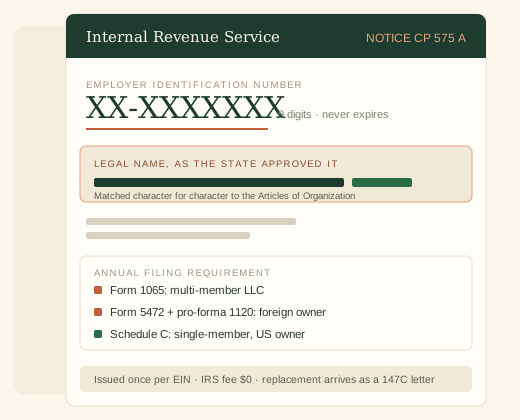
The XX-XXXXXXX format first appears on the CP-575 assignment letter, then on a W-9, a Form 1099, business tax returns, and bank applications.
The IRS prints the 9 digits on the CP-575 the moment it assigns the EIN, and issues only 1 CP-575 per number. From there the same format is copied onto a W-9 so payers can file a Form 1099, onto payroll filings, and onto every business bank application. A single wrong digit on a W-9 triggers backup withholding at 24% on later payments, which makes the exact 9-digit string a cash-flow matter. Where the number sits on each document is covered on LLC CP-575 letter and how to find your EIN.
The same 9 digits surface on more than 10 federal documents over a business's life. Form SS-4 requests it, the CP-575 confirms it, Form W-9 records it for payers, and Form 1099 reports it. Every Form 941 payroll return and each annual income-tax return repeats it. Banks copy it onto the signature card for a business checking account, and state agencies fold it into sales-tax and license filings. Because 1 wrong digit ripples across all of them, the confirmation letter is worth guarding. For a deeper map of the number's daily role, read using your EIN.
This page states federal tax rules current as of August 2026. It is not legal or tax advice. Confirm your business's position with a licensed CPA or attorney before filing.