Is a Texas EIN Different From a Federal EIN?
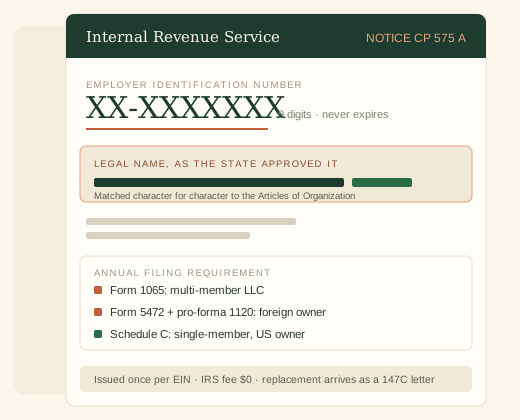
No. There is no Texas EIN. A business receives 1 federal EIN from the IRS, and that same 9-digit number, written XX-XXXXXXX for example 12-3456789, serves the business in Texas and in all 50 states.
The IRS issues the EIN under 26 U.S.C. section 6109, the statute that requires taxpayers to furnish an identifying number. It costs $0, never expires, and is never reissued to a different entity. A Texas registration for the Alaska border makes no difference: 1 EIN covers the business everywhere it files. The EIN is 1 of 5 federal tax IDs the IRS and SSA track. The full definition sits on what is an EIN and the IRS process on the IRS EIN number.
A common myth holds that moving a company from Texas to California, or opening a second location in Florida, forces a new EIN. It does not. The same 9-digit number follows the entity across all 50 states. Only a change in entity structure, such as a sole proprietorship incorporating or a partnership converting to a corporation, triggers a new EIN under IRS rules. A Texas LLC keeps its EIN through a name change, a new registered address, the addition of 3 members, and an election to be taxed as an S-corporation. The bank account, the payroll system, and every Form 1099 stay tied to that 1 number. Placing the EIN correctly on returns, W-9s, and bank forms is covered on using your EIN.
What Is the Difference Between an EIN and a Texas State Tax ID?
An EIN is the federal number the IRS assigns for tax filings. A Texas state tax ID is the separate registration the Texas Comptroller assigns for sales tax and franchise tax. A business holds both: 1 EIN and 1 Comptroller account.
| Identifier | Issued by | Purpose | Cost |
|---|---|---|---|
| Federal EIN | IRS | Federal tax, payroll, bank account | $0 |
| Texas sales tax permit | Texas Comptroller | Collect 6.25% state sales tax | $0 |
| Texas franchise tax account | Texas Comptroller | Report revenue over $2,470,000 | $0 |
| Texas Webfile number | Texas Comptroller | Online filing login for state returns | $0 |
Source: IRS and Texas Comptroller of Public Accounts, verified August 2026.
A Texas partnership files federal Form 1065 and a Texas corporation files Form 1120, both under the same EIN. The Comptroller general line is 800-252-5555, and franchise tax questions go to 800-252-1381. A lost EIN is recovered free with a 147C letter by calling the IRS at 800-829-4933; the original assignment arrives on the CP-575. Cost detail sits on LLC EIN cost.
A Texas LLC registers for the sales tax permit and franchise tax account through the Comptroller's Webfile system at no charge, entering the federal EIN as the master identifier on every state form. The 11-digit Texas taxpayer number the Comptroller assigns is not an EIN and never replaces the 9-digit federal number on IRS returns, payroll deposits, or bank paperwork. A business holds both IDs at once and reports federal and state obligations on separate schedules. The federal application itself runs on apply for an EIN online.
No SSN. No passport upload.
How Do You Get an EIN in Texas?
The same 4 IRS methods work in Texas: online in 15 minutes with an SSN, by fax in 4 to 7 business days, by mail in 6 to 11 weeks, or by phone for international applicants. All 4 cost $0.
| Method | Time to EIN | SSN needed? | IRS fee |
|---|---|---|---|
| IRS online assistant | About 15 minutes | Yes | $0 |
| Fax Form SS-4 | 4 to 7 business days | No | $0 |
| Mail Form SS-4 | 6 to 11 weeks | No | $0 |
| Phone, international only | On the call | No | $0 |
Source: IRS Form SS-4 instructions, verified August 2026.
The online route validates the applicant against SSN and ITIN records, so it stops anyone who holds neither at the validation screen. Those applicants use the fax route, entering the word Foreign on Form SS-4 line 7b and faxing to 855-641-6935 within the US or 855-215-1627 from abroad. The IRS international line, 267-941-1099, releases the number on the call. einforllc.co files Form SS-4 for $97 within 7 business days, or $127 within 24 hours. The online option is detailed on apply for an EIN online.
A Texas founder who holds an SSN completes the online assistant between 7 a.m. and 10 p.m. Eastern, Monday through Friday, and downloads the EIN confirmation in the same session. A founder without an SSN skips that route at the validation screen and relies on the fax method, where the IRS returns the CP-575 letter in 4 to 7 business days. Each applicant receives exactly 1 EIN per day under the IRS daily limit, so a founder forming 3 Texas entities files across 3 separate days. The full IRS reference sits on the IRS EIN number.
What Texas Taxes Apply to a New Business?
Texas charges no state income tax. A new business faces 2 main state taxes: franchise tax on annual revenue above $2,470,000, and 6.25% state sales tax plus up to 2% local for an 8.25% maximum.
| Texas tax | Rate | Threshold | Note |
|---|---|---|---|
| State income tax | 0% | None | Texas has no income tax |
| Franchise tax, retail and wholesale | 0.375% | Over $2,470,000 | On taxable margin |
| Franchise tax, other businesses | 0.75% | Over $2,470,000 | On taxable margin |
| Franchise tax EZ computation | 0.331% | Revenue up to $20,000,000 | Optional method |
| State sales tax | 6.25% | On taxable sales | Plus up to 2% local |
Source: Texas Comptroller franchise and sales tax rules, 2024 and 2025 reports, verified August 2026.
The franchise tax no-tax-due threshold rose to $2,470,000 for the 2024 and 2025 reports, up from $1,230,000, roughly $1.23 million, in 2023. A Texas LLC below $2,470,000 owes $0 in franchise tax. Taxable margin equals total revenue minus the greatest of cost of goods sold, compensation, 30% of revenue, or $1,000,000, capped at 70% of total revenue. State sales tax runs 6.25%, and local rates add up to 2% for an 8.25% combined maximum. The LLC-specific breakdown sits on EIN for a Texas LLC.
A Texas business collects the 6.25% state sales tax on taxable goods and remits it to the Comptroller monthly, quarterly, or yearly based on volume, using its federal EIN on every return. The franchise report is due May 15 each year, even for an LLC that owes $0 below the $2,470,000 threshold, and a missed report risks forfeiture of the LLC's right to transact business in Texas. This structure keeps the total state cost near $0 for a small Texas LLC, which is why the federal EIN is the 1 identifier that matters from day 1. Cost detail sits on LLC EIN cost.
What Does a Texas LLC Cost?
A Texas LLC costs $300 to file the Certificate of Formation, Form 205, with the Secretary of State. Expedited filing adds $25. The federal EIN that follows costs $0, and Comptroller tax registration costs $0.
| Item | Cost | Frequency |
|---|---|---|
| Certificate of Formation, Form 205 | $300 | One-time, Secretary of State |
| Expedited processing | $25 | Optional add-on |
| Federal EIN from the IRS | $0 | One-time |
| Texas sales tax permit | $0 | One-time, Comptroller |
| Franchise tax below $2,470,000 | $0 | Annual report |
| einforllc.co EIN filing — Standard | $97 | Faxed within 7 business days |
| einforllc.co EIN filing — Fast | $127 | Filed within 24 hours |
Source: Texas Secretary of State fee schedule and IRS, verified August 2026.
The $300 Texas filing fee compares with California, where a new LLC pays an $800 annual franchise tax on top of formation. A Texas LLC below $2,470,000 owes $0 in state franchise tax, so the federal EIN is the one number that carries across state lines. The same federal EIN rules apply on EIN number in California and EIN number in Florida.
This page states federal and Texas tax rules current as of August 2026. It is not legal or tax advice. Confirm your business's position with a licensed CPA or attorney before filing.